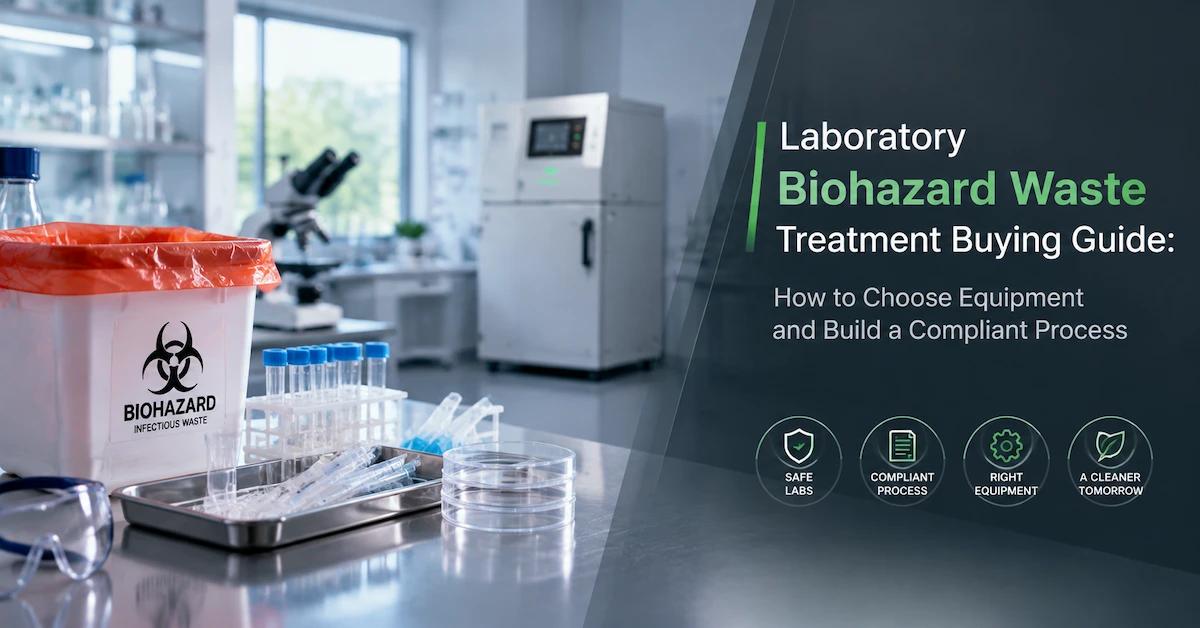

Quick Answer: Start laboratory biohazard waste treatment planning at the bench, where the waste is actually produced. Sort out the bags, sharps boxes, liquid vessels and mixed-hazard items first, then record their real weight and occupied volume. The treatment unit must suit those loads, pass a representative-load test and leave a record for every batch. An on-site unit may simplify the infectious-solid route, yet it will not replace the separate arrangements needed for radioactive, chemical, cytotoxic or otherwise excluded material.
Introduction: why laboratory waste decisions fail
Whether the site is a hospital laboratory, a university research center, a public-health institute or a biotech quality-control lab, its waste route reaches far beyond housekeeping. Get that route wrong and staff may be exposed during an internal transfer. Testing can stop, bags can sit too long, collection bills can climb, and the audit record may still fail to show where one troublesome batch went.
The difficult part is that "biohazard waste" is not one uniform material. A rack of capped culture tubes, a bag of used pipette tips, a sharps box, a flask of liquid culture and a solvent-contaminated specimen container may all leave the same room. They do not necessarily belong in the same treatment process. The biological agent, physical form, added chemical or radiological hazard, packaging, treatment objective and local legal definition all matter.
That is why the buying question is not simply, "Which machine has the highest temperature?" The useful questions are more practical:
- Which laboratory waste streams are eligible for the proposed process?
- What load is difficult to treat, and how will that load be validated?
- Can staff move waste into the system without reopening bags or handling loose sharps?
- What records prove that a batch completed an accepted cycle?
- Who takes over when the equipment is down?
- Does the treated residue have an approved final destination?
The sections below turn those questions into a working comparison that a laboratory manager, biosafety officer, facility engineer and buyer can review together before asking for prices.
What is laboratory biohazard waste treatment?
Laboratory biohazard waste treatment is the controlled inactivation or decontamination of laboratory waste that contains, or may contain, biological agents capable of causing harm. The purpose is to reduce the biological risk to an accepted level before reuse, recycling, final disposal or removal from containment. Treatment may take place inside the laboratory, in a central decontamination room elsewhere on the campus, or at a licensed off-site facility.
The World Health Organization's laboratory biosafety guidance makes an important distinction: the treatment objective is based on risk assessment, and different physical and chemical methods may be appropriate for different wastes. WHO describes autoclaving as a reliable method for many laboratory materials and wastes, while also emphasizing air removal, steam penetration, load type and process indicators. See WHO's Decontamination and waste management monograph.
A complete laboratory waste treatment system therefore includes more than the treatment vessel. It normally includes:
- Point-of-generation segregation and compatible containers.
- Closed internal transport and controlled interim storage.
- Waste characterization, weighing and batch identification.
- A validated treatment method for each accepted load family.
- Cycle review, failed-load quarantine and release authority.
- An approved route for treated residue and all excluded wastes.
- Operator training plus a practical schedule for servicing, calibration and record review.
A machine can only perform inside that chain of controls. If the chain is weak, a technically capable unit will still produce an unreliable waste route.
Start with a laboratory waste map
Before requesting a quotation, follow waste from the bench to its final destination. Do this by work area and procedure, not by purchasing category. A molecular diagnostics bench and a microbiology culture room can use similar plastics while producing very different biological risks.
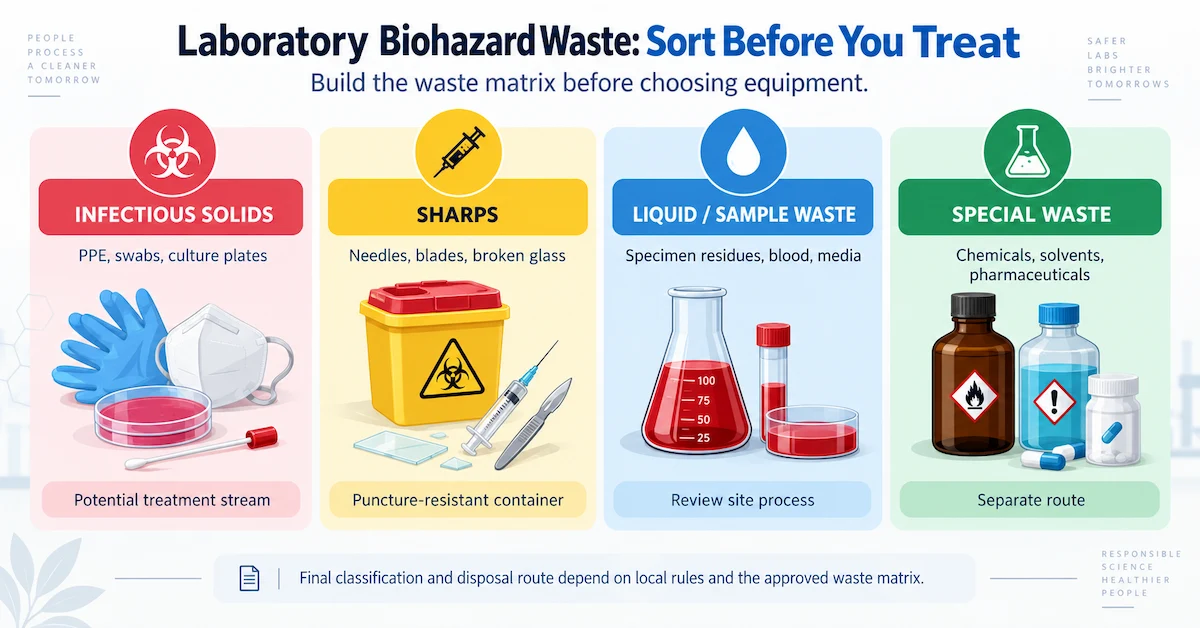
The following map is a starting point. Local rules and the laboratory's biological risk assessment control the final classification.
| Waste stream | Common laboratory examples | First control | Typical treatment or disposal question |
|---|---|---|---|
| Non-hazardous waste | Cardboard sleeves, clean bench paper and outer wrap that never met a specimen | Remove it before the biohazard bag is opened for use | Check the site's ordinary refuse and recycling rules |
| Infectious solids | Used culture plates, PPE, swabs, tips, tubes and absorbent material | Use the specified marked bag or rigid bin; close it at the fill line | Identify the validated cycle for this mix, including its normal packing density |
| Sharps | Needles, lancets, blades, slides, Pasteur pipettes and contaminated broken glass | Drop each item straight into the nearby puncture-resistant box | Obtain written confirmation that the sealed box and its contents are accepted |
| Infectious liquids | Culture broth, blood, body fluid and liquid process waste | Keep the liquid in a closed, compatible vessel with spill containment | Match the method to the vessel size, fill depth and concentration used in practice |
| Pathological or anatomical material | Tissue, retained specimens and small biological remains | Provide a dedicated leakproof vessel, with cold holding where the procedure requires it | Establish the lawful and culturally acceptable destination before storage begins |
| Chemical or pharmaceutical waste | Solvents, stains, fixatives, concentrated disinfectants and active substances | Use a label and container suitable for the actual chemical | Review the second hazard; it often rules out the infectious-waste thermal route |
| Radioactive waste | Specimens, tubes or pads carrying a research or diagnostic tracer | Keep the material within the radiation-control procedure | Confirm the authorized decay, holding and removal route with the radiation lead |
| Genetically modified or high-consequence material | Research cultures, vectors and regulated biological material | Protocol-specific containment and authorization | What inactivation verification and institutional approval are required? |
This step often reduces cost. Clean wrappers and uncontaminated shipping materials frequently enter a biohazard bin because that container is convenient. Removing them lowers the weight and volume presented to the treatment system without weakening biosafety.
It also prevents a dangerous assumption: biological contamination does not cancel a second hazard. A formalin-fixed specimen is not just biological waste. A culture mixed with solvent is not an ordinary infectious liquid. A radioactive sample does not become suitable for a thermal unit because the sample also contains microorganisms.
How the treatment process should work
A practical process begins at the point of generation and ends only when the residue reaches an approved destination. For routine infectious laboratory waste treatment, the workflow should be written in language an operator can use during a busy shift.
1. Segregate at the bench
Put each container where the item is discarded, not across the room. A used needle belongs immediately in its rigid sharps box; it should not pause on a tray. Bag infectious solids, keep liquids in closed compatible vessels, and send chemical, radioactive or other special waste into the route written for that hazard.
OSHA's laboratory and bloodborne-pathogen guidance provides a useful operational principle for human blood and other potentially infectious material: use engineering controls, place sharps containers close to where sharps are used, and replace them before overfilling. These U.S. requirements do not replace another country's rules, but they illustrate why container placement belongs in the treatment design. See OSHA's laboratory biological hazards guidance.
2. Close, identify and transfer
The source room, waste type, date, container ID and responsible person should be recoverable from the record. Move closed containers in a lidded, cleanable cart. The route should avoid public areas where feasible and should never require staff to compress a bag by hand.
3. Weigh and build the batch
Record mass and, where useful, approximate volume. Confirm the material belongs to an approved load family. Do not reopen bags to improve the mix. If visual checking is required, design that control before the bag is sealed or use a method that does not create an exposure.
4. Run the validated cycle
The selected cycle must match the material, container, load size and packing pattern. A cycle validated on loosely packed plastic disposables does not automatically cover a dense sharps container, a large liquid vessel or tightly nested glassware.
5. Review and release
Completion is not the same as release. The responsible person reviews process parameters, alarms, indicators and deviations. A failed or interrupted load stays in controlled quarantine until it is safely reprocessed or transferred through the contingency route.
6. Move the residue through the approved route
A successful biological cycle answers only the biological part of the problem. Glass can still cut, a chemical can remain toxic, a tracer can remain radioactive, and the law may still classify the residue as controlled waste. Release it only to a destination that has agreed to receive that particular output.
Compare the main treatment routes
No biohazard waste disposal solution wins in every laboratory. A sensible comparison starts with what the material is, how much appears on the busiest day, which utilities are available, how the result will be proven and where the residue may legally go.
| Route | Where it fits | Main control point | Common limitation |
|---|---|---|---|
| Licensed off-site service | Low or variable volumes; limited room or utilities | Packaging, manifests, pickup reliability and transporter authorization | Storage time, transport cost and dependence on a third party |
| Steam autoclave | Many solid and liquid laboratory loads where steam can penetrate | Air removal, steam quality, time, temperature and load pattern | Wet output; some loads trap air; shredding is normally separate |
| Frictional heat treatment (FHT) | Infectious solids that suit the process, especially where shredding and heating in one vessel improve the room workflow | Follow movement through the vessel, reduction of the pieces and the full temperature history for the declared load | It is not a catch-all answer for bulk liquid or material carrying a chemical or radioactive hazard |
| Chemical disinfection | Particular liquids, work surfaces and materials known to tolerate the chosen agent | Verify the product, working strength and wet contact time under the expected organic load | Concentrates expose workers and a spent solution or treated item may retain a chemical hazard |
| Microwave or another thermal technology | Material accepted by that system at a site able to provide its specified services | Check moisture, feed preparation, particle size, field distribution and cycle evidence | Each design brings its own exclusions and may need considerable feed preparation |
| Incineration | Pathological, pharmaceutical or unusual material for which an authorized combustion route is appropriate | Examine combustion conditions together with stack controls, emission monitoring and ash handling | The plant and its emission-control duties are much more substantial than a small laboratory installation |
The WHO laboratory manual is quite specific about a point that equipment comparisons sometimes miss: an autoclave cycle for one load may be unsuitable for another. Fluid depth matters, as do wrappers, porous contents and pockets of air. Consequently, a temperature shown on a brochure says little unless the proposed cycle has been challenged with the laboratory's own difficult load.
When on-site laboratory treatment makes sense
On-site laboratory waste treatment can shorten storage and reduce transfers, but ownership adds responsibilities that an off-site contract may currently carry. It deserves serious evaluation when:
- A clinical or public-health laboratory generates a steady stream of compatible infectious solids.
- A research campus can aggregate waste from several buildings into one controlled treatment room.
- Collection vehicles travel a long route, arrive irregularly or make each small pickup unusually expensive.
- Long storage times interfere with biosafety or available space.
- The organization needs immediate, searchable batch records.
- Trained operators, maintenance support and a backup route are available.
- Both the local authority and the intended disposal facility have reviewed the process and agree to the resulting waste form.
The case becomes much weaker if only one small compatible batch appears each week. The same is true when most material carries a chemical or radiological complication, the available room cannot support the utilities, or a licensed collector already delivers dependable service for less than the real ownership cost.
Many sites end up with a hybrid arrangement, and for good reason. They process an agreed family of infectious solids in-house, while specialist contractors continue to handle liquids, chemicals, radioactive or cytotoxic material, anatomical waste and unusual sharps. Splitting the routes this way usually reflects an honest waste study rather than an incomplete treatment plan.
Where frictional heat treatment fits
WAYDO describes Frictional Heat Treatment, or FHT, as a non-incineration process that combines shredding, mixing and thermal treatment in one vessel. A high-speed rotor reduces and mixes the material. Mechanical energy is converted into heat through friction within the moving load. The process then holds the thermal phase, cools the treated material and discharges a dry, shredded residue.
According to WAYDO's public FHT process page, the operating temperature reaches about 150 C, the published cycle time is roughly 25 to 35 minutes, and the company states a 6 Log10 microbial reduction under the referenced STAATT Level IV criterion. The site also publishes reductions of up to 80% in volume and 30% in weight. These are manufacturer-published screening figures. They do not replace model-specific validation reports, a site acceptance test or local authorization.
The company's treatable-materials guidance lists laboratory items such as culture media, nutrient plates, sampling materials, disposable plastic and glass laboratory ware, tubes, pipettes and Petri dishes. That list is a useful starting point for non-incineration biohazard waste treatment, not blanket approval for every item carrying a biohazard label.
For laboratories, the main value proposition is a shorter process chain. Size reduction and thermal treatment occur in one vessel, so the output is dry and unrecognizable rather than an intact wet bag. A facility without a steam plant may also avoid the external boiler associated with some autoclave installations. At a site that already operates a well-utilized, validated central autoclave, the existing route may still have the stronger lifecycle case.
An FHT proposal should state in writing whether it accepts:
- The laboratory's exact culture plates, tubes, tips and packaging.
- Closed sharps containers and their expected metal/glass fraction.
- Wet absorbents and high-density loads.
- Small liquid residues inside otherwise solid loads.
- Glass-rich materials and nested containers.
- Any pharmaceutical or bioprocess materials under consideration.
Radioactive material, flammable or explosive compounds and other manufacturer-excluded materials must remain outside the system. Chemical, cytotoxic, pathological and other special wastes require explicit technical and regulatory review rather than an assumption.
Validate the laboratory waste sterilization system
A laboratory waste sterilization system is credible only when a defined load can be processed repeatedly to an accepted endpoint. The display temperature is one piece of evidence, not the whole decision.
Validation should connect five elements:
- The load being claimed: record its ingredients, weight, occupied space, moisture, container and the way it is packed.
- Evidence that the installed unit is ready: document the installation, sensor calibration, permitted operating window and safety interlock checks.
- Challenge method: an accepted biological indicator or other verified challenge placed at a representative worst-case location.
- Cycle review: time-temperature or other critical process data, alarms, deviations and acceptance criteria.
- Traceability: source, weight, operator, cycle ID, release decision and final residue route.
WHO explains that steam treatment depends on removing trapped air and achieving adequate steam penetration. Biological and chemical indicators are used to validate autoclaving. FHT has different critical variables, including material movement, particle reduction, rotor performance and the temperature profile through the mixed load. The technologies differ, but the purchasing principle is the same: test the actual difficult load, not a light demonstration batch prepared for a showroom.
Ask the supplier for:
- A model-specific validation protocol and report.
- The challenge organism, indicator population and acceptance criterion.
- Sensor type, location, calibration method and interval.
- Minimum and maximum validated load conditions.
- Evidence covering dense, wet, plastic-rich, glass-rich or sharps-heavy loads as applicable.
- Alarm logic and the failed-cycle quarantine procedure.
- Installation, operational and performance qualification support where required.
- Data export, retention, user permissions and audit-trail functions.
- Change-control and revalidation triggers.
Revalidation is normally considered after a significant change to the waste mix, container, cycle, software, critical component, loading pattern or treatment objective. The biosafety officer, quality team and regulator may define additional triggers.
How to select biological waste treatment equipment
When comparing biological waste treatment equipment, use a weighted scorecard. A large capacity number should not compensate for missing compatibility evidence or weak local service.
| Selection factor | What buyers should verify | Why it matters |
|---|---|---|
| Waste acceptance | Written material matrix with exclusions and container conditions | Prevents incompatible or unapproved loading |
| Capacity | Mass, vessel volume, cycle time and realistic utilization | Avoids an undersized unit or long idle periods |
| Validation | Model and load-specific evidence; site qualification support | Links the purchase to a defensible treatment claim |
| Workflow safety | Closed loading, sharps handling, ergonomics and spill controls | Reduces staff contact and manual intervention |
| Utilities | Power, water, drainage, ventilation, heat and noise | Determines whether the room can support the system |
| Records | Batch ID, user, parameters, alarms, release and export | Supports quality review and compliance audits |
| Maintenance | Wear parts, intervals, local technicians and remote diagnostics | Controls downtime and lifecycle cost |
| Final residue | Particle condition, moisture, packaging and accepted destination | Confirms that treatment has a practical endpoint |
| Backup plan | Quarantine space and licensed alternative treatment | Keeps the laboratory compliant during outages |
Do not accept a generic "suitable for laboratory waste" statement as the material matrix. Ask the supplier to mark each waste family as accepted, conditionally accepted, excluded or pending validation.
Size equipment from measured waste, not headcount
Laboratory floor area, test volume and staff count are weak capacity proxies. A molecular testing center may process many specimens while producing mostly light plastics. A microbiology facility with culture work may generate smaller numbers of specimens but more challenging loads. Measure both kilograms and occupied container volume.
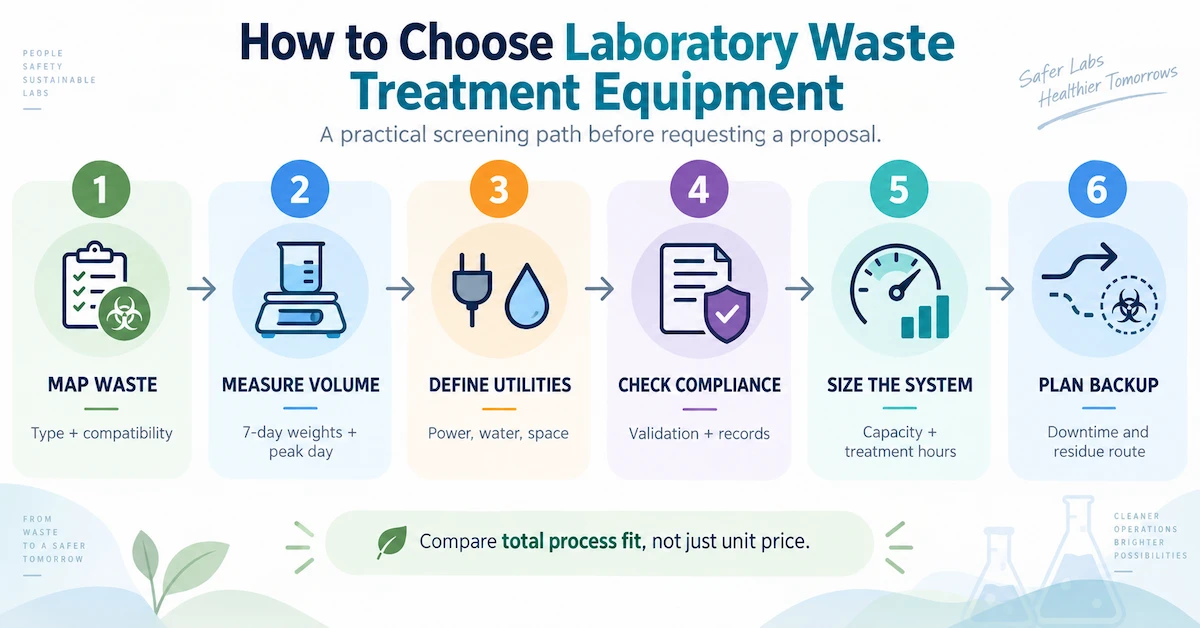
For at least seven representative days, record:
- Compatible infectious solids per shift.
- Closed sharps containers by size and weight.
- Liquid waste by vessel size and treatment route.
- Excluded chemical, pharmaceutical, radioactive and anatomical waste.
- Peak events such as validation campaigns, cleanouts or outbreak response.
- The largest likely single compatible batch.
A useful first calculation is:
Required operating throughput = peak compatible kg per day / available treatment hours
Then check whether the material fits the vessel volume, how many cycles are realistic in a shift, how much time is reserved for loading and release, and what margin is needed for maintenance or seasonal peaks.
WAYDO publishes four equipment sizes. The figures below are screening data from the public product pages and should be confirmed against the current technical data sheet.
| Model | Published capacity | Vessel volume | Published dimensions | First laboratory screening use |
|---|---|---|---|---|
| WAYDO WD05 | 18 kg/h | 150 L | 1590 x 780 x 1880 mm | Stand-alone laboratory, small clinical lab or compact shared facility |
| WAYDO WD15 | 40 kg/h | 170 L | 1590 x 780 x 1995 mm | A possible first screen for a research campus, public-health lab or several nearby buildings |
| WAYDO WD50 | 115 kg/h | 450 L | 2475 x 1200 x 2780 mm | Worth screening for an institutional campus only after its larger measured load is confirmed |
| WAYDO WD330 | 280 kg/h | 670 L | 2475 x 1200 x 3080 mm | Centralized treatment project rather than a typical laboratory |
Published hourly capacity is not guaranteed daily output. Cycle preparation, loading, review, discharge, cleaning, operator schedules, maintenance and downtime all reduce theoretical throughput. Low-density plastics may also fill a vessel before the nominal mass is reached.
Discuss Laboratory Capacity and Model Selection
Build compliance into the process
Compliance is not a logo on the equipment. It is the documented match between the laboratory's risk assessment, operating procedure, worker-protection rules, environmental requirements, transport rules, treatment authorization and final disposal route.
In Biosafety in Microbiological and Biomedical Laboratories, CDC and NIH frame biosafety around the risk assessment for the work being done. BMBL is presented as best-practice guidance, not as a regulation that automatically settles every local duty. In other words, use the guidance, but also list the statutes, permits and institutional approvals that actually govern the site. The CDC BMBL resource is the starting reference.
For medical laboratory waste management, build a compliance matrix with these columns:
| Control area | Evidence to retain |
|---|---|
| Waste classification | Risk assessment, procedure list and waste acceptance matrix |
| Worker protection | Training, exposure-control procedures, PPE and sharps controls |
| Internal movement | Container standard, route map, spill response and transfer log |
| Treatment authorization | Permit, regulator correspondence and approved technology scope |
| Process validation | Protocol, qualification reports, indicators and acceptance criteria |
| Routine operation | Batch records, alarms, release signatures and deviation reports |
| Equipment condition | Calibration, preventive maintenance, repairs and parts history |
| External transport | Licensed provider, manifests and chain-of-custody documents |
| Final destination | Acceptance terms for treated residue and excluded waste streams |
| Continuity | Downtime plan, quarantine limits and backup contract |
WHO places the duty squarely on the laboratory that generated the waste. Before material is released or removed, the laboratory has to ensure that it was effectively decontaminated; otherwise it has to arrange secure transport to the off-site treatment point. The same WHO monograph cautions that a treated item can still be dangerous because it is sharp, chemical or radioactive. Keep the waste map beside the compliance matrix so that this second hazard is not lost after a successful biological cycle.
Calculate total cost of ownership
The purchase price is only one line in a laboratory biohazard waste treatment decision. Compare five- or ten-year costs for the current route and each proposed alternative.
Include:
- Site survey, layout and permit support.
- Delivery, rigging, room alterations and utility connections.
- Commissioning, qualification and operator training.
- Electricity, water, drainage, ventilation and consumables.
- Labor for movement, weighing, loading, review and documentation.
- Biological indicators, calibration and periodic revalidation.
- Blades, seals, bearings, filters, sensors and other wear parts.
- Local service, travel charges, remote support and spare-parts stock.
- Treated-residue containers and final disposal fees.
- Backup collection during maintenance or failure.
- Where they apply, allow for financing charges, insurance and the eventual cost of taking the unit out of service.
Be conservative with savings. Remove a line from the old budget only when the new workflow truly makes that expense disappear. Fewer pickups or shorter transport are plausible benefits of on-site treatment, although a specialist contractor will still be needed for chemicals, radioactive items and the rest of the excluded waste.
The best financial model uses actual invoices and measured waste, not a generic savings percentage. A remote public-health lab may justify a compact system with a moderate load because transport is unreliable. A city laboratory with frequent, low-cost collection may find that ownership adds more complexity than value.
What to include in the request for quotation
A useful RFQ gives suppliers enough information to reject a poor fit before pricing. Send:
- Laboratory type, containment level and main procedures.
- Waste list by material, biological risk, container and added hazard.
- Seven-day average, peak and largest compatible batch by mass and volume.
- Sharps container sizes and expected metal or glass fraction.
- Liquid waste volumes and the intended separate treatment route.
- Current storage time, pickup schedule, distance and annual cost.
- Proposed room dimensions, door width, floor loading and delivery path.
- Electrical supply, water, drainage, ventilation and ambient conditions.
- Required validation endpoint, indicators and qualification documents.
- Data, audit-trail, language, cybersecurity and integration requirements.
- Local permits, residue destination and regulatory contacts.
- Training, warranty, preventive maintenance, response time and spare-parts expectations.
Ask each bidder to return a deviation list. A clear "not accepted" is more useful than a vague promise that every biohazard item can be treated.
A 45-day evaluation plan
Days 1-7: assign ownership
Name a biosafety lead, laboratory operations representative, facility engineer, procurement contact and quality reviewer. Collect current procedures, waste manifests, incident records and treatment invoices.
Days 8-16: map and measure
Walk each laboratory route. Record containers, weights, peak events, holding conditions and excluded streams. Do not open closed biohazard bags or hand-sort waste to complete the study.
Days 17-24: correct segregation
Move containers closer to the work, simplify labels and retrain staff. Repeat the measurement. Better segregation often changes the required equipment size.
Days 25-32: compare technical routes
Score off-site treatment, autoclaving, FHT and other locally accepted methods against compatibility, validation, space, utilities, staffing, records and residue requirements.
Days 33-39: test supplier evidence
Review the written material matrix, model data, validation reports, references and maintenance plan. Use the proposed difficult load in the technical discussion.
Days 40-45: confirm compliance and continuity
Where the project requires it, take the proposed route to the regulator or an authorized adviser. Obtain acceptance from the residue destination, set a maximum quarantine volume and check that the backup contractor can actually collect it. With those answers on file, the RFQ can go out.
Questions laboratory buyers raise before an RFQ
Which treatment method should a laboratory choose for biohazard waste?
Begin with the waste, because the technology label cannot make the decision. An autoclave is a familiar, dependable choice for suitable loads when air is removed and steam reaches the entire load. FHT may suit an infectious-solid stream when one-vessel size reduction and a dry output solve practical problems. Bulk liquids, chemicals, radioactive items, anatomical material and mixed hazards can point to entirely different routes. The risk assessment and the validated load should decide the answer.
Can all laboratory waste go into an FHT system?
No. WAYDO lists many infectious laboratory disposables as potentially treatable, but compatibility must be confirmed for the exact material and container. Radioactive materials, flammable or explosive compounds and other excluded items must not enter the system. Mixed chemical, cytotoxic, pathological and special wastes require written review and local authorization.
Is treated laboratory waste automatically non-hazardous?
Not necessarily. Imagine a glass pipette contaminated with both a culture and a toxic reagent: inactivating the culture does not make the glass blunt or the reagent harmless. Radioactivity and a legal waste classification also survive a biological cycle. The receiving facility, working under local rules, must therefore approve the resulting material before anyone treats it as ordinary, recyclable or specialist residue.
How should a laboratory validate a waste cycle?
Define the load, qualify the equipment, select an accepted challenge, run representative worst-case cycles and document acceptance criteria. Routine batch release should review critical process data and alarms. Revalidate after significant changes to material, packaging, loading pattern, cycle or equipment.
Should a small laboratory buy on-site equipment?
Only when the operating case supports it. Measure compatible waste and compare ownership with licensed collection. If the smallest unit would run infrequently, the laboratory lacks a compliant room, or most waste is excluded, off-site or shared treatment may be stronger.
What records should a laboratory keep?
For each batch, the record should let a reviewer reconstruct its journey: where it came from, what it contained, how it was packed and weighed, who ran it, which cycle was used, and whether an indicator or alarm changed the release decision. Link that record to equipment status and the residue destination. The site's quality system and local rules will set the signatures and retention period.
Do sterilization and decontamination mean the same thing?
No. Sterilization is the defined process used to destroy or remove every form of microbial life. Decontamination has a narrower practical aim: reduce contamination enough for the next intended action to be safe. A waste rule may ask for an accepted inactivation or decontamination endpoint rather than use the word "sterile," so the laboratory must follow the terminology and validation test written for its jurisdiction and application.
What information does WAYDO need to recommend a model?
Provide the waste matrix, average and peak compatible mass, occupied volume, largest batch, operating hours, room and utility data, required records, local treatment endpoint and service expectations. Photos and a layout can help when they contain no confidential research or personal data.
Final purchasing recommendation
Good laboratory biohazard waste treatment is a controlled route, not a machine standing in a utility room. First separate infectious solids, sharps, liquids and mixed hazards. Then measure the compatible fraction, compare on-site and off-site routes, test the supplier's evidence against a difficult representative load, and confirm who releases each batch.
For laboratories exploring FHT, begin with the waste acceptance matrix and seven-day data. Screen the WD05 or WD15 when the compatible volume fits a compact laboratory or shared campus project; consider larger models only when measured demand supports them. Confirm model specifications, utilities, validation, local approval and residue acceptance before issuing a purchase order.
Treat a precise exclusion as useful information, not a sales weakness. A proposal that names accepted loads and rejected ones gives staff a safer procedure, lets the compliance team test the claim, and allows purchasing to calculate a lifecycle cost without pretending that every existing disposal route will vanish.