
How should a hospital evaluate a medical waste treatment equipment supplier?
Start with the containers that will arrive at the treatment room. "Hospital, 100 kg per day, please quote" sounds precise but leaves out the decision-making details: what is in those kilograms, how it is packed, and when it arrives. The 100 kg here is an illustration, not a customer result or a WAYDO capacity figure. A medical waste treatment equipment supplier cannot responsibly select a configuration from that number alone.
Send us a list of segregated materials and their containers, the usual and busiest collection periods, staffed operating hours, a sketch of the room, and the intended route for treated output. We can then discuss which model deserves examination and identify the missing site or test evidence. An unanswered field is acceptable at the inquiry stage. A made-up estimate carried into a tender is much harder to correct.
What can a buyer verify before sending an RFQ?
Before an RFQ goes out, separate what you can read today from what a supplier must commit to for this site. A product photograph answers "what does the equipment look like?" It does not answer whether a particular sharps box can be loaded, whether the unit fits through a service door, or who will maintain it locally.
| Question | What our website presents | What the project response must still establish |
|---|---|---|
| Who and where? | Zhejiang Weidun Environmental Protection Technology Co., Ltd.; Hangzhou, China | Contracting entity, technical contact and local responsibilities |
| Product and application? | WAYDO WD05, WD15, WD50 and WD330; on-site healthcare and other treatment settings | Offered model, configuration, accepted feed, operating duty and room fit |
| Technology? | FHT process: loading, pre-shredding, frictional heating, treatment, cooling and discharge | Applicable controls, test method, load conditions and records |
| Materials? | Treatable examples and exclusions on the materials page | Written decision for each of the buyer's actual materials and containers |
| Service? | Assessment, design, installation, training, maintenance, monitoring and logistics categories | Included, optional and buyer-provided work, with commercial terms |
| Market and output? | International project support and a described treated-output workflow | Local approval path, receiver, records and responsibility for exclusions |
A committee can use the middle column to shortlist us. It should not copy that column into an acceptance specification. The right-hand column is where the offer becomes project-specific. A photograph and a published process number remain useful evidence of what we present publicly, but neither is a named customer's acceptance result.
Put the unanswered items on the same page as the quote
Put five short labels beside important claims in the comparison sheet: published, proposed, verified for this project, open, and excluded. For example, the FHT sequence is published; a WD50 arrangement for your room may be proposed; a reviewed drawing could verify its physical fit. The contents of an unidentified bin remain open. The labels expose differences that a single "compliant" tick box conceals.
Define the waste boundary before asking for a model
The treatable-materials page names dressings, PPE, selected disposable care items, some laboratory materials and properly collected sharps. It also names exclusions, including radioactive, flammable or explosive material and non-medical inert solids. Neither the page title nor the word "hospital" on a bin makes its contents acceptable to the machine. Pharmaceutical and chemical streams deserve an explicit discussion rather than an assumption hidden in a general waste total.
One row per material-and-container combination is more useful than one row per department. A ward might send two quite different presentations; two departments might send the same bagged material. Note whether the waste is wet, bulky or unusually dense, and whether rigid containers arrive sealed. Record how many containers appear in the busy collection period. We can review those rows against the proposed configuration and return an accepted, conditional, excluded or open response. Operations staff can later work from that same approved list.
| Feed-definition field | What the buyer should provide | Why the supplier needs it |
|---|---|---|
| Department or source | Operating room, ward, laboratory, dialysis unit, clinic or other source | The source helps explain the segregation process and likely material mix |
| Waste family | Existing hospital category and representative items | A broad label such as infectious waste is not enough for equipment review |
| Container | Bag, bin, rigid sharps container, box or other presentation | Loading and handling depend on the actual container, not only on its contents |
| Condition | Closed, open, wet, compacted, bulky, dense or mixed | Physical presentation affects loading, mixing and operating discussion |
| Quantity | Normal day, peak day, collection frequency and container count | Daily mass alone may not show the practical loading workload |
| Exclusions | Chemical, radioactive, flammable, pharmaceutical or other uncertain material | Different hazards may require a different route or a separate decision |
| Destination | Current collection, treatment or disposal route | Excluded material and downtime still need a defined path |
The same mass can describe different work
Picture two hypothetical lists that both add up to 100 kg in a day. In one, the weight is mostly loosely bagged dressings. In the other, rigid containers and dense laboratory material account for a substantial share. Equal weight does not give the operator equal loading work. Neither list describes an actual Weidun customer or a model rating; the comparison explains why a daily total is an incomplete input.
Keep the accepted-material list with the quotation revision, not in a separate email chain. When a department changes its segregation or introduces another container, the loading instruction and output route may need review along with model duty. Otherwise purchasing may accept a price for one feed while the operating team expects another.
Ask for a written answer to uncertain materials
This wording gives us something concrete to answer:
For the proposed model and configuration, please classify each material and container in the attached list as accepted, accepted with conditions, excluded, or requiring project-specific review. State any preparation, handling, loading, or documentation condition that applies.
Include photographs of the containers if they clarify the question, but remove patient details. A conditional answer should state the condition, not merely carry a footnote. If a stream is excluded, record its alternative route. The resulting document can serve both procurement and operator training; a claim about "all hospital waste" cannot.
Evaluate the technology explanation, not just the product name
Our FHT technology description starts with mechanical action. High-speed shredding creates friction; the material is heated within the same vessel before cooling and discharge. The process page lays out loading and pre-shredding, frictional heating, treatment, cooling and discharge. That sequence is the basis for a technical conversation with us as a medical waste treatment equipment manufacturer, not a substitute for the operating instructions of a particular model.
Take one container from the proposed waste list and trace it through those stages. How does it enter the loading point? Does the container itself enter? What does the operator check before the cycle? Which value is recorded during treatment and where is it measured? When can the output be discharged, and what record accompanies it? If the input is outside the agreed list, where does it wait? A process diagram becomes useful when its arrows can be matched to the hospital's actual handling route.
The public technology page describes a non-burning process without an external heat source, chemical additive or pressure vessel for the stated mechanism. It does not say that the complete installation needs no electrical connection, operator, maintenance access or local approval. Those are site and configuration questions. They belong in a drawing and a quotation, with the responsible party named.
Read published FHT figures with their conditions
The FHT process page publishes a 150°C treatment phase, a 6 Log10 efficacy description according to STAAT Level IV criteria, a 25–35 minute process cycle, and reductions of up to 80% in volume and 30% in weight. The technology page also shows a 135–150°C thermal profile. We reproduce those figures as manufacturer-published statements.We have not attached an independent laboratory report or a batch record from the reader's installation to this article.
Each number needs a different follow-up. For temperature, request the location of measurement and the record produced by the offered configuration. For the efficacy statement, request the test method, organism, sample location, load and date of the supporting report. For volume and weight, ask what was measured before and after treatment, and on which material. For cycle time, find out whether the stated interval includes loading, cooling, discharge and documentation. These questions keep a budget estimate from quietly turning a conditional website statement into a guaranteed site result.
| Published website statement | Appropriate procurement use | Unsafe interpretation |
|---|---|---|
| Treatment phase at 150°C | Ask how the offered system records and controls the relevant phase | Treating the number as proof that every future load is validated |
| 6 Log10 efficacy description | Request the available method, organism, conditions and supporting evidence | Calling the website statement an independent certificate |
| 25–35 minute cycle | Ask what the interval includes and which model and feed it refers to | Using the interval as total shift throughput without loading and discharge time |
| Up to 80% volume reduction | Ask for the measurement basis and feed condition | Promising a fixed storage or transport saving |
| Up to 30% weight reduction | Ask how input and output are weighed | Treating the figure as a guaranteed financial return |
| 135–150°C thermal profile | Ask how the profile applies to the proposed configuration | Treating a general chart as a site-specific acceptance test |
For any non-incineration medical waste treatment technology, preserve the conditions beside the number in the comparison sheet. Without them, a committee may compare unlike tests and only discover the mismatch at commissioning.
Separate supplier evidence from third-party evidence
The 6 Log10 sentence illustrates the difference. It appears on our process page. That establishes that we have made the statement, not that a hospital's chosen load has been independently tested. A dated report with method and load would support a narrower claim. A record from the installed unit would answer a different question again. Ask for the available documents and label the level of evidence in the procurement file. The public page should never be relabelled a customer acceptance record.
Check the supplier's product range against the application
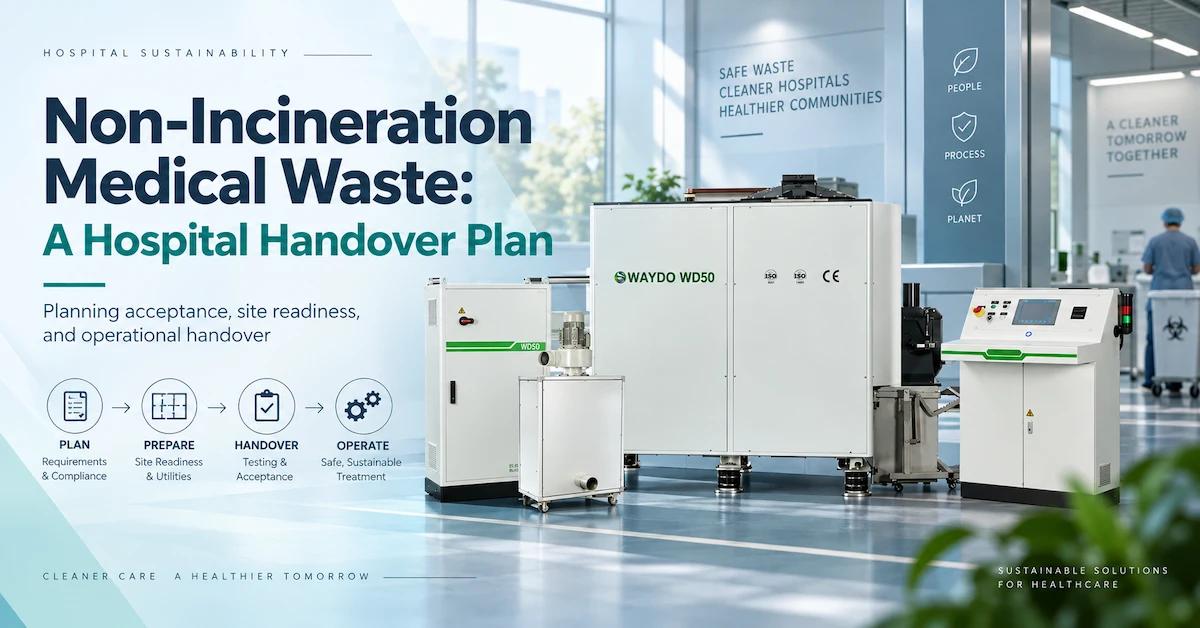
Our WAYDO range shows WD05, WD15, WD50 and WD330. The Solutions page mentions fixed and mobile arrangements, custom modules, automatic loading, removable residue bins and exhaust filtration options. If you are comparing us with another medical waste treatment system supplier or medical waste sterilization equipment supplier, do not compare model names in isolation. Mark the actual loading arrangement and options in each quote. The WD50 photograph in this article identifies the product family; it is not an option list for the quoted unit.
Selection starts after the waste exclusions have been removed from the daily total. Then look at the busiest collection period and the hours when staff can operate the system. A nominal daily mass cannot tell us whether five containers arrive across a shift or at once before staff leave. The route from incoming storage to discharge may also remove a seemingly plausible model from consideration. These are ordinary site observations, not performance claims about any WAYDO model.
| Supplier product question | What should be confirmed for the project |
|---|---|
| Which model is proposed? | Model name, configuration, options and revision of the quotation |
| Why this model? | Accepted feed, practical duty, operating window and room constraints |
| Which loading method applies? | Manual or automatic loading, container interface and operator task |
| What is included? | Machine, controls, options, bins, filtration, installation and commissioning |
| What is excluded? | Building work, utilities, civil work, permits, local tests and external disposal |
| How is the output handled? | Cooling, discharge, collecting container, storage and handover |
| How is the system supported? | Training, preventive maintenance, remote diagnostics, spare parts and response path |
| What changes the price? | Capacity assumptions, options, delivery location, installation scope and service term |
Model fit is not the same as catalogue size
Chamber size is not a cure for a narrow doorway or a loading point the operator cannot reach. Nor does a small daily average solve a short operating window. An equipment recommendation should show its working: compatible mass, container count in the busy period, assumed loading pattern, staff time, process interval, cooling and discharge, and what happens during an interruption. The published 25–35 minute cycle alone is not a shift schedule.
Bed count can orient the first call, but the ward, operating room and laboratory collection records tell us much more. Even a short observation sheet showing container types and collection times is preferable to a universal kilograms-per-bed assumption. For the shortlisted model, request a configuration-specific data sheet covering dimensions, utilities, interfaces, safety and maintenance access. The public product page does not establish a universal MOQ, electrical load, lead time, packaging, spare-part price, warranty or installation scope. Those belong in the written offer.
Evaluate the supplier as a service partner
The machine is only one line in a hospital project. Our services page describes assessment, design, training, maintenance, remote monitoring, spare parts, compliance support and logistics. It is a menu of capabilities, not a declaration that every item is included in the price of every WAYDO unit.
The first difficult handoff is usually between layout and installation. We describe waste characterization, capacity sizing and layout drawings; the hospital must still provide measurements and identify who prepares the room. If a local contractor makes the utility connections, the quotation should say who approves that work and who attends commissioning. Give every service line one status: included, optional, hospital-provided or unresolved pending site review.
| Service stage | Evidence or deliverable to request | Buyer-side owner |
|---|---|---|
| Site assessment | Waste characterization, process-flow review and site information list | Facilities, waste operations and procurement |
| Solution design | Model recommendation, layout drawing and assumptions | Engineering and clinical operations |
| Installation | Delivery boundary, utility interface, installation and commissioning scope | Facilities and project management |
| Training | Operator roles, training content, emergency procedure and record | Waste operations and safety |
| Maintenance | Preventive schedule, wear parts, contact route and escalation | Maintenance and procurement |
| Monitoring | Batch reports, alarms, traceability fields and access rights | Quality, compliance and operations |
| Output route | Container, storage, release record and receiving decision | Waste owner and local authority or receiver |
| Logistics | Packaging, shipping documents, customs, delivery and site coordination | Procurement and logistics |
Ask the service question before the price question
If one offer ends at dispatch and another includes on-site supervision, their totals are not comparable. Put room work, delivery, installation, commissioning, training, maintenance, parts, monitoring, local tests and output handling on separate lines. Compare the scope first; negotiate price second.
This does not mean buying every service. A hospital with its own maintenance staff may need a different handover from a multi-site group asking for a central dashboard. Tell us who will operate, maintain and record the process locally. We can then describe the equipment and service boundary against those roles, rather than present a package with a reassuring but undefined "full service" label.
Training is a technical control
Starting a cycle is the easy part to demonstrate. The operator also needs to recognize an excluded container, stop and escalate an exception, and know where treated output goes. Training must refer to the accepted waste matrix for this installation. If the hospital changes segregation later, the loading instructions may need revision before the new material is handled.
Our Services page mentions operation, emergency procedures, preventive maintenance, troubleshooting and Weidun training certificates. The offer should identify which roles attend, what evidence of training is delivered and whether refresher training is included. A course date or certificate for a particular hospital cannot be inferred from a public service description.
Verify factory and manufacturing evidence without inventing claims
If you found us by searching for an infectious waste treatment equipment supplier, establish who will be accountable for the configuration you buy. Our About Us page identifies our Hangzhou base and medical-waste focus. It does not tell a buyer which legal entity signs a particular export contract, whether a regional partner installs the unit, or who receives a warranty request. Put those names in the offer.
Do not substitute a factory picture for a factory audit or a customer reference. The public pages do not include a revision-controlled pack of material certificates, machine-specific inspection records and named installation results. Request the documents pertinent to the selected model and the decision at hand.
A practical factory evidence request
For a medical waste management equipment supplier, a short responsibility sheet is more revealing than a thick undated brochure. It should name the contracting party, technical contact, offered model, configuration owner, installer, commissioning lead, spare-parts route and warranty contact. A separate evidence index can list the available process document, feed matrix, inspection method and test conditions. Missing items stay visible as open questions; they are not filled with a certificate from another model.
What a factory photo can prove
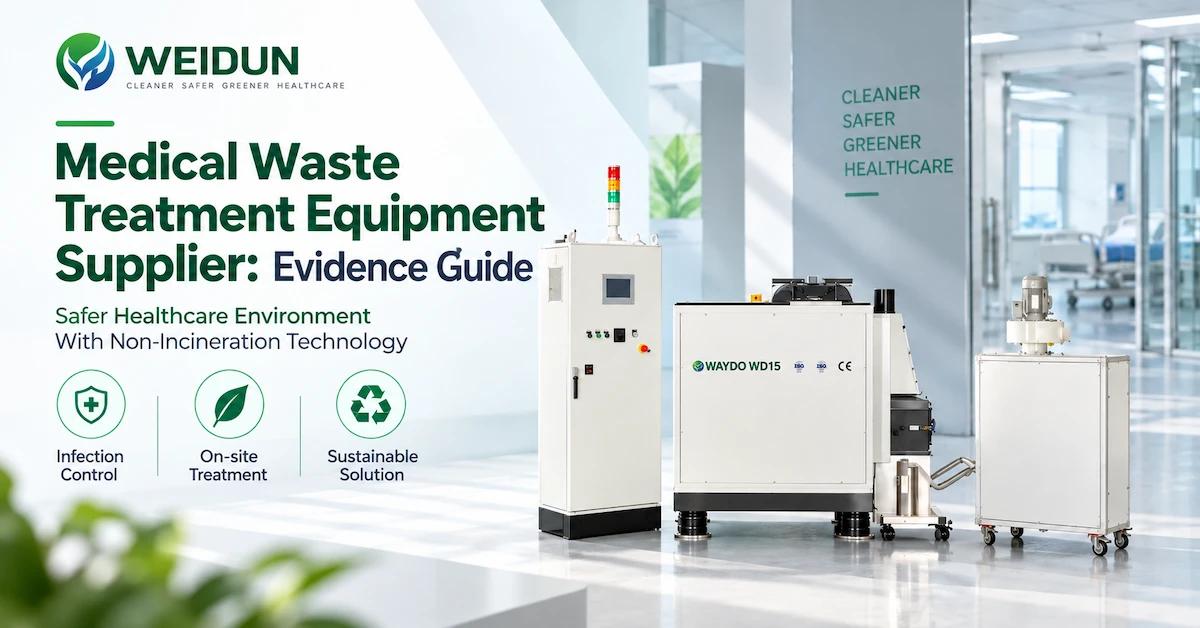
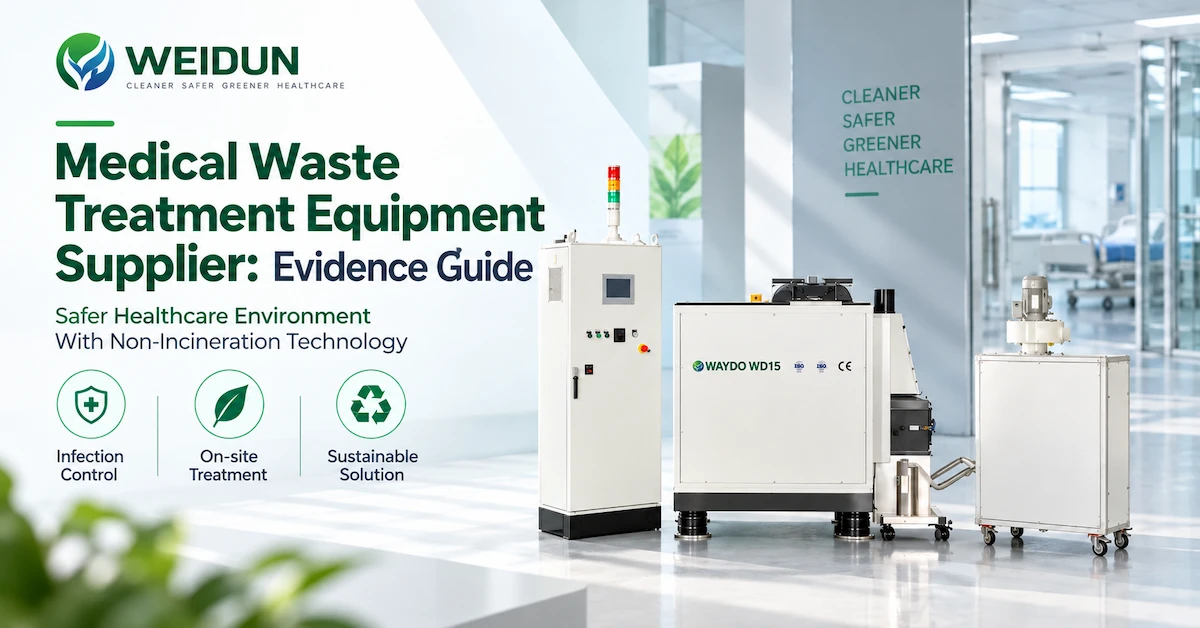
The photograph below is useful because it gives a buyer a loading arrangement to question. Where does the operator stand? What container is shown? Is that loading method standard or optional for the configuration on offer? The image cannot establish a customer's throughput, a certificate, a test outcome or a delivery date.
Ask for materials, quality and traceability evidence
Our public product pages do not specify every chamber material, rotor component, seal, bin, filter or pre-shipment check.Those details must come from a data sheet or inspection document for the offered configuration. Ask which parts contact waste or residue, what wears in normal service and what replacement work entails. A broad material adjective is not a bill of materials.
The Services page describes monitoring, alarms, batch reports and traceability. For the quoted unit, ask to see the actual report fields. Can a load be linked to its source, acceptance decision, cycle, exception and output bin? Who reviews or exports the record? How long is it retained? What happens if the network is down? The answer may differ by configuration, so "digital management" on its own is not a usable record specification.
Assess the site before treating the supplier as technically qualified
For hospital medical waste treatment solutions, the room can decide the equipment arrangement before a catalogue comparison does. Our Services page describes site assessment, process-flow analysis, sizing and layout drawings. To start that work, show the route from the existing waste holding area to the proposed treatment room, then follow the treated output to its next receiver. A measured route is more useful than a photograph of an empty room.
On that route, mark:
- Entry route from delivery point to treatment room
- Door widths, turns, ramps, lifts and floor transitions
- Incoming container staging
- Loading position and operator reach
- Service-panel access
- Ventilation, drainage and cleaning arrangements as applicable
- Electrical and other utility information to be confirmed by the project
- Output container position
- Temporary holding for untreated, excluded or interrupted material
- Technician access and spare-part movement
- Fire, safety and local facility requirements
- Room interfaces and building work responsibility
A machine may fit on a floor plan yet leave no safe service access or place the operator in the path of incoming containers. The drawing should account for the entire working arrangement, not just the machine footprint.
The existing temporary storage room may be a project asset
Our About page describes a compact integrated approach and discusses upgrading an existing temporary storage room. That is a possible design direction, not an approval of a room we have not surveyed. Measure door openings, turning points and service clearances. Note where the untreated containers wait and where the operator stands during loading. Ask the layout to distinguish existing work, hospital building work and equipment supplied in our offer.
The drawing should also name the proposed loading method and any removable residue bin or filtration option. A sketch that merely places a rectangle marked "WD50" in the room does not resolve container flow, cleaning, maintenance or output movement.
Site qualification questions
Ask every shortlisted supplier to answer the same questions:
| Site question | Requested supplier response |
|---|---|
| Can the unit enter the site? | Delivery route, dimensions to confirm and handling assumption |
| Can the unit fit the room? | Layout drawing, service access and proposed orientation |
| How does waste reach the loading point? | Container route and loading method |
| Where does output go? | Discharge, bin, holding and next movement |
| What must the hospital provide? | Utilities, floor, drainage, ventilation, room works and staff |
| What happens during maintenance? | Backup route and responsibility for untreated waste |
| How will staff be trained? | Training scope, roles, records and refresher plan |
| How is the project accepted? | Commissioning sequence, documents, checks and unresolved conditions |
Write the answers on the same drawing revision used for the quotation. That way a later change in orientation or loading method cannot be overlooked by the facilities team.
Compare suppliers by evidence, not by claims
A numerical score can conceal a missing prerequisite. A bid with a polished factory profile should not compensate for an unreviewed waste stream.Before assigning weights under your own tender rules, check three gates: does the offer address the actual containers and exclusions; does a proposed configuration fit the site and operating window; and is there a credible path to verify the treatment claim for the intended application? If any gate is open, record the missing evidence and its owner. Do not award a "pass" because another section of the brochure looks strong.
After the gates, compare the service and commercial boundary. Is installation included? Who trains the operators? How are wear parts obtained? Which record can be exported? What happens to untreated waste when the machine is unavailable? Prices should be compared only after these differences are visible. This method does not replace a public procurement scoring rule; it prevents a score from laundering an unsupported assumption.
Use an evidence status for every answer
Each claim in the response needs a status:
- Verified: supported by a document or project record reviewed by the buyer.
- Published: stated on the supplier's public website but not yet project-verified.
- Proposed: included in the supplier's offer and subject to agreed conditions.
- Open: requires a further answer, site review or local decision.
- Excluded: outside the offered scope or treatment boundary.
These labels are not grades. They tell the committee what can be decided now and what awaits a site visit or a document. For example, the public FHT cycle description is published; the loading method in a new quotation is proposed; a room clearance remains open until someone measures it. That is more informative than a single green cell in a spreadsheet.
Send an RFQ package a supplier can actually answer
A useful RFQ for an on-site medical waste treatment system is not necessarily long. It is consistent. Send the same version of the material list, collection pattern and room information to every shortlisted supplier. If a late correction changes a container or a peak quantity, issue a revision to all bidders. Otherwise two apparently comparable offers may be responses to different jobs.
| RFQ input | What to send or request |
|---|---|
| Project brief | Facility, location, number of sites, current route, decision stage and fixed or mobile preference |
| Waste matrix | Departments, materials, containers, normal and peak quantities, exclusions; request accepted, conditional or excluded status |
| Duty | Arrival times, staffed operating hours, observed peak, planned days and backup route |
| Site | Room, door and access measurements, container path, utilities known, output destination; request a layout |
| Evidence | Process and model documents, available test methods, quality checks, training, records and service terms |
| Commercial | Itemized machine and options, installation, logistics, packaging, spare parts, MOQ, lead time, warranty and validity |
| Handover | Delivery checks, commissioning, operator training, output handling and responsibility for unresolved conditions |
Keep patient information out of site photographs. A supplier can assess door widths, container routes and operator reach without seeing an identifiable patient record. MOQ, lead time, packaging, utilities and test-document availability must be answered for the named configuration and destination; our public pages do not establish universal values.
What Weidun can discuss with a buyer
We can discuss the WAYDO product family, FHT sequence and service categories shown on our site. For a medical waste management equipment supplier inquiry, however, the useful conversation begins with your feed and site rather than a request for every brochure. Tell us which waste streams you want evaluated, which are already handled elsewhere, and whether you need equipment only or help with assessment, layout, training, maintenance and records. We can then identify the appropriate technical documents and the issues that require local decisions.
The Contact Us page lists weidun-market@wdnst.com and +86-0571-87854001. Its purpose here is to start a specific project review. It cannot itself approve an accepted-material list, issue a local permit or choose a final model.
What to include in the first inquiry
A high-quality inquiry can be concise:
| Information | Example of what to send |
|---|---|
| Facility | Hospital, laboratory, clinic, treatment centre or network |
| Location | Country, region and site type |
| Waste stream | Segregated infectious materials and exclusions |
| Containers | Bag, bin, rigid sharps container or other presentation |
| Quantity | Normal and peak quantity, with collection pattern |
| Operating window | Hours when trained operators are available |
| Room | Basic dimensions, access route and photographs if appropriate |
| Output | Intended receiver or statement that this remains open |
| Scope | Equipment only, design, installation, training, maintenance or full service |
| Decision stage | Initial research, budget estimate, RFQ, tender or replacement |
You do not need a finished engineering pack for the first inquiry. Label unmeasured quantities and undecided output routes as such. A clear question with a few genuine site observations is better than a complete-looking form filled with guesses.
Request a Supplier and Site Fit Review
Continue from process evidence to product and project scope
For the technology boundary, review our FHT Technology, FHT Process and treatable materials. Then inspect the relevant model, the Solutions overview and our site assessment services. Our earlier hospital RFP requirements guide addresses the broader tender document; this article concentrates on qualifying the supplier's actual evidence and scope.
Which WAYDO page should a buyer review?
For a small institution, the buyer may start with WAYDO WD05. For a medium institution, WAYDO WD15 may be relevant to the discussion. For a hospital or healthcare group, the buyer can review WAYDO WD50. For a regional or higher-volume application, WAYDO WD330 can enter the conversation.
These are starting points, not capacity promises. Model selection depends on measured compatible waste, operating hours, loading method, room and service scope. Ask for the rationale in the quotation.
FAQ for buyers comparing medical waste treatment equipment suppliers
What is the most important question to ask a medical waste treatment equipment supplier?
Ask: "Which items on our waste list can enter the quoted configuration, in the containers we actually use?" Attach the list rather than asking the question in isolation. A supplier may understand "infectious waste" differently from the hospital's segregation team. The written reply should mark each item accepted, conditional, excluded or unresolved. Only then is a comparison of model, process, price or service meaningful.
How do I distinguish a manufacturer from a distributor?
Look at accountability, not just the logo on a brochure. Ask which entity signs the contract; who approves a configuration change; whose name is on the technical drawing; who supplies the rotor or other wear parts; and who handles a fault after commissioning. A local partner can be useful, but its relationship to the manufacturer and the warranty route should be explicit in the offer. We should state our own role just as clearly.
Should the RFQ name FHT technology?
If the hospital is still comparing treatment methods, specify the waste, desired treatment objective, evidence and site constraints first. If FHT has already been selected, ask us to explain loading, pre-shredding, frictional heating, treatment, cooling and discharge for the offered WAYDO configuration. Naming a technology is not the same as accepting every feed item or approving a room layout.
Can a supplier's published 150°C figure be used as a hospital acceptance criterion?
Not by itself. Our FHT process page describes a 150°C treatment phase. Before putting that figure into a contract, ask what is measured, where it is measured, how it is recorded and how an exception is handled. The acceptance document must also identify the machine and feed under review. A temperature on a public process page is not a test record for your installation.
Does a 25–35 minute cycle equal 25–35 minutes of total throughput?
No. Our process page uses 25–35 minutes for a cycle, but a shift schedule has more steps. Someone must bring containers to the room, check the feed, load the equipment, deal with the output and record any interruption. Ask for a worked daily duty against your collection times and available operator hours. An average daily weight can conceal a difficult late-afternoon peak.
What evidence should I request for materials and workmanship?
Start with the parts that contact waste or affect maintenance: chamber, rotor, seals, collection bin and any quoted filtration option. Ask what they are, how they are inspected and what replacement entails. Request the available pre-shipment checks and model documents for the exact offered configuration. A photograph of a finished unit cannot answer a material-grade question, and an unrelated certificate cannot stand in for a machine-specific check.
How should I compare service offers?
Put the two quotes side by side with a separate line for installation, operator training, maintenance, parts, monitoring and the output route. Mark who pays for building alterations and local testing. One price may be for equipment at dispatch; another may include work on site. Compare the boundary first, then the price. Ask us to identify anything we expect the hospital or local partner to supply.
Does Weidun publish MOQ, lead time and packaging for every model?
No universal MOQ, delivery schedule or packing specification for all models and destinations is established by the public pages used here. These depend on the named configuration and shipment. Ask for them in the written quotation, including what the delivery date means: dispatch, arrival or readiness for commissioning. We will not insert a generic number into this article and invite a purchasing error.
What should happen when the supplier cannot answer a question immediately?
Keep it open. The reply should say whether the missing input belongs to us, the hospital, the local installer or an authority, and which drawing or record will settle it. Put the question in the same revision log as the quotation. It is better to delay a model recommendation than to quietly assume that a sealed sharps container, room door or waste stream will be suitable.
Before we quote: the decisions we need from you
Tell us what the hospital has already decided and what remains open. A project at an early research stage may have only a waste survey and a possible room. A tender-stage project should have a clearer feed boundary, site drawing, operating window and division of work. We can discuss both, but the answers will be different. A budget indication based on an incomplete waste list should not later be treated as an approved design.
Three attachments help most: the segregated material and container list; the normal and peak collection pattern; and a sketch of the proposed room with access dimensions. Add the country and intended output receiver. We can then discuss which WAYDO model merits a technical review, what the published FHT information can and cannot support, and what further documents or site checks the proposal needs. Keep a list of unresolved items with the quotation; they are part of the decision, not fine print.
This guide uses our published company, product, process, materials and service information. The three images are product and factory/loading media, not named customer case studies. No private batch record, universal MOQ, guaranteed delivery date or project certificate has been added. Author: Weidun Eco content team. Technical review of a particular project belongs with the responsible Weidun technical contact. Updated: October 12, 2026.