
A hospital waste room does not care which technology won a brochure comparison. At 4:40 p.m., it cares whether the last infectious load can be treated before the night shift. Imagine two sites. The first already runs a steam plant and has engineers who inspect pressure vessels. The second is a remote medical center where adding a boiler would mean new piping, water treatment and a larger utility room. Calling one machine "better" for both sites would be a category error.
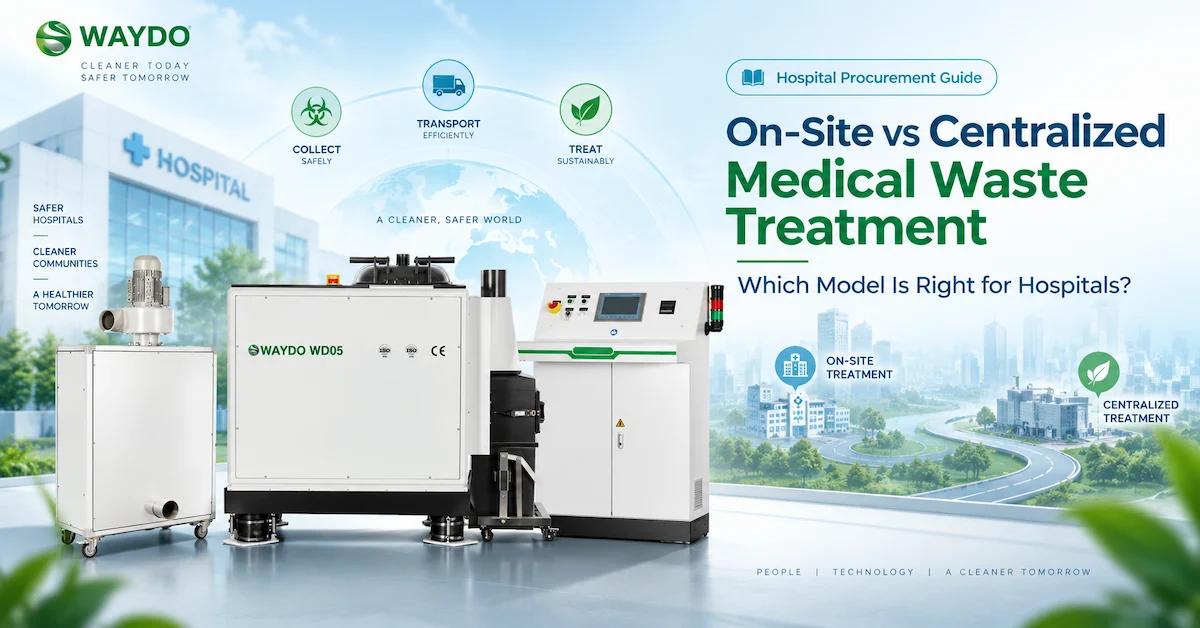
That is why autoclave vs frictional heat sterilization needs a practical answer. An autoclave heats compatible waste with saturated steam under pressure. Frictional Heat Treatment, or FHT, uses a rotor to shred and mix the load; the mechanical work generates the heat used for treatment. One method has decades of familiarity behind it. The other joins shredding and heating in a single vessel, without an external steam boiler.
The short answer? An autoclave often makes sense where steam infrastructure and pressure-system skills already exist. FHT deserves a close look where the project needs a compact, on-site process that produces a dry, shredded and unrecognizable residue. Neither statement settles the purchase. Waste composition, validation, local acceptance, utilities, service and the route after treatment still decide the case.
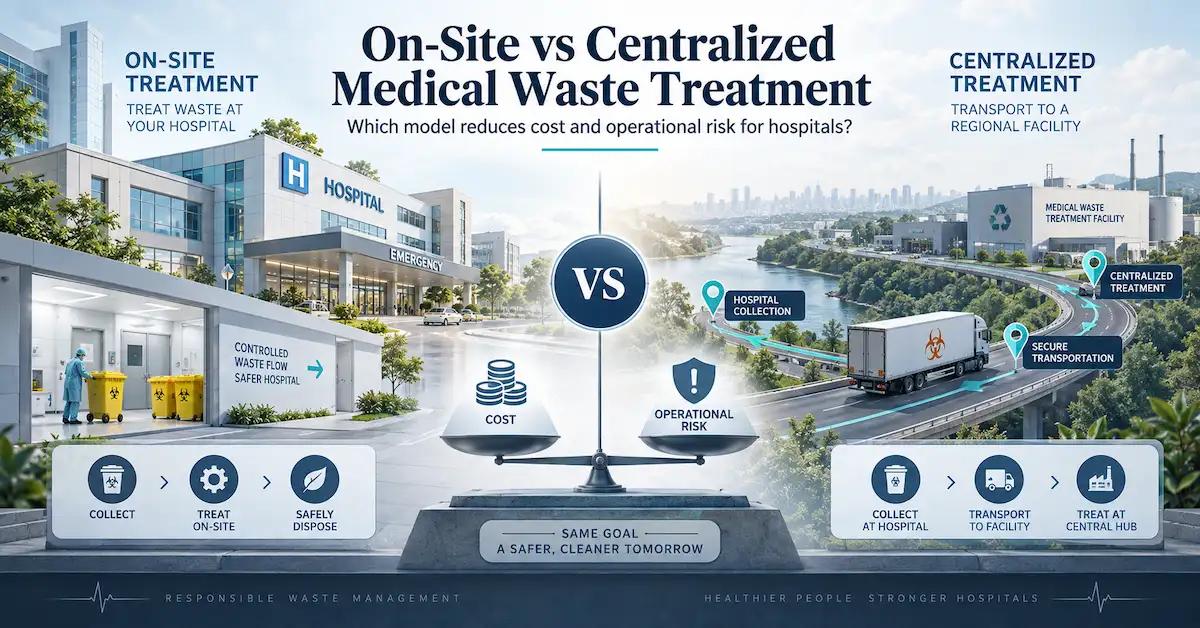
For buyers looking for an autoclave alternative for medical waste, start with the route a bag takes after it leaves the ward. Does it cross the campus? How long does it wait? Is another shredder required? Those questions usually narrow the shortlist faster than the highest temperature printed on a data sheet.

FHT or autoclave: the two-minute comparison
| What the buyer is comparing | Medical waste autoclave | WAYDO FHT system |
|---|---|---|
| Source of heat | Saturated steam | Mechanical friction inside the load |
| Pressure vessel | Yes | Not used in the published WAYDO design |
| External steam boiler | Common in dedicated installations | Not required by the published process |
| Shredding | Separate, optional or integrated on some designs | Part of the treatment cycle |
| Typical residue | May remain recognizable without shredding | Intended to be dry, shredded and unrecognizable* |
| Main validation concern | Air removal and steam penetration | Mixing, rotor performance and thermal uniformity |
| A natural project fit | A site with established steam and pressure-system support | A site seeking integrated on-site treatment |
*Residue condition varies with the waste mix, loading practice, selected model and validated cycle. WAYDO performance figures in this article are manufacturer-published values and should be checked against model-specific reports.
This table is only the doorway. Seven tidy rows say nothing about a 760 mm service door, an undersized electrical panel or a replacement part stuck at customs. Details like those have ended more equipment shortlists than any argument about peak temperature.
Begin with the bag's route
Follow one red bag. A nurse closes it in the isolation ward. A porter carries it to a holding room. Another worker weighs it and records the department. Collection might happen that afternoon. Or on Thursday. In between, labels get damp, bags are moved to make space and one badly placed sharp can turn an ordinary lift into an incident.
The World Health Organization's health-care waste overview puts blood-contaminated items, laboratory cultures and isolation-area waste within the infectious category when pathogens are known or suspected. Its advice begins well before treatment: avoid needless waste, keep hazardous material out of the general stream and protect the people who handle what remains. None of that is glamorous. All of it matters.
Technology affects the number of steps between the ward and final disposal. A conventional autoclave may sterilize a bag, after which the hospital unloads recognizable material and transfers it to a shredder. An integrated FHT cycle aims to shred, heat, cool and discharge in one enclosed process. That difference can change floor space, labor, cleaning, storage volume, operator exposure and record keeping.
This is also why a serious medical waste sterilization comparison cannot stop at "steam versus friction." It must include what happens before the chamber closes and after it opens.
How a medical waste autoclave works
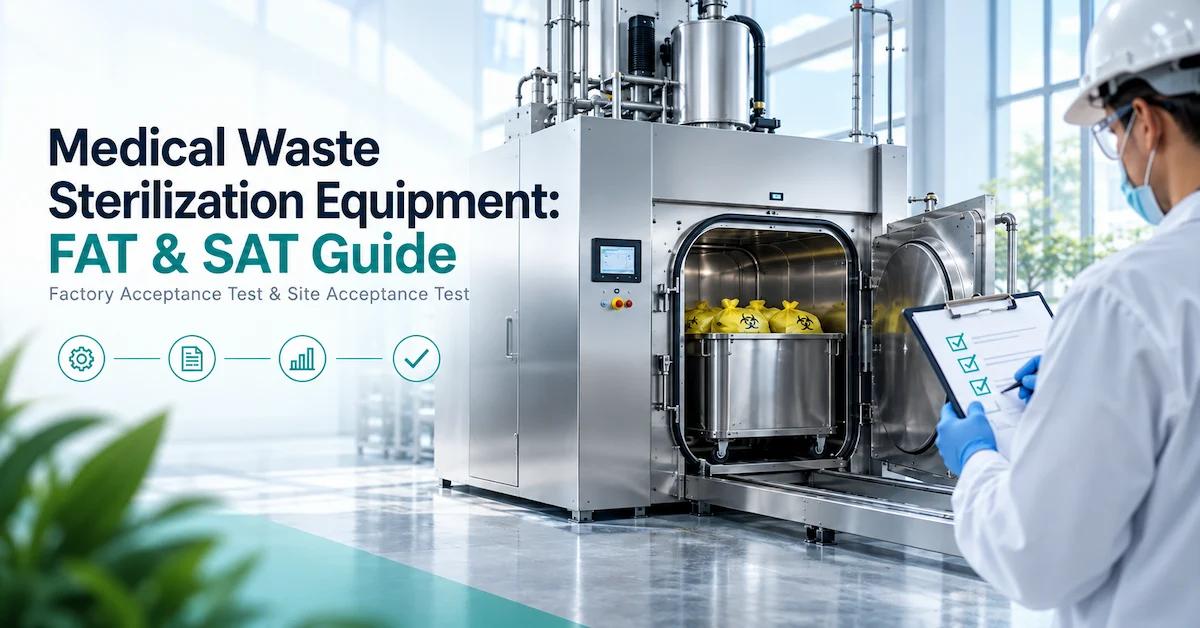
An autoclave is a sealed pressure vessel. The operator loads compatible waste, the door locks, air is removed and saturated steam enters the chamber. The load then stays at a validated combination of temperature, pressure and time. After exposure, the machine exhausts the steam and returns to a condition that permits safe unloading. Some systems add vacuum pulses, drying, batch logging or an integrated shredder.
The difficult part is not making hot steam. It is getting that steam to the coldest, most protected point in a real load. A loosely packed textile bag behaves differently from a dense container. Trapped air acts as insulation. A sealed vessel inside the load can prevent steam contact. For that reason, a screen showing the target temperature is not enough evidence that the batch was treated successfully.
The WHO handbook, Safe management of wastes from health-care activities, uses 121°C for 30 minutes as an example. Those numbers are often repeated without the sentence that should follow them: the right cycle changes with the machine, the packaging, the density of the waste and the inactivation target. A copied time-and-temperature pair is not load validation.
Where an autoclave earns its place
Familiarity is useful. Hospital infection-control teams understand steam sterilization, biomedical engineers can often find relevant service skills, and many regulators have reviewed autoclave records for years. If a medical campus already has reliable steam, treated water, drainage, ventilation and a pressure-vessel inspection program, much of the supporting infrastructure may already be paid for.
Autoclaving may also suit a carefully segregated recovery route. Glass, metal or selected plastics can remain identifiable after treatment and might be recoverable if local rules and the receiving recycler allow it. The word "might" matters. Treatment does not automatically turn medical waste into an approved recyclable commodity.
The work that sits around the chamber
A conventional steam cycle does not necessarily destroy the physical identity of the load. A syringe body, tube or disposable instrument may look much the same afterward. When the permitted disposal route requires unrecognizable material, a shredder or compactor becomes another part of the project.
That extra machine changes more than the equipment list. Who moves the load? Where is a jam cleared? Can the floor be washed without sending water toward an electrical cabinet? The steam side brings its own questions about the boiler, rated piping, treated water, condensate, ventilation and pressure inspection. None of that makes autoclaving a poor technology. It does mean that the chamber price is only one line in the project.
How FHT medical waste treatment technology works
FHT medical waste treatment technology takes a different route through the same problem. A high-torque rotor works inside a treatment vessel. It cuts, shreds and mixes the waste. Contact among the rotor, chamber and moving material turns mechanical energy into heat. As the pieces become smaller, the batch mixes more readily and heat has more paths through the load.
In the published WAYDO sequence, waste is loaded and pre-shredded, rotor speed increases, friction raises the temperature, and the batch passes through a controlled treatment phase. Water is then introduced for cooling before automatic discharge. The FHT process page describes a cycle of about 25–35 minutes and an operating temperature reaching up to 150°C.
The clever part is not that friction somehow replaces microbiology. It is that the same action used to make the material unrecognizable also supplies heat. The hospital may avoid unloading a recognizable batch from one machine and carrying it to a second shredder. It still has to prove microbial inactivation, maintain the rotor and respect the approved waste matrix.

What WAYDO publishes, and what a buyer should request
| FHT reference | Published WAYDO value |
|---|---|
| Maximum operating temperature | Up to 150°C / 302°F |
| Reported microbial reduction | 6 Log10, described as STAAT Level IV |
| Approximate cycle time | 25–35 minutes |
| Volume reduction | Up to 80%, depending on the load |
| Weight reduction | Up to 30%, depending on the load |
| External chemical disinfectant | Not required in the published process |
| External pressure vessel | Not required in the published design |
These numbers are useful for screening. They are not the validation file. Before accepting them, ask what waste was tested, how heavy the load was, where temperature was measured, how long the material remained in the treatment band, which biological challenge was used, and what particle size came out. Ask about the cooling phase too.
An "up to 80%" volume reduction is not an 80% promise for every bag. A light load dominated by plastic film behaves differently from wet textiles, tubing and liquid residue. A 6 Log10 statement also needs a test method and a defined load. The number on the touchscreen cannot answer those questions by itself.
Frictional heat treatment vs autoclave in daily operation
The most useful frictional heat treatment vs autoclave discussion happens at shift level. What does an operator touch? What can go wrong? What record is left when the batch is finished?
Heat transfer and cold spots
Steam treatment depends on air removal and contact between saturated steam and the load. The autoclave team should know the coldest location for each approved loading pattern. FHT depends on mechanical mixing and frictional heating. Its team should know how rotor speed, torque, particle size, blade condition and moisture affect thermal uniformity.
Both processes can work well. Both can also fail quietly if loading drifts away from the validated procedure. A half-empty chamber, an overloaded bag or an unexpected amount of liquid may alter the cycle. That is why acceptance testing must use representative waste rather than a tidy demonstration load chosen for the showroom.
Shredding and what leaves the room
An autoclave without a shredder can produce treated material that is still recognizable. That may be acceptable for a controlled recovery route, or unacceptable where policy requires physical destruction. FHT uses shredding during treatment and is designed to discharge a fine, unrecognizable residue.
Finer is not always better. Once the residue is thoroughly mixed, recovering one plastic or metal fraction may become harder. On the other hand, destroying recognizable items discourages unauthorized reuse and frees storage space. A facility that wants resource recovery should talk to the receiving company before it chooses the particle size it thinks it wants.
Utilities and maintenance
Autoclaves usually bring steam, water, drainage, pressure controls and condensate management into the conversation. FHT brings electrical capacity, cooling water, rotor and blade service, ventilation and residue collection. One list is not inherently shorter than the other at every site. Existing infrastructure changes the answer.
Consider a campus with spare boiler capacity. Connecting an autoclave may be straightforward. Now move the same project to an island clinic where treated water and steam technicians are scarce. The FHT route can look very different there. Reverse the example and the conclusion may reverse too.
Handling and worker exposure
Every transfer is a moment when a worker is close to the material. A conventional two-machine route may involve loading the autoclave, unloading treated but recognizable waste, taking it to a shredder and clearing the final output. An integrated cycle can reduce those intermediate touches.
Reduced handling is not the same as zero risk. PPE, sharps controls, cleaning, lockout procedures, emergency training and safe loading rules remain essential. FHT also contains fast-moving mechanical parts; an autoclave contains pressure and hot steam. Safety comes from the whole operating system, not from a technology label.

Validation: the part of the comparison that matters most
Which process reaches the higher headline temperature? That is the wrong opening question. A better one is: which process can demonstrate repeatable inactivation on the waste this facility actually produces?
For an autoclave, ask how air is removed from difficult loads. Find the validated exposure time at the coldest point. Review the biological indicator organism, frequency and placement. Check how bag type, container geometry and load density are controlled. Then look at the failed-cycle procedure. Does the system prevent release of a questionable batch?
For FHT, put equal pressure on the mechanical side. Does the rotor maintain speed and torque under wet or dense loads? Where is temperature measured? How does the process mix light plastic with wet textile? What particle size comes out when blades approach their service limit? Can the machine store a complete batch record, including alarms and operator actions?
A credible validation file connects four things: a defined waste load, a defined cycle, a biological result and a repeatable operator procedure. If one of those pieces is missing, the report is difficult to apply to the installed machine. Third-party testing is valuable, but commissioning tests on the actual site still matter.
Request a model-specific validation package
Cost: price the route, not just the machine
Purchase price is easy to compare because it appears in one line of a quote. Lifecycle cost is messier, and therefore more useful.
Put the overlooked items beside the purchase price:
| Autoclave budget lines that are easy to miss | FHT budget lines that are easy to miss |
|---|---|
| Steam generation, treated water and condensate drainage | Electrical upgrades and cooling-water connection |
| Vacuum equipment, exhaust handling and pressure inspection | Blades, bearings, filters and rotor service |
| Biological monitoring and possible downstream shredding | Residue bins, ventilation, commissioning and validation |
| Steam, water, labor, service and downtime | Electricity, water, labor, service and downtime |
FHT may remove an external boiler, a separate pressure-vessel program or a downstream shredder from the plan. That is only a saving if the site would otherwise have paid for those items. Existing infrastructure can turn the calculation around.
Use a plain formula before building a more detailed model:
10-year cost = purchase + installation + utilities + labor + consumables + service + downtime + storage + transport + final disposal
Then compare the result with the current route. How many collections could be avoided? Is infectious waste now travelling 200 kilometers? How much floor area is tied up in temporary storage? What does one day of equipment downtime cost? Can a replacement blade or door seal be sourced locally? These are ordinary questions, but they often decide the tender.
A remote hospital paying high collection fees may find on-site FHT financially attractive. A large campus with spare steam capacity may reach the opposite answer. Percentage-saving claims from another project cannot replace local arithmetic.
A decision matrix for different facilities
Picture the first site again: spare steam capacity, a pressure-vessel engineer on call and staff who already run biological indicators. An autoclave belongs near the top of that shortlist, especially if a shredder is in place or recognizable residue is permitted.
Now picture the remote site. Steam would need a new building, the waste travels a long distance, and the team wants to reduce its volume before it leaves. FHT belongs near the top of this shortlist. A truck-mounted or containerized unit may also solve a problem for a temporary hospital, emergency response or military medical service.
Neither list is a substitute for regulator input. The authority may define which categories can be treated, which validation organism is accepted, how records are retained and where the residue can go. Get those answers before the purchase order, not during commissioning.

Choosing a WAYDO FHT model
WAYDO publishes four capacity levels. Bed count is convenient, but rough. Give 300 beds to a surgical hospital and to a rehabilitation center; their waste scales will rarely tell the same story at the end of the week.

| Model | Published capacity | Vessel volume | Published bed reference | A reasonable first conversation |
|---|---|---|---|---|
| WAYDO WD05 | 18 kg/h | 150 L | Up to 100 beds | Clinics, laboratories and compact sites |
| WAYDO WD15 | 40 kg/h | 170 L | Up to 300 beds | Community hospitals and research facilities |
| WAYDO WD50 | 115 kg/h | 450 L | Up to 600 beds | Hospitals, medical centers and campuses |
| WAYDO WD330 | 280 kg/h | 670 L | Up to 1,300 beds | Large hospital groups and centralized projects |
The larger model can feel like the safer choice. Sometimes it is merely the costlier one. Weigh several ordinary days and at least one peak period, after segregation has removed general waste. Note wet loads, bulky pieces, working hours and realistic expansion. Leave time for cleaning and service; no shift runs at brochure efficiency forever.
A 40 kg/h nameplate does not quietly become 960 kg each day. There are batch changes, checks, breaks, cleaning and the occasional stubborn load. Draw an actual shift schedule. It will expose assumptions that multiplication hides.
Send your daily waste data for a model recommendation
A seven-question procurement check
Before comparing final quotes, put these questions in the meeting agenda:
- What does the facility produce on a normal day, a peak day and an outbreak day?
- Which categories are accepted by the manufacturer and by the local authority?
- What output condition is required: merely treated, dry, unrecognizable or suitable for a specific recovery route?
- Which utilities are already reliable, and which ones would have to be built?
- What evidence links the proposed cycle to a representative waste load?
- Who provides local service, routine parts and emergency support?
- Where will the treated residue go, and is that destination approved in writing?
These questions sound basic because they are. Projects get into trouble when teams jump from a daily kilogram estimate straight to a purchase price and leave the rest for later.
What can be treated, and what should stay out
Both technologies are intended for compatible infectious healthcare waste. Neither is a universal answer for every hazardous stream.
The WAYDO treatable materials page lists contaminated dressings, disposable PPE, single-use care kits, laboratory disposables, tubing, dialysis components, filters, selected sharps after correct collection, certain pathological residues and expired vaccines among the possible inputs. The exact list needs written confirmation for the proposed model and jurisdiction.
Radioactive material, flammable or explosive compounds, and non-medical inert solids such as stones or wood are excluded from the published matrix. Mercury-containing, cytotoxic, volatile chemical, pharmaceutical and special pathological waste commonly require separate routes. Local rules may be stricter than a general manufacturer list.
Segregation protects more than the machine. It protects staff, keeps validation meaningful and prevents treated residue from entering the wrong destination. A system cannot correct a dangerous input simply because its normal cycle reaches a high temperature.
Service, records and the 2 a.m. question
The machine is only half of the treatment system. The other half appears when a cycle alarms at 2 a.m. Who answers the phone? Which parts are on the shelf? Can the operator quarantine the load and retrieve the batch record? How long before a qualified technician reaches the site?
The Weidun service program describes site assessment, layout planning, training, preventive maintenance, remote diagnostics, spare parts, logistics, commissioning and compliance support. A buyer should turn each heading into a contract question. "Remote support" is useful only if its hours, language and response time match the hospital's operation.
Records deserve the same attention. Can an auditor trace a batch from its department and weight to the cycle curve, alarm history, operator response and final release? If the answer is yes, the data are doing useful work. Colored gauges on a screen are decoration until they support that trace.
Questions project teams usually ask
Are frictional heat sterilization and autoclaving the same process?
No. Steam does the heating inside an autoclave, under pressure. In FHT, the working rotor heats the batch while shredding and mixing it. Both count as non-incineration medical waste treatment; what they demand from utilities, mechanics and validation is quite different.
Is FHT a real autoclave alternative for medical waste?
It can be for compatible infectious waste when the authority accepts the process and the installed cycle is validated. It is especially relevant when a project wants integrated shredding without an external steam boiler. It does not replace the separate treatment routes required for radioactive, cytotoxic or other incompatible waste.
Which technology produces a drier residue?
Steam adds moisture, although some autoclaves include drying. WAYDO describes its FHT output as dry after cooling and discharge. Ask both suppliers for a moisture test using a representative load; the word "dry" in a brochure is not a measurement.
Will either method always cost less to run?
No fixed winner here. Cheap campus steam can favor an autoclave. An expensive off-site collection route can favor on-site FHT. Change the electricity tariff, transport distance or service contract and the answer may move again. Use the local numbers.
Does FHT use chemical disinfectants?
The published WAYDO process does not require chemical disinfectants. That does not make chemical waste acceptable in the chamber. Input segregation remains mandatory.
Can either process treat every medical waste category?
No. Packaging, material, moisture, hazard class, manufacturer limits and local regulation all affect eligibility. Get a signed acceptance matrix before commissioning.
How should a 6 Log10 claim be checked?
Ask which organism was used, how the challenge was placed, what the test load contained, how many samples were taken, who wrote the report and whether the local authority accepts the method. Then repeat the required validation on the installed system.
Which system is safer?
Safety depends on the installation and the people operating it. Autoclaves bring pressure and steam hazards. FHT systems bring rotating equipment, blades, electrical energy and cooling systems. The safer system is the one the local team can operate, maintain, isolate and validate correctly.
Final verdict: which technology is better?
The answer becomes clearer when the sales labels are removed.
Choose an autoclave because the site has the steam, skills, accepted validation route and residue plan to use it well. Do not choose it only because steam treatment is familiar. Choose FHT because integrated shredding, compact on-site processing and the absence of an external steam boiler solve real project constraints. Do not choose it only because the published cycle reaches 150°C.
For a defensible autoclave vs frictional heat sterilization decision, collect five pieces of evidence: a real waste study, a utility and room survey, model-specific biological validation, a lifecycle cost model and written regulatory acceptance. Add a downtime plan before signing.
That conclusion is less dramatic than declaring a universal winner, but it is far more useful. A treatment system has to work on an ordinary Tuesday, with the actual waste, the available operator and the local service team. That is the standard worth buying against.