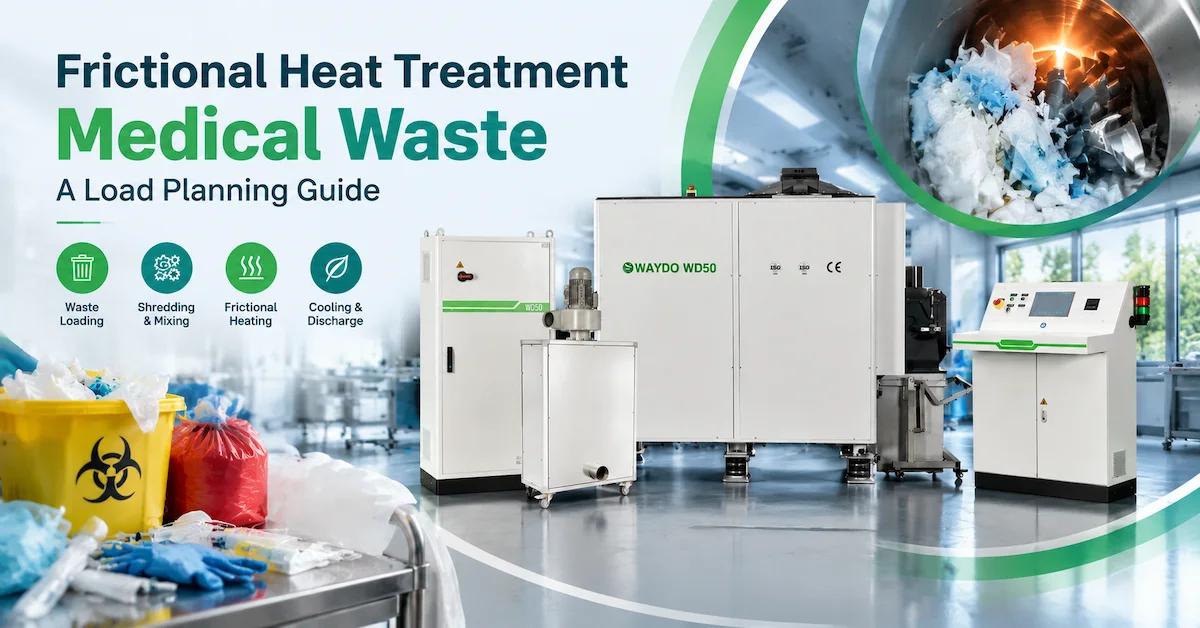

What Should a Frictional Heat Treatment Medical Waste Load Plan Include?
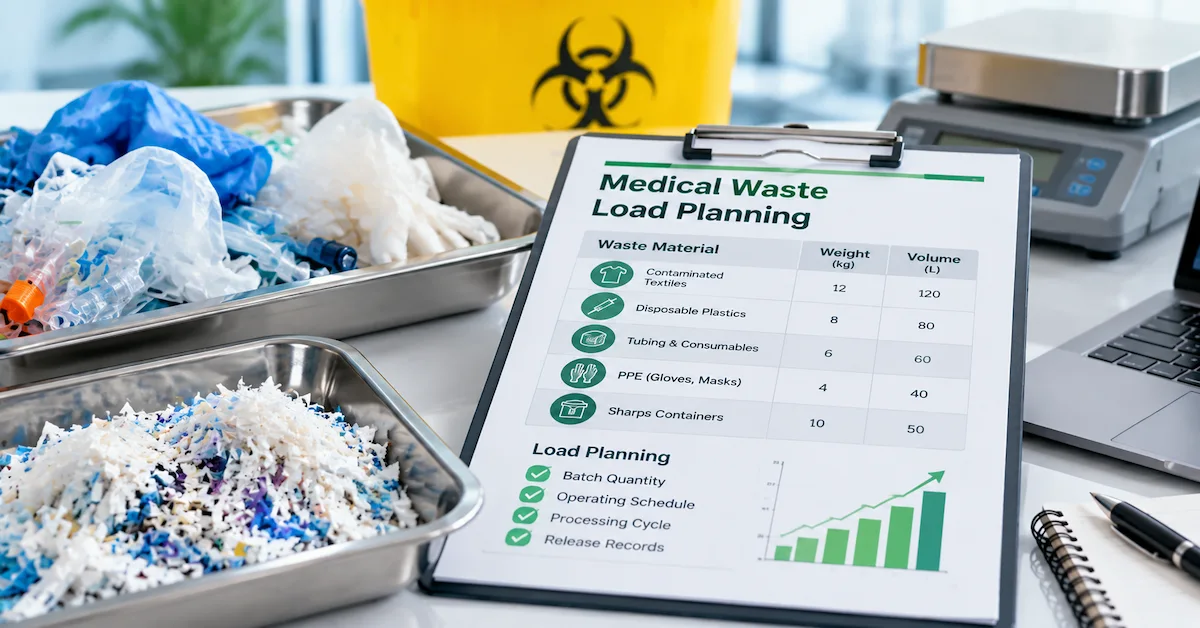
Keep the source department and material description alongside the container details, permitted batch quantity and operating recipe. The release record completes the chain. Read together, those records should answer one question: can this installation handle our workload during the hours we actually staff the room?
An equipment brochure cannot answer that question on its own. A facility generating mostly lightweight protective clothing has a different loading problem from one receiving dense dialysis consumables. Even when their daily weights match, their storage volume, handling sequence and treatment behaviour may differ. Ask for a proposal that describes the mixture behind the capacity figure.
When requesting a frictional heat treatment medical waste proposal, include a written feed description. Keep a copy with the quotation. If a new department later adds a different material, the original description gives both sides something specific to check. A clinical-waste label on the bag does not settle whether its contents suit the process.
WEIDUN supplies WAYDO equipment for hospitals, laboratories and treatment facilities. Its published FHT process description combines shredding, mixing, frictional heating, cooling and discharge. That sequence provides the engineering context for the load plan below; the installed machine's approved instructions remain the operating authority.
Request a Waste Load Assessment
For an initial review, send your country, facility type, daily and peak quantities, main waste materials and available operating hours. Photographs should show closed containers or clean representative materials, without patient information.
Start With the Waste That Actually Reaches the Treatment Room
Separate a department name from a material description
"Laboratory waste" is too broad for a purchase specification. It might mean contaminated disposable plastics, glass consumables, culture materials, solvents or discarded reagents. Those are not interchangeable treatment inputs. Record the material itself, the contamination category and any contents that require a separate route.
The WHO health-care waste fact sheet, dated October 24, 2024, distinguishes infectious, pathological, sharps, chemical, pharmaceutical, cytotoxic and radioactive waste. This classification is a useful starting point for segregation. It is not a statement that one machine can handle all those categories.
For the equipment inquiry, list items such as contaminated dressings, disposable gowns, selected tubing and approved sharps containers separately. Add the packaging material, approximate container volume and any free-liquid content. Ask WEIDUN to mark each stream as accepted, conditionally accepted or excluded for the proposed configuration.
Do not create an unsafe sorting exercise
A purchasing survey should use existing waste records, staff interviews and an approved local assessment procedure. It should not ask procurement staff to open infectious bags or manually recover sharps. Infection prevention and the waste manager should decide how representative information can be collected safely.
Keep chemical, cytotoxic, pharmaceutical and radioactive streams out of the assumed feed unless a competent review explicitly establishes a lawful, validated route. Flammable or explosive materials are excluded by WEIDUN's published treatable materials guidance. Unusual pathological loads also require a separate assessment rather than a general promise.
| Record | What the buyer supplies | What must be resolved |
|---|---|---|
| Material | Dressings, plastics, tubing or other defined items | Written compatibility and exclusions |
| Packaging | Bag and container type, size and closure | Loading method and packaging restrictions |
| Quantity | Weight and volume by collection round | Batch limits and operating schedule |
| Moisture | Known wet materials and free liquids | Approved load conditions and cooling needs |
| Exceptional items | Chemicals, batteries, aerosols or heavy objects | Segregation and alternative disposal |
Why Kilograms and Litres Must Be Considered Together
Weight controls the daily mass balance; volume determines how much space that mass occupies. A proposed batch must satisfy both the permitted mass and the permitted loading envelope. Vessel volume is not automatically usable waste volume, and neither number should be converted into a batch limit without the manufacturer's loading instructions.
Here is a hypothetical calculation, not a hospital case or a WAYDO test result. Suppose 120 litres of one material weigh 12 kilograms. Its apparent bulk density is 0.10 kilograms per litre. A second material weighs 24 kilograms in the same space: 0.20 kilograms per litre. The bin size has not changed, but the mass has doubled.
Both samples occupy the same collection space, but they do not impose the same mass load. Conversely, matching their weights would not match their volumes. This is why a quotation based only on kilograms per day can miss a handling constraint. Supply weights together with container counts and container sizes, then ask how the proposed batch is limited.
Collect a usable operating profile
Choose a survey period that captures the facility's normal variation, including busy procedure days and changes between departments. Record collection times as well as totals. A hospital delivering most of its waste near the end of a shift may need a different schedule from one delivering evenly throughout the day.
Keep at least three quantities distinct: total waste generated, waste accepted for the proposed process, and waste actually released after successful treatment. The first helps understand the facility. The second sizes the system. The third is the denominator for meaningful operating-cost comparisons.
How Frictional Heat Treatment Technology Changes the Load Discussion
In WEIDUN's described process, mechanical shredding and mixing generate heat inside the treatment chamber. The published technology overview explains the integrated approach. When evaluating frictional heat treatment technology, ask how the selected load moves through each stage, rather than treating the chamber as a passive container.
WEIDUN's process page lists a 150-degree-Celsius treatment stage, a stated six-log microbial-reduction target and approximately 25 to 35 minutes per cycle. These are published manufacturer indicators. They do not establish a validated recipe for a particular waste mixture, and the total cycle range is not the same as the exposure time at the treatment condition.
A six-log reduction describes a millionfold reduction in the measured target population under the test conditions. It should not be rewritten as proof that every organism in every batch has been eliminated. Ask for the test organism, method, load description, measurement locations, results and applicability to the offered model.
Write the recipe boundaries before the demonstration
For medical waste friction heat sterilization, the proposal should identify the permitted load range and the parameters that define a completed cycle. The manufacturer must determine those parameters through its validated process. A buyer should not invent a temperature-time combination or modify a recipe to fit a purchasing spreadsheet.
Request written treatment of abnormal events: a stalled process, an interrupted supply, a sensor alarm or a batch that does not meet release criteria. Who can access the material? Can the machine restart safely? What happens to the batch identity? These questions belong in the operating and service documentation before delivery.
The practical attraction of an integrated medical waste shredding and sterilization system is that those operations can be combined in one equipment arrangement. That does not remove collection, safe loading, cleaning, maintenance or residue-handling work. Check the complete workflow, including the time spent outside the chamber.
Turn a Daily Quantity Into a Realistic Shift Schedule
Start with the quantity of compatible waste requiring treatment on the design day. Divide it by the actual hours available for treatment, after accounting for planned work that cannot occur at the same time. This yields a required effective hourly output. Compare that figure with a demonstrated schedule, not just a headline production rate.
Take an illustrative design day with 180 kilograms of accepted waste and a six-hour staffed window. Reserve an hour for checks, start-up, cleaning and handover that cannot overlap treatment. That leaves five hours, so the installation must average 36 kilograms per available hour. All these inputs are assumptions for the example; they are not a customer result or a WAYDO guarantee.
The calculation exposes the next question. Can the offered machine repeatedly handle the agreed load and complete all required steps within those five hours? A nominal rate above 36 kilograms per hour does not settle it. Loading delays, cooling, discharge, record review and a rejected batch may change the achievable schedule.
Check recovery after a disruption
Ask what happens when a collection round is late or a maintenance task removes part of the shift. Establish lawful storage limits with the local waste-management team and identify a backup service. Storage rules vary by jurisdiction and waste category; a general blog cannot set the permitted holding time for your facility.
For an on-site medical waste treatment system, resilience is partly a service question. A second unit, a longer operating shift or a licensed external contractor may each solve different problems. Compare them against actual downtime risks rather than selecting the largest chamber by default.
Also check the smallest normal load. A system selected solely for an occasional peak may spend most days handling small quantities. Ask the supplier to explain the supported operating range, start-up implications and any restrictions on partial batches. Do not assume a machine performs identically at all fill levels.
Use WAYDO Specifications as Shortlist Data, Not Batch Instructions
WEIDUN's product pages publish four WAYDO models. The table preserves the stated vessel volumes and production capacities as a starting point for equipment discussions. Final sizing needs the selected feed, full-cycle schedule, utilities and performance evidence. Bed counts are omitted because measured waste is a better basis for this load-planning exercise.
| Model | Published vessel volume | Published capacity | Question for the proposal |
|---|---|---|---|
| WAYDO WD05 | 150 litres | 18 kg/hour | Can the routine load fit the available shift? |
| WAYDO WD15 | 170 litres | 40 kg/hour | What mixture supports the stated rate? |
| WAYDO WD50 | 450 litres | 115 kg/hour | How do loading and discharge affect output? |
| WAYDO WD330 | 670 litres | 280 kg/hour | Can upstream collection sustain the planned line? |
The WD50 page also lists dimensions of 2475 by 1200 by 2780 millimetres and a weight of 1800 kilograms. Treat these as product specifications to confirm on the current general-arrangement drawing. The service envelope, loading equipment, floor loading and delivery route require additional engineering review.
Published numbers do not reveal every commercial detail. Material grades for wetted and wear parts, blade specification, installed electrical power, connection sizes, packing dimensions and model-specific lead time must be requested. Do not fill those gaps with an assumed stainless-steel grade, shipping weight or delivery promise.
Get a Model and Utility Review
Measure Operating Cost per Released Kilogram
A meaningful cost model uses kilograms successfully treated and released under the agreed procedure. Counting only material loaded can hide failed cycles, retreatment and material still awaiting a decision. For purchasing, define the denominator before comparing suppliers' spreadsheets.
Request energy consumption over the complete operating sequence, including relevant auxiliaries. Installed power in kilowatts is not the same as consumption in kilowatt-hours. A motor nameplate cannot establish electricity cost per batch. The same distinction applies to a cooling-water connection and measured water use.
WEIDUN describes water-injection cooling on its process page. A non-incineration medical waste treatment technology should therefore not be described as utility-free merely because it does not use a conventional combustion furnace. Ask for the selected configuration's supply requirements, discharge arrangements and standby consumption.
A calculation that keeps the assumptions visible
Use this structure: batch operating cost equals measured electricity cost, water and discharge cost, consumables, attributable labour, maintenance allowance, and residue handling. Divide that total by the released batch mass. Keep capital recovery and financing separate until the operating comparison is understood.
For arithmetic only, assume a batch costs 12 currency units to run. Release 30 kilograms and the direct cost is 0.40 units per kilogram; release 20 kilograms and it is 0.60. These are not quoted prices or measured WEIDUN results. The difference comes entirely from the assumed usable output, which is easy to overlook when comparing a neat-looking cost spreadsheet.
Wear parts deserve their own line. Ask which components are consumable, what inspection triggers apply, whether replacement requires a specialist, and which spares should be kept locally. A low electricity estimate can be outweighed by an unplanned service visit. Obtain written scope and replacement pricing rather than a general "low maintenance" claim.
Frictional Heat Treatment vs Autoclave: Compare the Same Workload
A useful frictional heat treatment vs autoclave evaluation starts with the same accepted feed and required output condition. Do not compare an integrated process with a steam vessel while leaving the latter's loading, shredding or associated equipment outside the boundary.
Autoclaves use steam-based treatment; WEIDUN describes FHT as generating heat through mechanical work in an integrated chamber. The infrastructure and handling arrangements therefore need separate review. Neither process name proves suitability for a particular mixed waste stream or removes the need for local authorization and validation.
| Compare | Question for FHT | Question for an autoclave proposal |
|---|---|---|
| Feed definition | Which materials and containers suit the integrated process? | Which loads and containers are validated for steam treatment? |
| Physical destruction | What output form is achieved and documented? | Is shredding included, and at which process stage? |
| Utilities | What are measured electricity, cooling and exhaust needs? | What are steam, water, electricity and condensate needs? |
| Daily output | What full-cycle schedule handles the agreed mixture? | What complete loading-to-release schedule is supported? |
| Compliance | Which evidence applies to this configuration and location? | Which evidence applies to this configuration and location? |
WHO advises considering alternatives to incineration where sufficient resources exist to operate and maintain them and dispose of the treated waste. That is a conditional systems recommendation, not approval of a named manufacturer. Its Safe management of wastes from health-care activities, second edition provides broader planning guidance.
For a fuller technology comparison, use WEIDUN's FHT and autoclave comparison guide. Keep the commercial decision grounded in measured performance on an agreed load, local service availability and the complete treatment boundary.
Ask the Manufacturer for a Load-Specific Demonstration Record
When contacting a medical waste sterilization equipment manufacturer, explain what you want the demonstration to establish. "Show the machine running" is not enough. Ask for a record connecting the equipment identity, sample description, permitted batch conditions, cycle data, measured utilities and treatment evidence.
A clean surrogate demonstration can help assess handling, controls and mechanical workflow. It does not automatically prove microbial performance on infectious waste. Agree which questions the demonstration answers and which require a separate validated test. Any biological challenge work needs an appropriately qualified team and approved procedure.
The report should identify the tested configuration and distinguish observations from acceptance conclusions. If the offered machine differs from the tested machine, ask what evidence supports the transfer. A certificate logo printed on a cabinet is not a substitute for a current document with a relevant scope.
Keep the failed-batch decision explicit
Agree who can release a batch and what records they need. A cycle screen showing "complete" should be interpreted through the approved procedure, including any required process checks and testing. Define how an alarmed or incomplete load is identified and controlled so it cannot be mixed with released residue.
Ask how batch records can be retained, retrieved and associated with a particular collection round. Confirm whether export functions, printer supplies, software access and remote support are included in the quotation. Avoid promising traceability that depends on an optional component the buyer has not ordered.
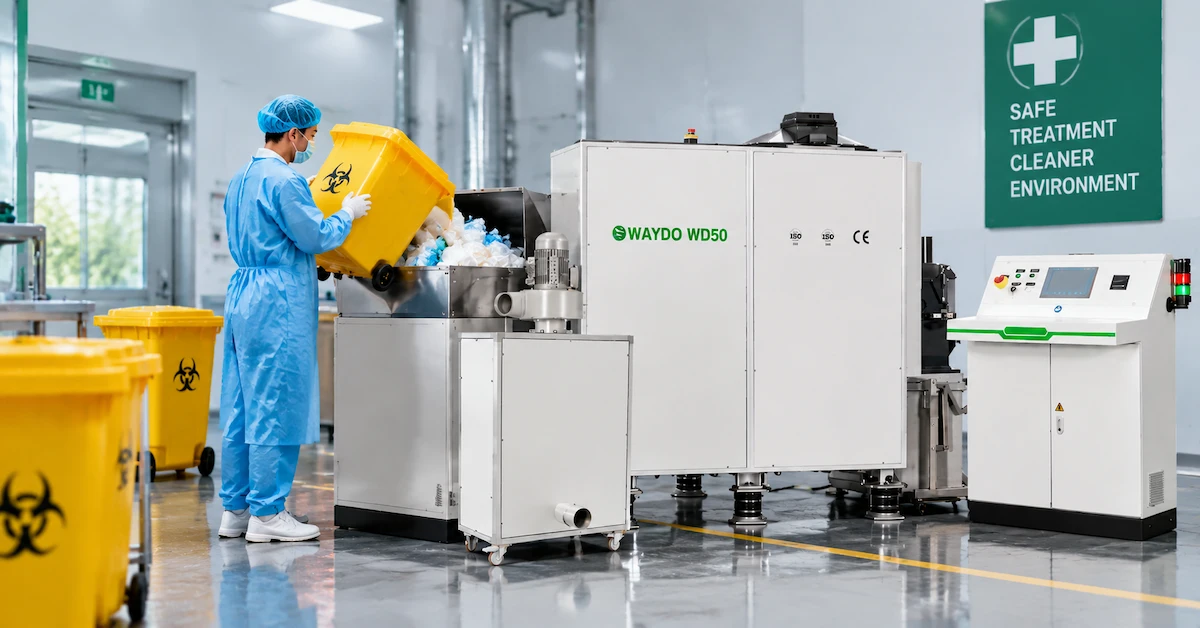
Resolve the Residue Route Before Signing the Order
Reducing infectious risk and changing a material's physical form do not automatically authorize municipal disposal, recycling or fuel use. The receiving contractor and competent local authority must establish the permitted route. Describe the expected output in the project discussion and obtain the receiving facility's requirements in writing.
WEIDUN publishes volume- and weight-reduction indicators, but neither should be copied directly into a disposal-cost saving. A contractor may charge by mass, container, collection frequency or a minimum service fee. The cost model needs the actual tariff and the accepted output classification.
For infectious medical waste treatment equipment serving several facilities, also determine how incoming loads remain identifiable. Collection scheduling, storage and rejected-material handling can limit practical throughput even when the treatment machine has spare capacity. Discuss those interfaces before purchasing extra capacity.
The same care applies to site access. Check door widths, lifting arrangements, floor loading, maintenance access and the route for replacing large parts. WEIDUN's services information can support the installation discussion; the contract should still allocate responsibilities for civil works, utilities, permits and commissioning.
What to Include in a Qualified WEIDUN Inquiry
A qualified inquiry makes it possible to recommend a configuration instead of returning a generic brochure. Identify the buying organization, installation country, facility type and procurement stage. Provide a practical contact for engineering questions as well as the commercial contact.
Attach the accepted-waste estimate, peak-day quantity, collection schedule, known packaging and moisture conditions, and available operating hours. Include a room sketch showing delivery access and utility locations. Where information is still uncertain, state that clearly rather than inventing a value to complete the form.
Ask for an itemized response covering equipment, loading options, residue bins, exhaust provisions, recommended spares, training, commissioning and documentation. Request current material specifications and model-specific test evidence. For commercial terms, confirm order quantity, manufacturing lead time, packing method, shipping dimensions, delivery term and warranty scope in writing.
WEIDUN's published contact location is Hangzhou, Zhejiang, China. The company markets WAYDO non-incineration systems for healthcare and related treatment applications. The company information page and contact page provide a direct route to the team. Regulatory suitability must be assessed for the destination market, not inferred from the supplier's location.
Buyer Questions About FHT Load Planning
Can a vessel-volume figure be used as the waste loading limit?
No. The published vessel volume describes the equipment chamber. The permitted waste volume, mass, container type and loading arrangement must come from the selected machine's instructions. Ask for both mass and volume boundaries and the waste description to which they apply.
Does a 25-to-35-minute cycle mean that many minutes at treatment temperature?
No. A total cycle can include several stages. WEIDUN's process page describes heating, treatment, cooling and discharge. Obtain the approved recipe and the basis for the quoted complete-cycle duration; do not treat the total as a sterilization exposure period.
Can mixed hospital waste be treated without segregation?
Do not assume so. A hospital waste stream can include incompatible chemical, pharmaceutical, cytotoxic, radioactive or other exceptional items. Define accepted materials and exclusions first. The equipment inquiry should describe segregated compatible waste, not everything collected under a hospital's address.
Which WAYDO model should we request for a medium-sized hospital?
Begin with measured compatible waste, the collection pattern and available operating hours. A bed count alone does not specify those conditions. Send the load profile to WEIDUN and request a written model recommendation with its capacity assumptions, utility requirements and service scope.
What are the minimum order quantity and delivery time?
They require a current quotation. This guide does not invent a standard MOQ or manufacturing schedule. State how many installations are planned and the target commissioning date, then request separate dates for technical approval, manufacture, shipment, installation and acceptance.
Can this guide replace project validation or a local permit?
No. It is a procurement planning guide. The selected configuration needs applicable technical documentation, an agreed validation and acceptance process, and the authorizations required in the destination. Named technical reviewers and their approval should be recorded in the project's own controlled documentation.
Request a Proposal Built Around Your Actual Waste
The next step in a frictional heat treatment medical waste project is a load review, not an unsupported capacity promise. Send WEIDUN your waste profile, country, daily and peak quantities, operating schedule and room constraints. Request a proposal that states its assumptions and separates confirmed specifications from items awaiting engineering review.
A useful response should connect the recommended WAYDO model with a permitted feed description, a practical operating schedule, model-specific evidence and an itemized commercial scope. That gives procurement and engineering a common basis for comparison before an order is placed.