
Quick answer: A mobile medical waste treatment system is most useful when a remote hospital, emergency clinic, field hospital, island facility, border medical post, or temporary healthcare project cannot depend on a long untreated-waste transport route. The right system is not selected by container size alone. Buyers must match accepted waste, daily and peak mass, available utilities, operator coverage, deployment time, residue route, validation evidence, service response, and local authorization.
This guide is written for hospital procurement teams, public-health planners, humanitarian logistics managers, environmental engineers, healthcare groups, and licensed treatment operators. It explains how to compare a mobile medical waste treatment system with a fixed plant or an external collection contract, and how to prepare an RFQ that a manufacturer can price accurately.
Request a Mobile Treatment Solution
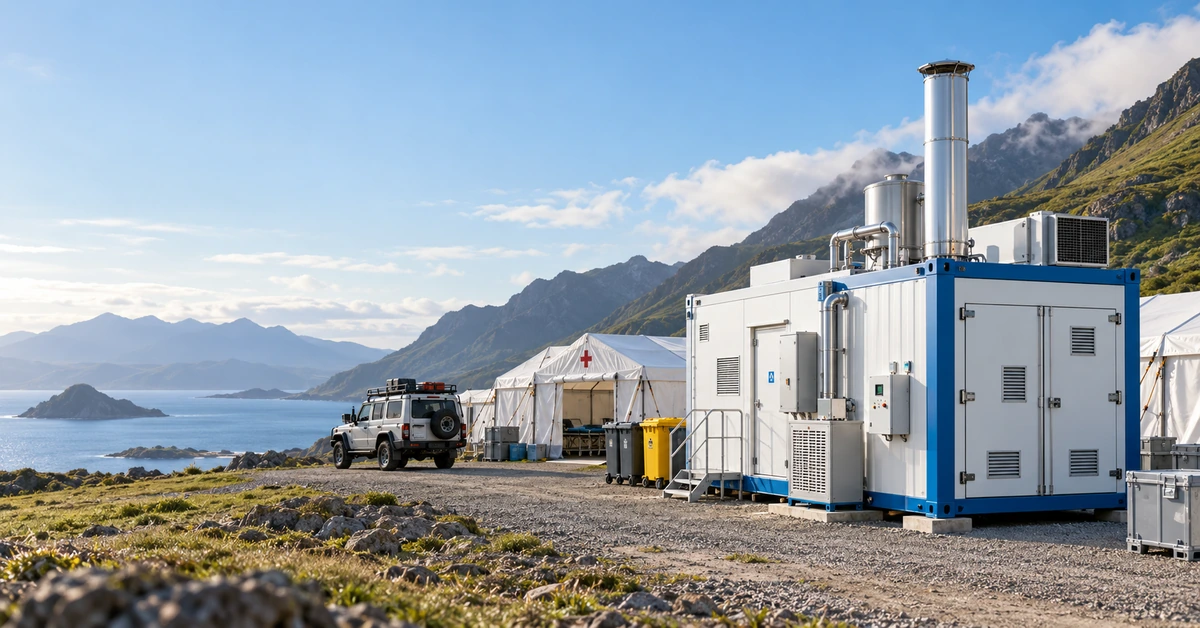
Who needs a mobile medical waste treatment system?
The strongest use case is a healthcare site where distance, access, or uncertainty makes a conventional collection model difficult to control. A remote hospital may have only one licensed pickup route each week. A field hospital may be operating before permanent utilities are complete. An island clinic may face weather-related shipping delays. A disaster-response team may need to establish a treatment point quickly and move it when the mission changes. A regional health authority may want one modular system that can serve several smaller facilities without building a permanent plant at every site.
These buyers have a shared procurement problem: untreated infectious waste remains on the site while the next safe step depends on a vehicle, a road, a ferry, a receiving window, or an external contractor. A small WAYDO WD05 configuration or a larger model from the WAYDO product range may be considered, but only after the waste stream and operating schedule are defined.
A mobile system is also relevant for planned surge capacity. Hospitals can use a mobile unit during renovation, an infectious-disease surge, a temporary ward expansion, a public event, or a planned outage of a central treatment line. In those cases the equipment is not a replacement for all permanent infrastructure. It is a controllable backup route that needs its own acceptance matrix, trained operators, records, maintenance plan, and final disposal arrangement.
What makes mobile treatment different from a fixed plant?
A fixed plant can be optimized around one building, one utility design, and one long-term staff group. A mobile or containerized system has to be designed around movement, site preparation, repeated connection, loading access, weather exposure, transport restrictions, and fast commissioning. The engineering question is therefore broader than whether the equipment can treat the waste. The buyer must ask whether the whole operating package can be deployed safely and repeated at the next location.
| Decision factor | Mobile or containerized unit | Fixed on-site system | External treatment service |
|---|---|---|---|
| Best initial fit | Remote, temporary, surge, or multi-site demand | Stable volume at one prepared facility | Small or variable generators with reliable access |
| Main proof required | Deployment plan, utilities, lifting, transport, commissioning | Layout, permanent utilities, validation and staffing | Licenses, route capacity, manifests and service levels |
| Risk to test | Site readiness and repeat deployment | Downtime and local operator coverage | Transport interruption and rejected loads |
| Typical commercial question | What is included in relocation and commissioning? | What is the installed lifecycle cost? | What is the total cost per pickup and treated load? |
The most useful comparison is a route map. Start at the department or treatment point where waste is generated. Then show segregation, container closure, internal movement, temporary storage, loading, treatment, cooling, residue release, and final destination. For an external service, add vehicle collection, public-road movement, receiving inspection, treatment batch, and final residue documentation. For a mobile system, add transport to the site, setup, utility connection, operator briefing, shutdown, decontamination, and relocation.
Start with the waste stream, not the equipment name
“Medical waste” is not a complete design basis. A remote hospital may produce infectious soft waste, sharps, contaminated packaging, laboratory waste, glass, pathological material, pharmaceuticals, chemicals, cytotoxic material, and ordinary refuse. These categories may have different legal routes and may not be compatible with one process. A mobile infectious medical waste treatment system should therefore be quoted against an accepted, conditional, and excluded material matrix.
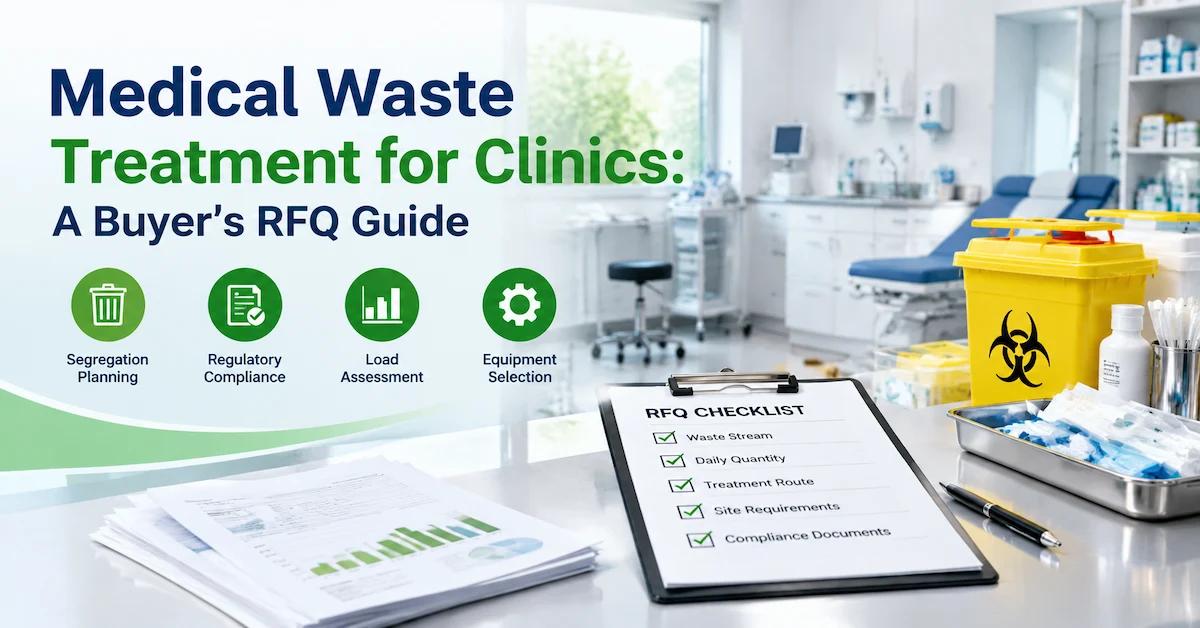
Before asking for a price, collect at least seven representative operating days. Record the department, waste category, container type, gross weight, estimated net mass, occupied volume, moisture, sharps or glass content, collection time, storage duration, and current final route. Add a peak day if one is known. A temporary clinic may have a low average volume but a very high daily peak during an emergency, vaccination campaign, outbreak response, or mass-casualty event.
The data pack should include:
- Facility type, country, climate, access road, operating hours, and expected mission duration.
- Average, peak, and growth-case mass and occupied volume for each waste category.
- Container dimensions, closure method, labeling, weighing method, and internal route.
- Storage-room capacity, maximum holding time, temperature controls, and cleaning arrangement.
- Available electricity, water, drainage, ventilation, cooling, lifting, and communications.
- Required deployment date, possible relocation frequency, and permitted transport method.
- Local rules for treatment, transport, residue, worker protection, and reporting.
Unknown values can stay marked as unknown. The important point is that the RFQ should show how uncertainty changes the recommendation. A supplier should not silently assume that all waste is compatible or that the unit will run at the headline hourly rate for every shift.
How Weidun's FHT approach fits remote healthcare
Weidun Environmental is a medical waste treatment manufacturer based in Hangzhou, Zhejiang, China. Its website presents Frictional Heat Treatment, or FHT, as a non-burning approach that combines mechanical size reduction with heat generated by friction. The product platform is positioned for hospitals, laboratories, clinics, centralized treatment facilities, defense and border medical facilities, and other sites that need a closed-loop infectious waste workflow.
FHT is not a permission to place every waste stream into one machine. The buyer still needs a project-specific waste matrix, local authorization review, process endpoint, validation protocol, operator procedure, residue route, and service plan. The relevant technical description is available on the Frictional Heat Treatment technology page. The operating sequence can be reviewed through the FHT process and treatment workflow.
For procurement teams, the practical question is what work the system performs. That work may include loading, size reduction, mixing, frictional heating, monitoring, cooling, discharge, cleaning, documentation, and residue handling. A non-incineration medical waste treatment system should be evaluated by these steps and by the evidence available for the intended load, not by the technology label alone.
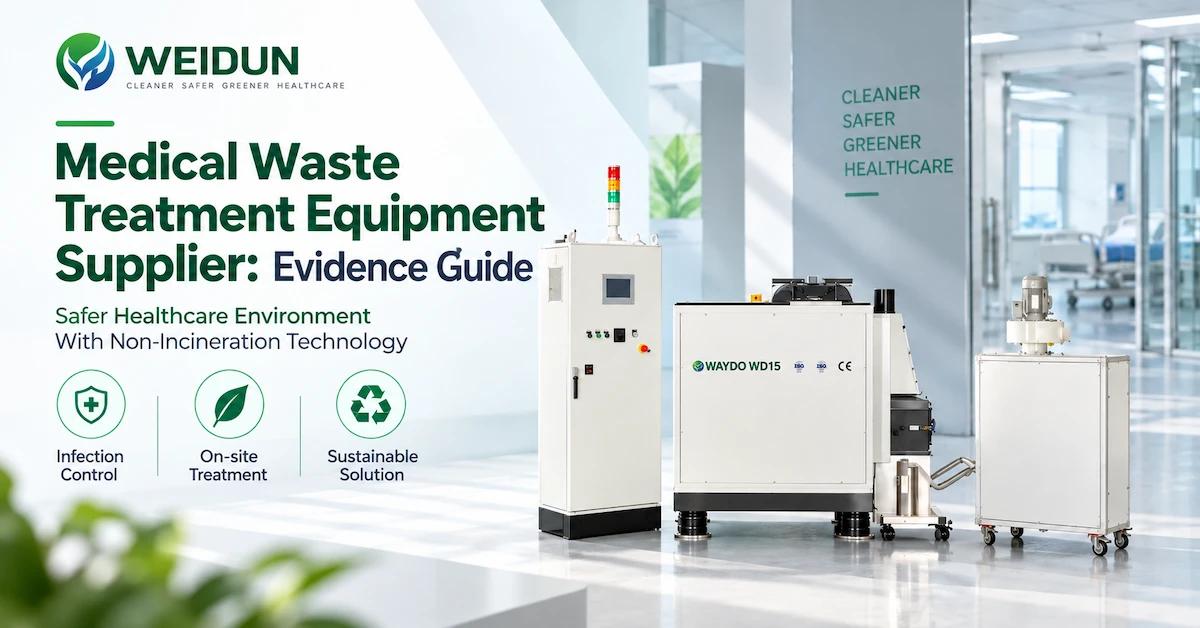
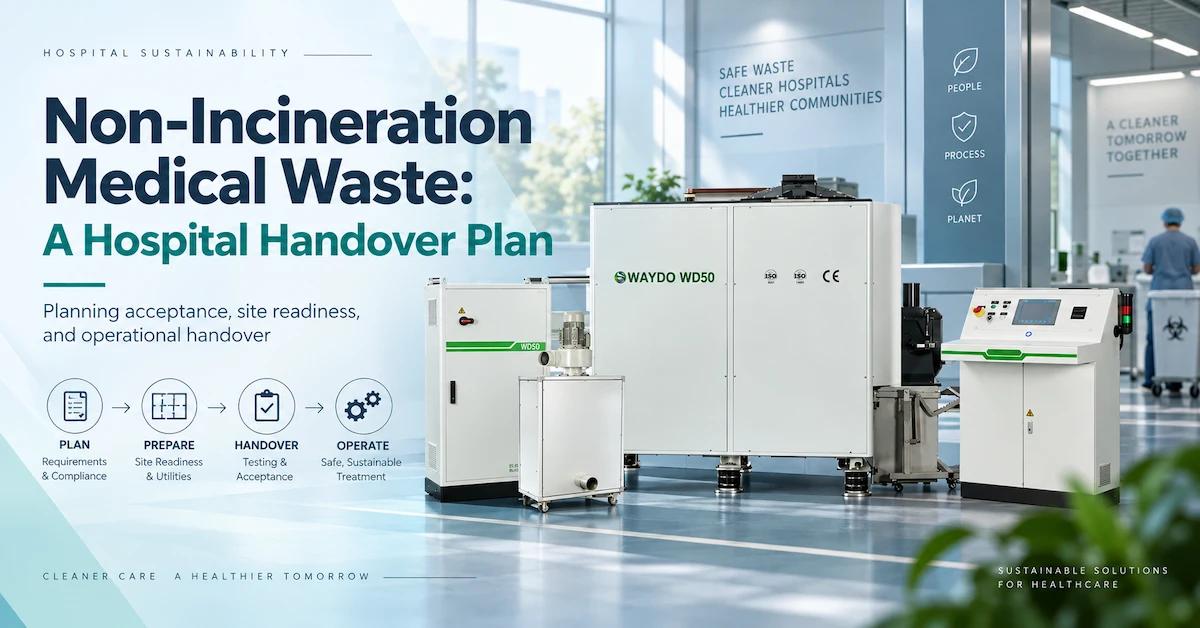
The equipment page shows four WAYDO model families: WD05, WD15, WD50, and WD330. A buyer may use the WD05 product page for smaller planning cases, the WD15 product page for a higher routine load, the WD50 product page for hospital or healthcare-group projects, and the WD330 product page when a larger regional or centralized line is being considered. These pages are starting points for model orientation; they do not replace a site survey or validation plan.
Choose the configuration: truck mounted, containerized, or modular
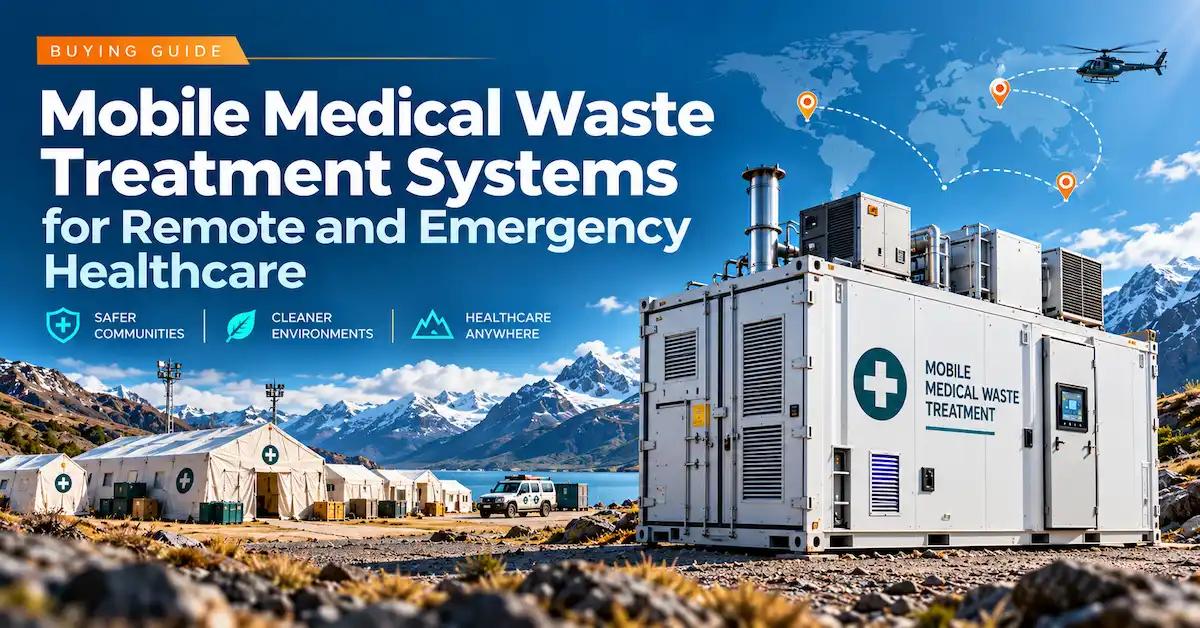
The phrase “mobile medical waste treatment system” can describe several engineering arrangements. A truck-mounted unit may be moved as a complete vehicle. A containerized medical waste treatment system may use a standard transportable module that is delivered to a prepared pad and connected to utilities. A modular system may separate treatment, loading, storage, filtration, cooling, residue collection, or control functions so that the installation can be adapted to the site.
Truck mounted units
Truck-mounted equipment is appropriate when rapid movement is part of the operating model. The buyer must confirm road weight, overall dimensions, axle loads, turning radius, bridge limits, fuel or power requirements, weather protection, parking, loading access, and the procedure for cleaning and securing the unit before movement. The commercial proposal should identify who provides the vehicle, registration, insurance, driver, route planning, and emergency roadside response.
Containerized modules
A containerized system is often easier to plan for a remote hospital or emergency healthcare site because the module can be delivered by road, sea, rail, or combined logistics. The site still needs a stable pad, access for unloading, safe working clearance, drainage, ventilation, electrical connection, water or cooling connection where required, and a controlled route for incoming and treated material. Ask the supplier for layout drawings, connection points, lifting points, center of gravity, maintenance clearances, and the time required for commissioning.
Custom modules
Custom modules make sense when a healthcare group must integrate treatment with existing storage, weighing, traceability, power generation, or centralized disposal infrastructure. Custom engineering should be tied to a written scope. Otherwise, the project can become a series of site changes with unclear responsibility. The scope should define what is supplied by the manufacturer, what is supplied locally, the acceptance test, the documentation set, the operator training, and the final handover record.
Capacity planning for remote and emergency facilities
Capacity should be calculated from compatible mass, occupied volume, peak batch, operating hours, cycle time, loading time, cooling time, discharge time, cleaning, maintenance, and backup requirements. Bed count can be an early planning reference, but it is not a capacity formula. A remote hospital with a small bed count can generate a high infectious-waste peak, while a larger outpatient facility may produce a different mix with more packaging and less daily mass.
Use three scenarios:
- Expected case: the normal compatible mass and normal number of operating cycles.
- Peak case: a surge day, outbreak day, event day, or delayed pickup day.
- Growth or contingency case: the additional load expected from new wards, a second facility, or an outage at another plant.
For each scenario, show the number of cycles, operator hours, storage hours, residual output, planned maintenance, and external backup volume. If the mobile unit will serve multiple clinics, show travel time and the arrival pattern of containers. A system can have enough active treatment capacity but still fail because containers arrive together, the loading area is too small, or the receiving team cannot reconcile weights and batch records.
| RFQ input | Why it matters | Evidence to request |
|---|---|---|
| Compatible mass | Determines the practical load and model range | Seven-day waste audit and written acceptance matrix |
| Peak batch | Tests storage, cycle scheduling, and surge response | Peak-day data and contingency scenario |
| Site utilities | Confirms the module can operate at the remote site | Utility schedule, drawings, connection limits, and site photos |
| Operating staff | Shows whether the planned schedule is realistic | Shift plan, training matrix, and absence cover |
| Backup route | Protects the facility during downtime or relocation | Signed contractor route, response time, price, and volume limit |
What evidence should a buyer request from the manufacturer?
Original evidence is what separates a useful procurement article from a generic equipment description. Ask the manufacturer to identify which information is verified for the proposed configuration, which information is published screening data, and which information remains pending confirmation. The same discipline should apply to every bidder.
For Weidun or any equipment supplier, request:
- Legal manufacturer identity, manufacturing location, service responsibility, and export contact.
- Exact model, configuration, options, dimensions, weight, lifting points, and utility connections.
- Accepted, conditional, and excluded waste categories linked to the actual waste audit.
- Capacity basis: active treatment rate, full-cycle rate, shift plan, or daily throughput.
- Process description, monitoring points, alarms, control logic, cooling, discharge, and cleaning.
- Validation or test evidence for the intended material, load, cycle, and endpoint.
- Factory acceptance testing, site acceptance testing, commissioning, training, and handover records.
- Wear parts, preventive maintenance, calibration, spare-parts stock, remote support, and response time.
- Packaging, shipping method, delivery scope, installation exclusions, and relocation responsibility.
- MOQ, lead time, quotation validity, payment milestones, warranty, and project-specific commercial assumptions.
MOQ and delivery are not universal numbers for a mobile system. A single standard unit, a containerized line, and a multi-site program may have different commercial terms. Put the requested deployment quantity, destination, shipping method, required date, installation scope, and training plan in the inquiry so the manufacturer can answer with a real project basis.
Non-incineration treatment and environmental planning
Many remote and emergency healthcare buyers prefer a non-incineration medical waste treatment system because they want to avoid an open-ended dependence on combustion infrastructure, fuel supply, or a distant disposal plant. That preference should be converted into measurable procurement questions. What waste is accepted? What is the treatment endpoint? What happens to the treated residue? Which emissions, odor, noise, water, and cleaning controls apply? What records demonstrate a completed cycle? What local authority review is required?
Weidun describes its FHT process as non-burning and presents the output as dry, odorless, biologically inert material suitable for an authorized downstream route when the intended process and local requirements are met. Buyers should still review the treatable materials and process boundaries before making a compliance or disposal claim. Treatment is not the same statement as final disposal permission. The output route must be written into the operating plan.
Environmental review should also cover shipping and relocation. A mobile unit can reduce public-road movement of untreated compatible waste, but the unit itself still has a transport footprint. Ask for the packaging method, protection against weather and vibration, cleaning before movement, route restrictions, and the documentation needed after the unit leaves the site.
Deployment checklist for remote hospitals
A practical deployment plan has four phases: site readiness, delivery, commissioning, and routine operation. The manufacturer and buyer should assign one responsible party to every interface.
Site readiness
Confirm the pad, road access, unloading area, lifting equipment, electrical supply, water, drainage, ventilation, lighting, operator space, storage, cleaning area, emergency egress, fire protection, communications, and security. Record site photos and dimensions. A simple drawing should show the route from incoming containers to the loading point and the separate route for treated residue.
Delivery and installation
Define who coordinates freight, customs, unloading, crane or forklift support, temporary storage, placement, connection, weather protection, and waste segregation during installation. A mobile medical waste treatment system should not arrive at a remote facility without an agreed unloading method and a protected area for the first startup.
Commissioning and training
Commissioning should include utility checks, empty-cycle checks, alarm checks, safety interlocks, loading practice, cleaning, recordkeeping, and an agreed challenge load. Training should cover segregation, container inspection, loading, cycle selection, failed loads, emergency stop, spill response, personal protection, record review, residue release, and escalation. Attendance is not the same as competence. Ask how the operator demonstrates that the procedure can be repeated.
Routine operation
The routine plan should identify shift coverage, container tracking, weighing, batch records, routine checks, preventive maintenance, calibration, cleaning, consumables, wear parts, service contact, and the alternative route during downtime. For a multi-site program, use the same forms and data fields at every location so that a central manager can compare cycles and investigate an incident later.
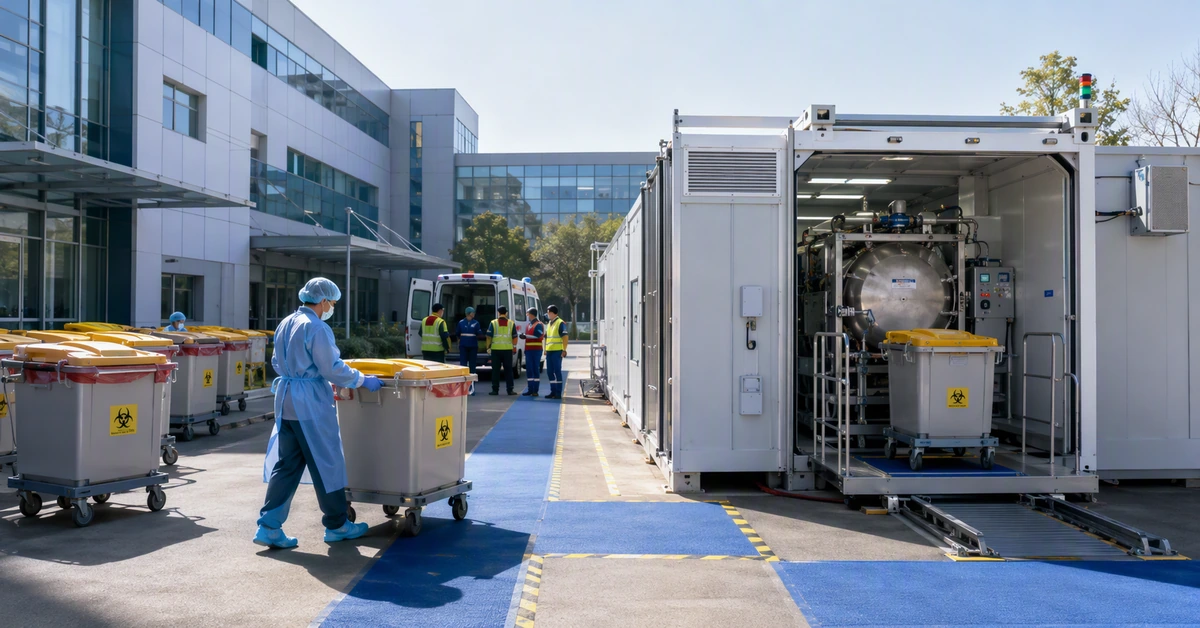
How to compare mobile treatment costs
A medical waste treatment system for remote hospitals should be compared on total route cost, not machine price alone. A mobile project may include equipment, container or vehicle integration, shipping, customs, site works, utilities, lifting, commissioning, training, operator labor, maintenance, wear parts, validation, insurance, relocation, storage, residue handling, and backup collection. An external service may include containers, pickup, fuel, transport, treatment, surcharges, rejected loads, emergency collection, and final disposal.
Build a five-year and ten-year view. Then test low utilization, expected utilization, peak demand, fuel changes, wage changes, maintenance downtime, relocation, and changes in the excluded waste fraction. The most valuable output is not a single saving percentage. It is a transparent table showing which assumption changes the decision.
| Cost line | Mobile system questions | Evidence |
|---|---|---|
| Capital and freight | Does the price include module, controls, shipping, packing, insurance, and unloading? | Itemized quotation and shipping scope |
| Site preparation | Who provides pad, power, water, drainage, ventilation, lifting, and security? | Layout, utility schedule, and responsibility matrix |
| People and service | What are the training, travel, maintenance, calibration, and response costs? | Service plan, parts list, and response commitment |
| Relocation | How is the unit cleaned, secured, shipped, reconnected, and recommissioned? | Relocation method statement and price schedule |
| Residue and backup | Where does excluded waste or treated residue go during downtime? | Authorized route, contractor terms, and emergency volume |
Internal links that help a buyer move from research to inquiry
A good buyer journey should not force the reader to search the site for the next technical answer. From this article, a procurement manager can move directly to the WAYDO product overview, read about FHT technology, review the treatment workflow, check treatable materials and boundaries, learn about services, or submit a project request through the inquiry page.
Use the model links according to the project signal. A small remote clinic can start with WD05. A medium healthcare facility can review WD15. A hospital group or larger on-site program can compare WD50. A regional center or higher-volume planning case can review WD330. The final recommendation should be based on the measured waste stream and site conditions.
RFQ questions for a mobile medical waste treatment project
- Which waste categories, containers, moisture range, and sharps profile form the design basis?
- Which materials are accepted, conditional, or excluded?
- Does the capacity number mean active rate, full-cycle rate, shift rate, or daily throughput?
- What are the exact module dimensions, transport weight, lifting points, and maintenance clearances?
- Which electrical, water, drainage, ventilation, cooling, and communication interfaces are required?
- What is included in packaging, shipping, customs support, unloading, installation, and commissioning?
- What model-specific validation documents are available for the intended load and process endpoint?
- How are FAT, SAT, operator training, failed loads, and corrective actions documented?
- What MOQ, lead time, warranty, spare-parts stock, and service response apply to this project?
- How is the unit cleaned, secured, transported, reconnected, and recommissioned after relocation?
- How is each load linked to a batch record, residue release, and final disposal document?
- What route remains available during planned maintenance, unplanned downtime, weather disruption, or a second emergency?
Frequently asked questions
What is a mobile medical waste treatment system?
It is a treatment unit designed to be transported, deployed, or relocated rather than permanently installed at one site. It may be truck mounted, containerized, or built as a modular system. The complete solution includes equipment, site interfaces, operating procedures, staff, records, service, and a final residue route.
Is a containerized medical waste treatment system suitable for a remote hospital?
It can be suitable when the site can support delivery, placement, utilities, safe loading, trained operators, storage, maintenance, and authorized residue handling. The buyer should complete a site survey and waste audit before selecting a model.
Can one system treat every hospital waste stream?
No. Chemicals, pharmaceuticals, cytotoxic material, radioactive material, pathological material, certain liquids, and unusual sharps may require other routes. The supplier must provide an accepted, conditional, and excluded matrix for the proposed process.
What is the difference between mobile and decentralized treatment?
Mobile treatment describes equipment that can move or be deployed at different sites. Decentralized treatment describes an operating network with several treatment points instead of one large hub. A decentralized medical waste treatment system may use fixed units, mobile units, or a combination.
Is non-incineration the same as zero environmental impact?
No. Non-incineration describes the treatment approach, not every environmental outcome. Buyers should review energy, water, noise, odor, transport, cleaning, residue, maintenance, and local authorization requirements.
Which product should a remote healthcare buyer review first?
Use the waste audit and the operating model first. WD05 and WD15 may be starting points for smaller planning cases, WD50 may suit a larger hospital or healthcare group, and WD330 may be considered for higher-volume or regional planning. The published product range is not a substitute for project validation.
How quickly can a mobile system be delivered?
Delivery depends on the model, configuration, production schedule, shipping method, destination, customs, site readiness, and commissioning scope. Put the required date and destination in the inquiry and ask for a written lead-time schedule rather than relying on a general estimate.
What information should be sent to the manufacturer?
Send facility location, waste categories, average and peak mass, container types, available utilities, access constraints, deployment date, expected mission duration, preferred configuration, local requirements, and the exact questions that must be answered in the quotation. Photos and a simple site plan usually improve the first technical response.
Conclusion: specify the route before choosing the unit
The best mobile medical waste treatment system is the one that gives a remote or emergency healthcare site a controllable route from generation to authorized final destination. It should be sized from compatible waste, tested against peak demand, supported by deployment drawings, operated by trained staff, documented through batch records, maintained with available parts, and protected by a credible backup route.
Weidun's WAYDO platform gives buyers a starting range of FHT-based models and the option to discuss fixed, mobile, containerized, or custom configurations. The next step is not to ask for a brochure alone. Send the waste data, site conditions, deployment target, and required evidence so the manufacturer can recommend a configuration that can be reviewed by procurement, engineering, infection prevention, finance, and local authorities.