
Who verifies each handover in a non-incineration hospital project?
Assign a responsible person at every step; do not assume a container has been accepted just because it reached the treatment room. A machine does not remove the need to identify each incoming stream, record its treatment, and confirm who receives the output. For a hospital assessing non-incineration medical waste treatment, we recommend tracing one real waste movement: from the department's sealed container, through weighing and accepted loading, to the treatment record, the output container, and the next intended receiver. Put a person and a decision at each handover before comparing equipment quotations.
Define the feed before the first container changes hands
Start with what the hospital actually collects, not what a product category appears to cover. Our treatable-materials page names examples of infectious dressings, PPE, selected clinical consumables, properly collected sharps and laboratory materials. It separately lists radioactive materials and flammable or explosive compounds as non-treatable. Those published categories are a starting point for a discussion; they are not a model-specific approval for every container or mixed load.
Ask each department to describe its usual container and contents together. "Sharps" alone does not tell us whether a closed rigid box, loose contents, or another collection format arrives at the loading area. A laboratory bag may carry a different question if it also contains chemical residues. Items with uncertain status should remain outside the proposed accepted feed until the hospital identifies the right route and we respond to the actual material description.
| Record at collection | Example of a useful buyer description | Decision still needed |
|---|---|---|
| Origin and waste family | Department and existing segregation label | Does it fall within the feed proposed for the named model? |
| Container and presentation | Bag, closed sharps box, bin; usual fill level | Can that complete presentation be loaded as proposed? |
| Mass and arrival pattern | Weighed normal and peak periods, not bed count | How many compatible loads fit the staffed window? |
| Potential second hazard | Chemical, pharmaceutical or other concern identified on site | Keep separate pending the responsible team's decision. |
| Current destination | Existing collection or treatment route | What remains in place for excluded items and downtime? |
This is a working inventory, not a fictional customer's test result. Where the feed is uncertain, ask for a written "proposed / conditional / excluded / needs review" response against the chosen configuration. That response is more valuable than treating the phrase infectious waste treatment equipment as an acceptance certificate.
Hand over a container with an identifiable decision
For an operating proposal, specify who confirms the container belongs to the agreed feed, who records its mass or count, and who holds it when the answer is unclear. The collection team knows how the waste arrives; the treatment operator sees what reaches the loading point. If those teams use different category names, settle the mismatch before routine operation.
Our site presents department collection, weighing and handover, on-site treatment and final movement as a connected workflow. The local site's record format and responsible staff still need to be agreed by the hospital. We would use your actual collection description to discuss the corresponding loading arrangement rather than infer it from a picture.
What the published FHT data can, and cannot, establish
In our published FHT process, a rotor pre-shreds and mixes the feed, friction generates heat, a treatment phase follows, and the material is cooled and discharged. The page states a 150°C treatment phase and a 25–35 minute cycle. It also describes a 6 Log10 efficacy criterion and reductions of up to 80% by volume and up to 30% by weight. These are figures on our website, not site-specific measurements for your waste. The page does not, by itself, supply a named hospital's batch log, a test report for your material, or approval of its output destination.
| Our publicly stated process figure | Use it to ask us | Do not infer |
|---|---|---|
| 150°C treatment phase | How will the offered system document the relevant phase? | That every future load at your site has been verified. |
| 25–35 minute cycle | What exactly is included for the proposed model and feed? | That all receiving, loading and discharge work fits this interval. |
| 6 Log10 efficacy description | Which method and conditions support the statement for the proposed application? | An independently reviewed result for your load without its evidence. |
| Up to 80% volume / 30% weight reduction | What feed and measurement basis underlie the figures? | A fixed reduction, disposal classification or financial saving. |
The difference matters for a medical waste sterilization system proposal. Our public process description tells you what the technology is intended to do. A hospital acceptance plan must identify the actual waste envelope, offered equipment, relevant evidence, process records and people authorized to review them. A cycle description and an approval to release a particular batch are different things.
For more on frictional heat treatment medical waste, our process article explains shredding, heating, cooling and residue in detail. Here the buyer's practical question is narrower: which record follows an identifiable container into treatment and which decision follows the output away from it?
Match model discussions to the handover workload
Our published FHT equipment article gives approximate reference values of a 150 L chamber and 18 kg/h for WD05, 170 L and 40 kg/h for WD15, and 450 L and 115 kg/h for WD50. These are manufacturer-published comparison figures, not a guaranteed duty for an unknown mix or shift. Our Solutions range also shows WD330; do not transfer the other models' figures to it.
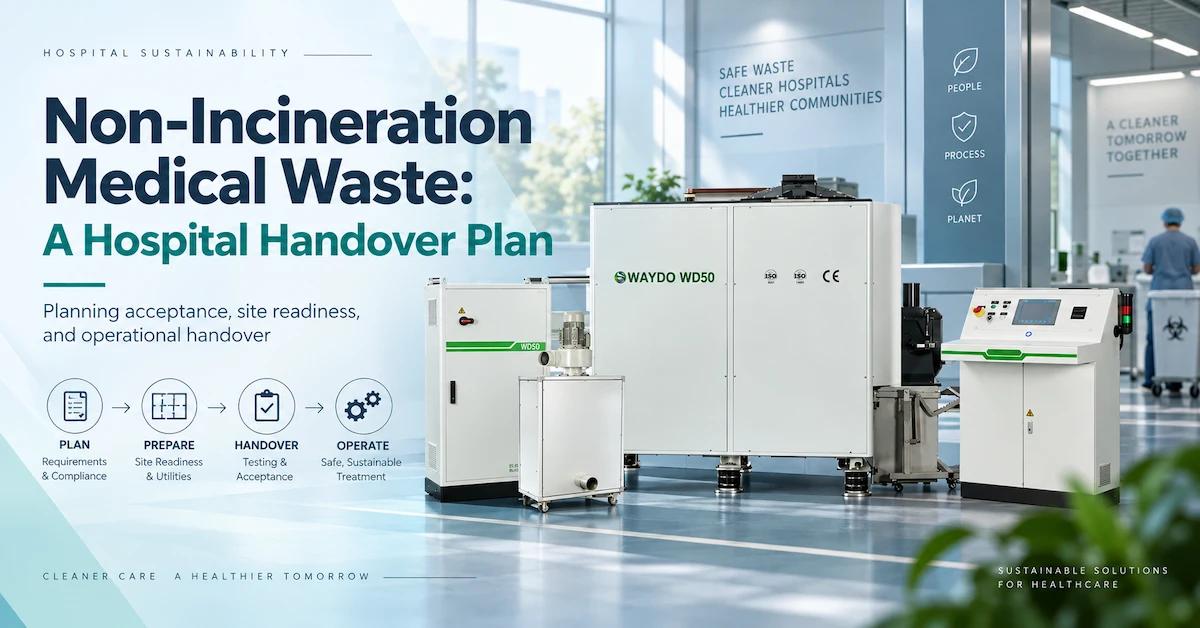
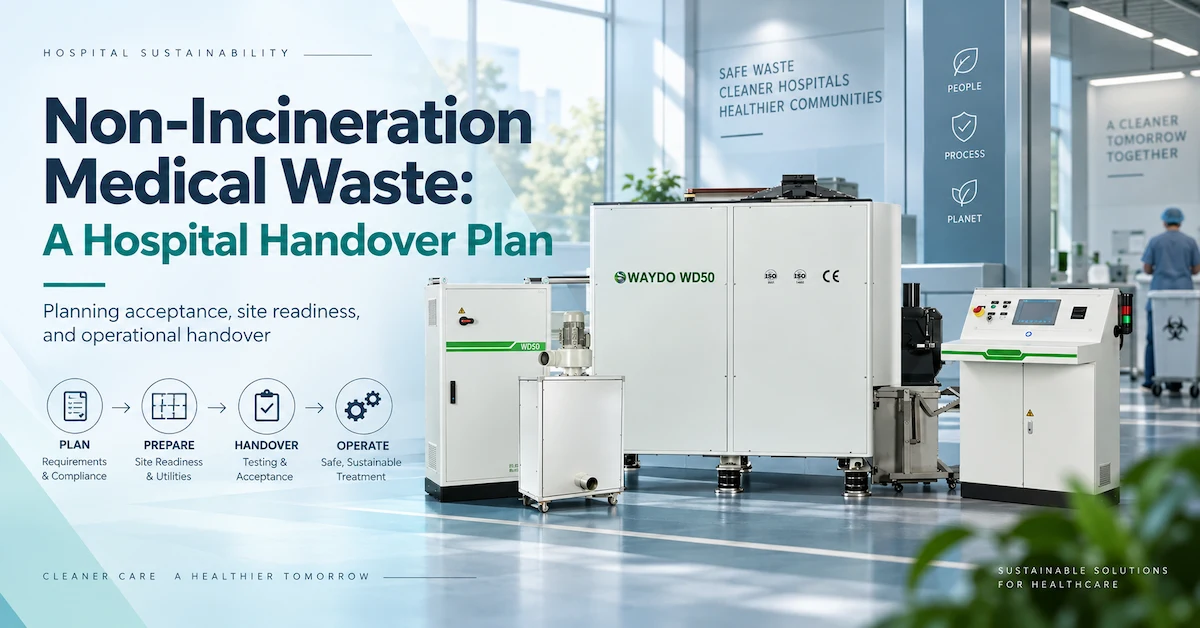
An hourly reference is useful only after the hospital tells us how many compatible containers arrive, how full they are, when operators are available, and whether there is room for the incoming and outgoing containers. A light but bulky load may occupy the proposed chamber before reaching a mass-based rate. Start a discussion with the WAYDO WD50 product if that is the model under review, but request a model-specific proposal based on the recorded feed and schedule. Our capacity-planning guide addresses the separate sizing calculation.
Follow one load through six documented handovers
An operator-friendly route can fit on one sheet. The entries below describe questions to settle, not a claim that every hospital already uses this document or that every WAYDO option exports the same fields. Keep your existing facility procedures and have the relevant decision owners agree changes before commissioning.
| Handover point | What to connect in the record | Who must be identified locally |
|---|---|---|
| Department to collection | Waste category, container identity or traceable group, origin and date | Department and collection contact |
| Collection to treatment area | Quantity, arrival, condition and any discrepancy | Receiving and segregation reviewer |
| Acceptance to loading | Decision against the approved feed; hold or exclude exceptions | Authorized treatment operator |
| Loading to completed cycle | Load reference linked to the applicable process record | Operator and person reviewing treatment evidence |
| Discharge to output holding | Output quantity/container, event time and any abnormal condition | Output handler and reviewer |
| Output to next receiver | Receiver, acceptance basis and required handover documents | Hospital's responsible release authority and receiver |
The point is continuity. If the incoming container cannot be connected to the treatment record, a finished cycle says little about that container. If the output container cannot be connected to the reviewed event, a label on the bin does not close the gap. Ask us which records the proposed configuration can provide; our services page describes monitoring and batch reports, but the exact fields and integration scope belong in the offer.
This is where an on-site medical waste treatment project changes operations. The treatment room receives an actual waste stream, not an abstract daily average. An equipment quotation should therefore state what arrives at the machine, what handling or loading options are included, and how an excluded or interrupted load is kept on a separate route. Do not assume an illustrated bin lift, a particular reporting interface or an output bin is included without the quotation saying so.
Do not leave the output route for after installation
Our FHT process page describes cooling and discharge of a dry, unrecognizable residue. That description does not settle how a particular jurisdiction classifies a particular hospital's treated material. Before buying the equipment, the hospital should identify its intended receiver and ask that party what it will accept, which documents are required, and who is authorized to release the material. If the receiving decision is unresolved, mark it unresolved in the project scope.
The output side has practical consequences for the room: a place for the collecting bin, a route out of the treatment area, handling for material awaiting a decision, and a separate arrangement for rejected or untreated waste. Our Solutions page shows removable residue collecting bins among available accessories and options. Their presence on the page does not mean a particular option has been quoted or installed.
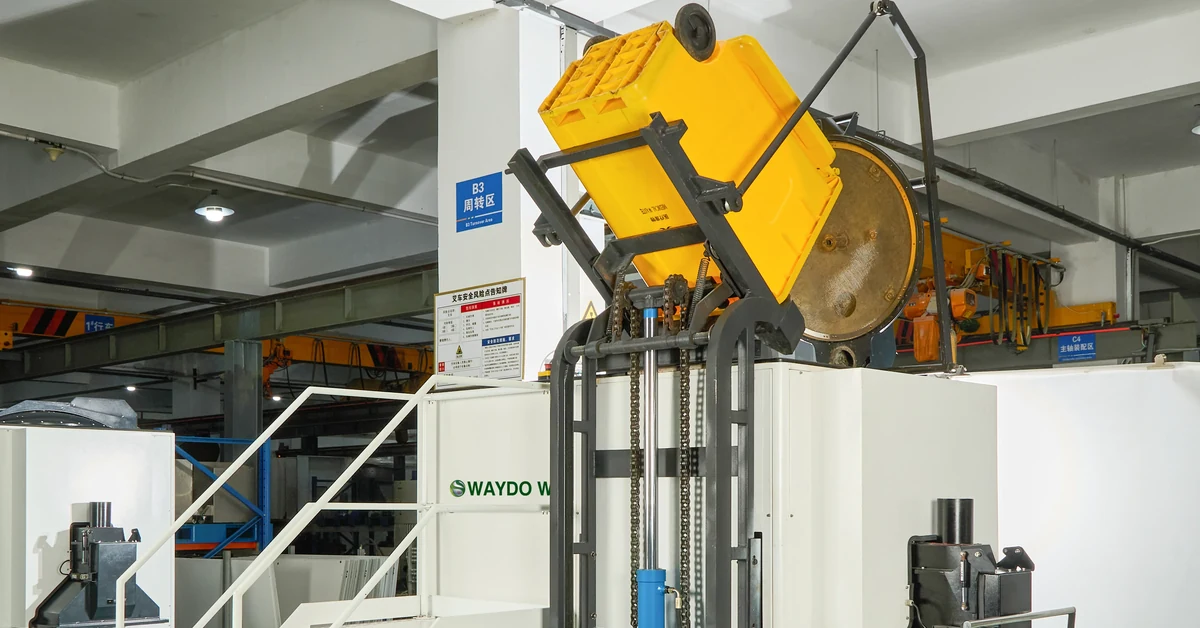
This is the key distinction in a non-incineration medical waste disposal plan: treatment is one step; final handover remains a separate agreement. Claims about a reduction in transport or storage cannot substitute for a receiver, an accepted output description and a working route during downtime. We do not quote an invented customer's savings or imply that material automatically becomes municipal waste.
A useful question for the output receiver
"For material from this proposed process, generated from this accepted feed at this location, what evidence and handling conditions would you require before accepting it?" Record the response with the project scope. If the answer depends on a permit, testing or another authority, ask the responsible local party to settle it rather than asking a marketing page to do that work.
What to send us for a useful WAYDO response
When you are ready to discuss hospital medical waste treatment, send the site location, facility type, actual segregated waste list, typical and peak container counts, available operating hours, basic room dimensions, and a description of the current post-treatment or collection destination. If possible, include anonymized photographs of the container and proposed room, without patient information. Tell us who in your team can answer feed, facilities and output-route questions.
Our site assessment and solution-design service describes waste characterization, capacity sizing and layout drawings. For your project, ask for a written response covering: the proposed feed and exclusions; named model and options; the loading/output interface; which technical data are available for the proposed configuration; and what the hospital must confirm locally. Do not assume a MOQ, delivery date, certification, electrical requirement or particular test result when none has been supplied for your project.
The buyer journey is deliberate: compare your question against the existing method comparison, review the FHT process and materials, inspect the relevant WAYDO model, and discuss the site solution and services. This article does not try to become another full comparison or an RFP template.
Discuss Your Waste and Handover Route
FAQ: the questions behind the handover plan
Does a 25–35 minute published cycle define our daily throughput?
No. That range appears on our FHT process page. It does not establish your actual loading interval, waste presentation, available staff time, output handling or interruption plan. Give us the quantity and arrival pattern of the feed you want assessed, then ask for a model-specific duty estimate with its assumptions shown.
Can our sharps containers be accepted without opening them?
Our materials page lists sharps after proper collection, but it does not approve every container design for every configuration. Describe or photograph the closed container used by the hospital, and request a written answer for the proposed model and loading arrangement. Do not change safe handling practice based on a generic article.
Does FHT output automatically qualify for ordinary disposal?
No universal destination follows from an equipment page. Our site describes the physical output and published process, but the hospital must agree the receiving route for its actual location and material. Identify the receiving party, its requirements and the person who will review the relevant treatment records before a release decision.
What if a load is outside the accepted feed or a cycle is interrupted?
The hospital needs a written hold-and-review route that keeps uncertain material from being treated or released as a completed load. Ask us how the proposed equipment reports an interruption and how its operating instructions handle the situation. Keep the backup collection route in the site plan; this page does not prescribe an unverified recovery procedure for a specific machine.
Does the website's 6 Log10 figure validate our hospital's waste?
No. Our FHT process page states that efficacy criterion, but the public figure alone does not document results for your waste mix, containers or offered configuration. Ask us for the available method and supporting documentation, then agree with your project team what application-specific evidence and acceptance checks are needed. Do not describe a published process claim as your hospital's completed test.
Can we install a WAYDO system in our current waste room?
That requires a site review. Our site-assessment service discusses waste flow, sizing and layout drawings, but a generic equipment image cannot establish access, loading clearance or an output path in your room. Send measured room dimensions, door and container routes, and known utility information. Ask us to show the proposed arrangement and identify the building work that remains the buyer's responsibility.
What should we send for an initial, useful quotation?
Send your location, segregated waste list, normal and peak container quantities, staffed operating window, current container types and a simple room plan. Identify the intended output receiver or mark that decision as open. We can then discuss a named WAYDO model, the feed needing written review and the information still required before a project-specific offer. A price requested without the feed and site boundary cannot settle those questions.
Start with one real route, not a generic performance promise
To evaluate non-incineration medical waste technology for a hospital, follow a real container from its department to an agreed receiver and write down every person, record and unresolved decision along the way. Our FHT technology and WAYDO pages establish what we publicly describe; your feed, installed layout, proposed model and receiving conditions determine what can be offered for the project. This is a more useful inquiry than asking whether alternative medical waste treatment methods are universally better.