Picture a busy morning at the chair. The treatment goes to plan, yet the sharps box is nearly full, gauze is wet with blood, and an extracted tooth has slipped into the wrong bin. Waste is a small line in most clinic budgets, yet poor handling can expose staff, create avoidable collection costs and turn an ordinary inspection into a long afternoon.
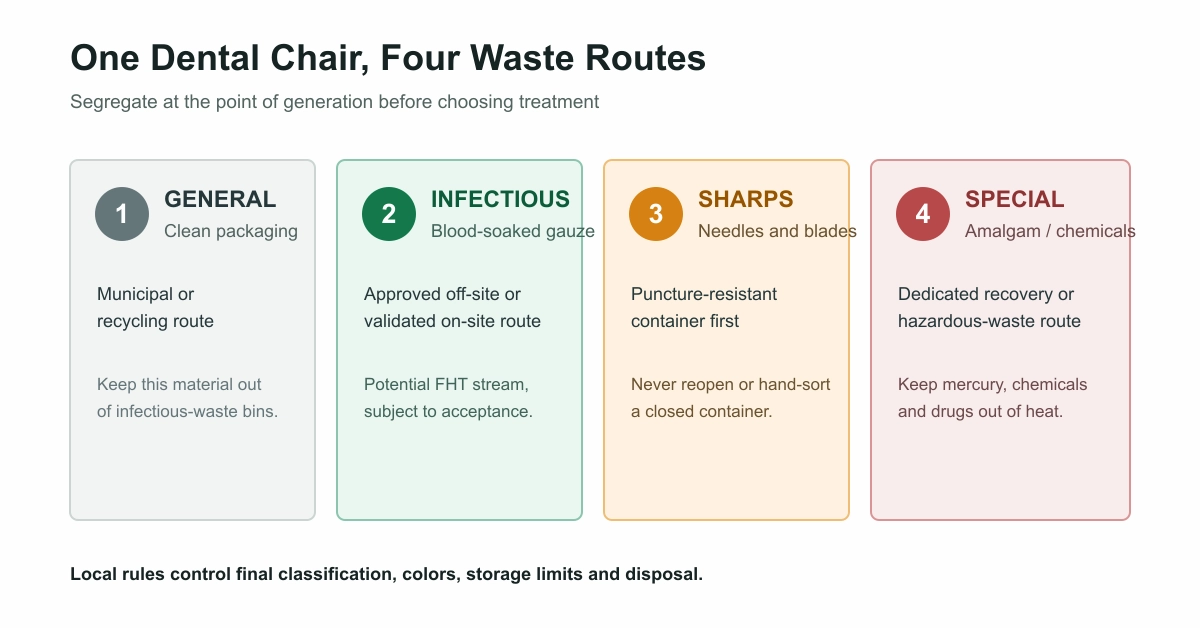
The right approach to dental clinic medical waste treatment is not to buy one machine and feed every waste stream into it. It is to separate ordinary waste, infectious soft waste, sharps, amalgam-bearing material, chemicals and pharmaceuticals at the point of generation. Only then can a clinic decide whether licensed off-site collection, shared treatment or on-site equipment is the sensible route.
For a single-chair practice with modest waste volumes, scheduled collection may still be the most economical answer. On-site treatment becomes more interesting for dental hospitals, multi-chair clinics, training centers, remote public clinics and groups that can aggregate compatible infectious waste. At a site with that mix, a compact non-incineration unit may cut storage days, remove a transfer step and leave a residue that no longer looks like the original waste, but only after local approval and a load-specific validation.
The notes below follow the waste from chairside sorting to the final record, then spell out the questions worth asking before a quotation is requested.
The short answer: what equipment does a dental clinic need?
Before anyone compares machines, the clinic has to make the waste routine work. The practical list is short. Put a sharps box beside the chair, keep leak-resistant bags or bins ready, give amalgam and chemicals their own containers, reserve a secure holding spot, label each route, log the weight, and name the licensed disposal partner. A clinic considering on-site treatment then adds a validated unit sized to its compatible infectious fraction, not to the weight of everything leaving the building.
| Waste stream | Common dental examples | First control | Usual next route |
|---|---|---|---|
| General waste | Unsoiled cartons, paper and packaging | Normal recycling or refuse bin | City service or contracted collector |
| Infectious soft waste | Blood-wet gauze, used barriers and accepted single-use items | Marked leak-resistant bag or bin | Licensed collection or a validated on-site cycle |
| Sharps | Needles, blades, burs, wire ends and contaminated glass | Rigid closable box placed where the procedure happens | Approved sharps route; on-site use requires written acceptance |
| Amalgam material | Debris from fillings, chairside traps, pump filters, and teeth with amalgam | Keep it in a closed recovery container; add a separator when local rules call for one | Send it to an authorized mercury recovery or recycling service |
| Chemical waste | Film fixer or developer, solvents, and used disinfectant | Use a compatible, clearly marked container | Hand it to a licensed hazardous-waste contractor |
| Pharmaceutical waste | Expired medicines, anesthetic cartridges, and other regulated products | Keep them in a separate medicine-waste container | Use the authorized return or disposal route |
That separation is the foundation of safe dental medical waste disposal. It also prevents a costly mistake: sizing a treatment system against general waste that should never have entered the hazardous stream.
Why dental waste is different from a small hospital waste bag
Dental practices produce many light disposable items, but the risk profile is not uniform. A clean mask wrapper and a needle from a local anesthetic syringe may leave the same treatment room, yet they should not share a container. A cotton roll with a small saliva stain may be managed differently from gauze that releases blood when compressed. Local definitions control the final classification, so staff need a written rule that translates regulation into something usable beside the chair.
There is another difference: mercury and chemistry sit unusually close to infection-control waste in dentistry. An extracted tooth may be regulated medical waste, but a tooth containing amalgam should not be sent into a heat process. Film-processing chemicals may be absent in a digital clinic, while an older practice still has fixer containing recoverable silver. Dentistry also brings compatibility questions around surface disinfectants, bonding agents and medicines.
CDC guidance in the United States treats most visibly soiled dental-office items as general medical waste; blood-soaked gauze, extracted teeth and used needles receive closer handling requirements. The same CDC material says an extracted tooth that contains amalgam should stay out of any load that will be heated or burned. Use those examples as a reference only; the rule that controls your clinic is the one issued by your own country, province or municipality. See the CDC's current dental waste handling guidance.
This is why a credible dental clinic waste management plan starts with a waste survey rather than an equipment catalog.
Start with a seven-day waste survey
A quotation based only on patient visits is guesswork. Two clinics seeing 60 patients can produce different loads: one performs implant surgery and extractions; the other focuses on examinations and aligner follow-up. Count the waste that actually needs treatment.
For seven representative working days, record:
- The weight of infectious soft waste at the end of each shift.
- The number and size of sharps containers closed during the period.
- The amount of clean packaging incorrectly found in clinical-waste bins.
- Any extracted teeth, noting whether amalgam is present.
- Amalgam separator collections, chairside-trap material and pump filters.
- Expired medicines, anesthetic cartridges and chemical liquids kept on separate routes.
- Peak events, such as an oral-surgery list or training day.
Do not open bags or hand-sort hazardous waste to produce the survey. Use the existing closed-container workflow, weigh safely and improve segregation prospectively. A short staff briefing before the count often reduces the measured infectious fraction by keeping clean packaging out of the red bag.
The result should be three numbers, not one: average kilograms per day, peak kilograms per day and the largest expected single batch of compatible waste. Those numbers anchor the rest of the equipment decision.
The equipment stack, from chairside to final record
Searching for medical waste treatment equipment for dental clinics often returns a sterilizer first. In practice, the treatment unit sits near the end of a longer chain. Each link needs to work.
1. Point-of-use containers
Sharps containers belong close enough to the procedure that a clinician does not cross the room holding a used needle. They should be closable, puncture resistant, leak resistant where relevant, upright and replaced before overfilling. OSHA's Bloodborne Pathogens guidance describes immediate disposal of contaminated needles into secured, closable, puncture-resistant and labeled containers. Other jurisdictions use similar principles even when labels and colors differ.
Soft infectious waste needs a leak-resistant bag or rigid bin that matches local color and marking rules. The outer surface must stay clean enough to handle safely. When a bag leaks, tying another knot is not a remedy. Use secondary containment and check which stream was put inside.
2. Stream-specific containers
Amalgam, chemical liquids and pharmaceuticals need their own compatible containers. A red bag is not a universal hazardous-waste box. Label each route in plain language staff can act on: “infectious soft waste,” “sharps,” “amalgam for recycling,” “chemical waste” and “pharmaceutical return,” adjusted to local terminology.
U.S. dental offices that place or remove amalgam are generally subject to EPA requirements covering amalgam separators and prohibited discharges. The EPA dental effluent guideline is a jurisdiction-specific example of why wastewater controls and solid-waste treatment must be designed as separate systems.
3. Internal transport and storage
A lidded cart keeps sealed bags off staff uniforms and away from public corridors. The storage area needs controlled access, cleanable surfaces, ventilation appropriate to local requirements, pest protection and a collection schedule that prevents accumulation. “We have space in the utility closet” is not a storage plan.
Where several branches feed one treatment hub, chain-of-custody records matter. Record the source clinic, container type, weight, time, collector and receiving operator. A barcode system is useful, but a disciplined paper log is better than an expensive scanner nobody uses.
4. Weighing and traceability
A legal-for-trade scale is not always required, but the instrument should suit the expected load and be checked routinely. Weight records help a practice detect segregation drift, reconcile contractor invoices and plan treatment capacity. For on-site equipment, the batch record should connect source, weight, cycle data, alarms, release decision and residue destination.
5. Treatment equipment
For compatible infectious waste, options may include off-site autoclaving, microwave systems, steam processes with internal mixing, chemical treatment or friction-based systems. The World Health Organization encourages safe, environmentally sound options such as autoclaving, microwaving, steam treatment with internal mixing and chemical treatment where feasible, in preference to poorly controlled incineration. WHO's health-care waste fact sheet provides the wider context.
Before signing, walk through the room with the supplier. Check the electrical service, water or drain connection if needed, ventilation, loading clearance, residue containers, cleaning tools, emergency isolation, and maintenance access. Ask the supplier to write each of those room and service items into the quote.
When on-site treatment makes sense
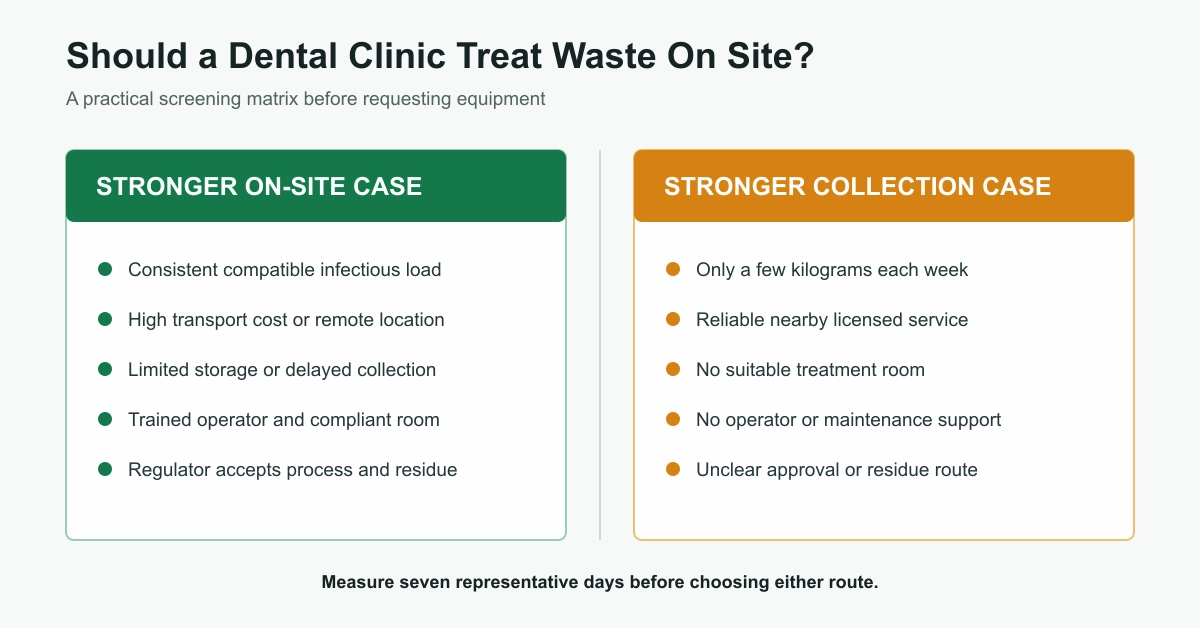
On-site dental waste treatment can solve real problems, but only when the clinic has enough compatible waste and enough operational discipline to use the equipment well.
It deserves serious evaluation when:
- A dental hospital or surgical center produces a consistent infectious load.
- A multi-clinic group can use one approved regional hub.
- A remote clinic faces infrequent, expensive or unreliable collection.
- Waste must travel a long distance before treatment.
- Storage space is tight and collected bags remain on site too long.
- The organization wants auditable batch records and less handling between treatment steps.
- Local regulators accept the proposed process and residue route.
It may be the wrong answer when a small practice produces only a few kilograms a week, lacks a trained operator, has no compliant room, or can obtain reliable collection at reasonable cost. Idle equipment still needs maintenance, validation and staff attention. A machine that runs once every few weeks may also conflict with storage-time limits.
The economic comparison should include collection frequency, transport distance, contractor minimum charges, storage, staff time, utilities, maintenance, validation and downtime. A low purchase price cannot repair a poor workflow.
How frictional heat treatment fits a dental setting
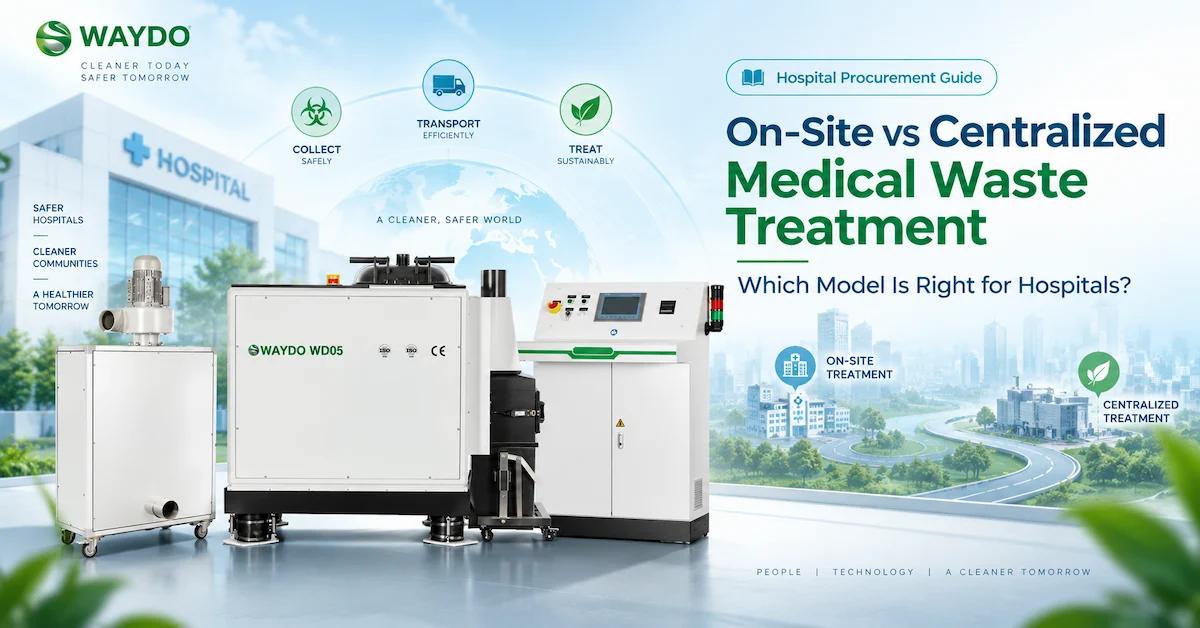
WAYDO's Frictional Heat Treatment, or FHT, combines shredding, mixing and thermal treatment in one vessel. A rotor first reduces and mixes the load. As speed rises, mechanical friction generates heat within the moving material. The published process then holds the treatment phase, introduces water for cooling and automatically discharges a dry, shredded residue.
According to WAYDO's public FHT process description, the operating temperature reaches 150 C, the cycle takes about 25 to 35 minutes and the claimed microbial reduction is 6 Log10 under the referenced STAATT Level IV criteria. Published volume and weight reductions are “up to” 80% and 30%, respectively, and vary with the load. These are screening figures, not a substitute for model-specific reports, site acceptance tests or local approval.
For a dental facility, integrated shredding is relevant because masks, tubing, gauze and small disposable items can occupy far more bin space than their weight suggests. Shredding also makes the output unrecognizable. The absence of an external steam boiler may simplify some installations. At another site, an existing central autoclave could remain the better choice. Infrastructure decides more than fashion.
The correct phrase is dental medical waste sterilization, not “put everything dental into a sterilizer.” The clinic must first remove streams that are incompatible with heat, unsafe for the equipment or assigned to another regulated route.
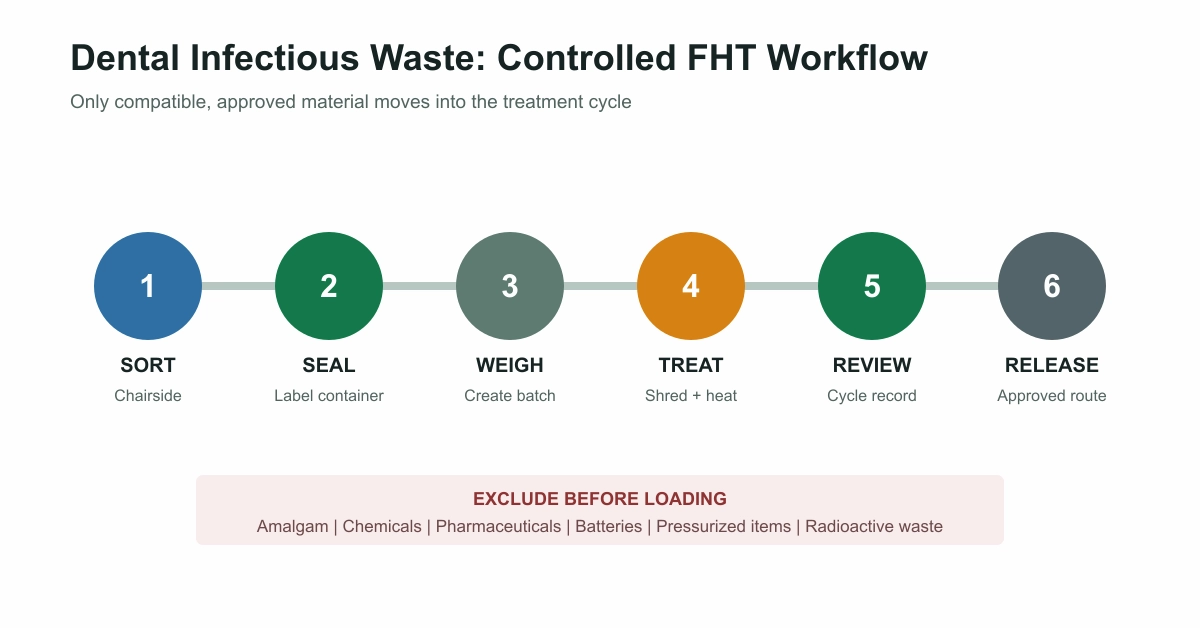
A practical FHT workflow
- Segregate waste at the dental chair.
- Seal and label compatible infectious material.
- Move it in a closed cart to controlled storage or the treatment room.
- Weigh the load and create the batch record.
- Verify that prohibited materials are absent without reopening or hand-sorting bags.
- Load the validated quantity and select the approved cycle.
- Review cycle data and alarms before release.
- Move treated residue through the locally approved final route.
Request a Dental Waste Workflow Review
Dental sharps need a two-stage answer
Dental sharps waste treatment begins at the chair, not inside the treatment chamber. Needles, blades, contaminated burs and sharp wire ends go directly into an approved sharps container. They should not be pushed down by hand, transferred loosely into another bin or recapped except under narrowly defined procedures allowed by the applicable safety rules.
When the container reaches its fill line, staff close it and follow the approved collection route. If a clinic wants to process closed sharps containers in an on-site system, it needs written answers to several questions:
- Does the manufacturer accept the container material and its complete contents?
- Is the loading method designed to avoid reopening the container?
- Has the cycle been validated with the density and geometry of a representative sharps load?
- Can the rotor and vessel tolerate the expected metal and glass fraction?
- What particle size and sharp-edge condition remain after treatment?
- Does the regulator allow that residue to enter the proposed final destination?
WAYDO's treatable-materials page lists selected needles, syringes, scalpels, blades and lancets after proper collection. That public list is a useful starting point, not blanket permission for every dental sharp or container. Orthodontic wire, rotary instruments and unusual metal components deserve model-specific confirmation.
The best sharps process is the one that never asks a worker to improvise. If a proposed workflow requires staff to reopen a closed container, manually pick out metal or reach into residue, the workflow needs redesign.
What must stay out of a general infectious-waste treatment load
The most important purchasing question is sometimes, “What will this machine not treat?” Dental facilities should establish separate written routes for at least the following materials.
Amalgam and mercury-bearing material
Amalgam waste belongs in a mercury recovery or recycling route, not in a routine heat-treatment batch. This includes scrap amalgam, chairside trap contents, vacuum pump filters and extracted teeth containing amalgam. Heating can create a mercury-vapor concern. Keep the container closed, use the required separator and follow the recycler's instructions.
The CDC specifically advises that extracted teeth with amalgam should not be heat sterilized and should not enter a waste route using heat or incineration. Extracted teeth without amalgam still require handling according to local medical-waste rules; a tooth retained for teaching follows a different preparation and sterilization protocol from a tooth being discarded.
Chemicals and imaging liquids
Do not pour leftover disinfectants, etchants, solvents, fixer or developer into an infectious-waste load simply because the container is small. Chemical compatibility, wastewater rules and hazardous-waste classifications apply. Digital imaging has reduced liquid photographic waste, but it has not erased chemical waste from every practice.
Pharmaceuticals and anesthetic products
Expired drugs, controlled substances and partly used pharmaceuticals follow jurisdiction-specific return or destruction routes. A thermal system approved for infectious soft waste is not automatically approved for pharmaceuticals. Keep inventory control, reverse distribution and waste treatment as distinct responsibilities.
Batteries, electronics and pressurized items
Batteries, electronic sensors, aerosol cans, gas cartridges and other pressurized or energy-storing items can damage equipment or introduce fire and explosion hazards. WAYDO's public materials list excludes flammable or explosive compounds. A pre-load checklist should say this plainly.
Radioactive or cytotoxic waste
These streams require specialist controls and should not enter a general dental infectious-waste cycle. Even when they are rare in ordinary dentistry, referral centers and hospital departments should keep them in the exclusion list.
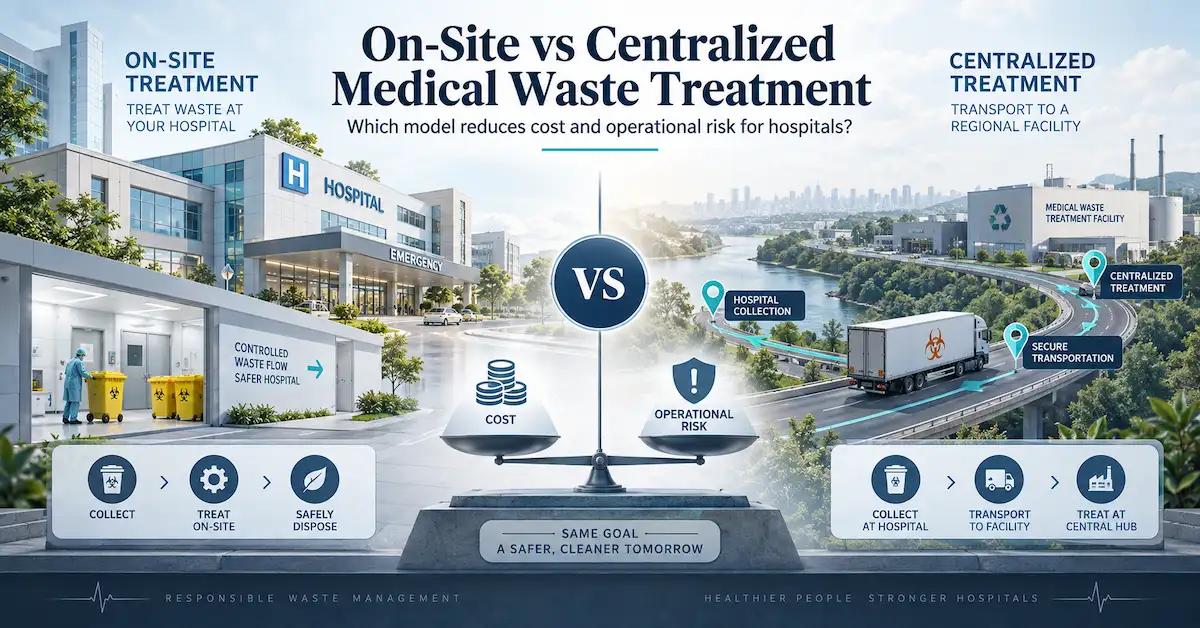
Comparing collection, autoclaving and FHT
No single route wins for every dental clinic. The comparison below is more useful than a generic “best equipment” list.
| Decision factor | Licensed off-site collection | On-site autoclave | On-site WAYDO FHT |
|---|---|---|---|
| Best initial fit | Low or irregular waste volume | Site already has steam skills and a validated chamber | Consistent compatible load; integrated shredding is valuable |
| Upfront equipment | Low at the clinic | Chamber plus utilities; shredder may be separate | Treatment vessel with integrated shredding |
| Storage before treatment | Until collection | Until a viable cycle is ready | Until a viable cycle is ready |
| Physical destruction | Per contractor's downstream process | Not inherent unless shredding is included | Integrated into the published process |
| Main operating control | Packaging, manifests and pickup reliability | Air removal, steam penetration and pressure-system maintenance | Load mixing, rotor condition, temperature profile and blade maintenance |
| Utility question | Minimal on-site treatment utilities | Steam or steam generation, water, drainage and ventilation | Electricity, cooling water, drainage and ventilation as specified |
| Good reason to choose it | Reliable local service costs less than ownership | Existing infrastructure lowers lifecycle cost | Fewer treatment steps and no external steam boiler solve site constraints |
This is the heart of non-incineration dental waste treatment: choose the route that can be validated, operated and supported at the facility, then keep excluded materials out of it. “Non-incineration” describes a family of technologies, not an automatic approval.
Sizing WAYDO equipment for clinics and dental groups
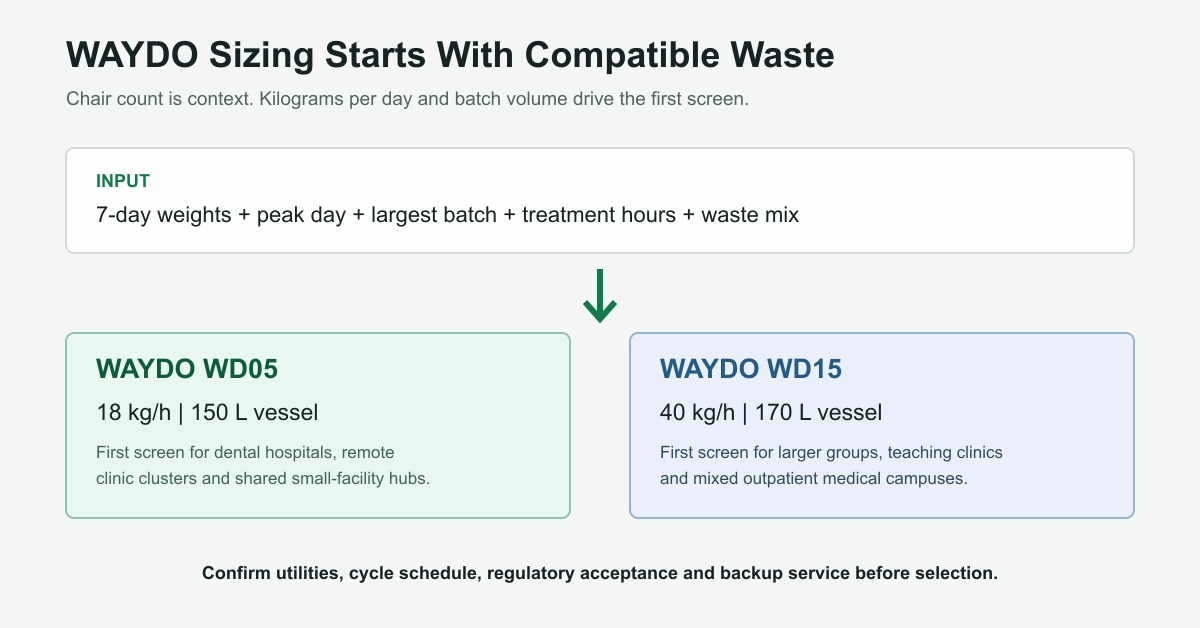
WAYDO publishes four product sizes, but chair count is a poor substitute for weighed waste. For clinics and dental facilities, the WAYDO WD05 and WAYDO WD15 are the first models to screen; larger units are more likely to serve hospital campuses or centralized projects.
| Model | Published capacity | Vessel volume | Published dimensions | First screening conversation |
|---|---|---|---|---|
| WAYDO WD05 | 18 kg/h | 150 L | 1590 x 780 x 1880 mm | Dental hospital, multi-chair center, remote clinic cluster or shared small-facility hub |
| WAYDO WD15 | 40 kg/h | 170 L | 1590 x 780 x 1995 mm | Larger dental group, teaching clinic, community medical center or mixed outpatient campus |
| WAYDO WD50 | 115 kg/h | 450 L | 2475 x 1200 x 2780 mm | Hospital or regional treatment project with substantially higher volume |
| WAYDO WD330 | 280 kg/h | 670 L | 2475 x 1200 x 3080 mm | Centralized or large institutional project, not a typical dental office |
Published hourly capacity should not be multiplied by 24 and treated as guaranteed daily output. Loading, cycle time, checks, cooling, unloading, cleaning, maintenance and working hours all reduce theoretical throughput. Waste density also matters: 10 kg of light protective material occupies a different volume from 10 kg of wet gauze and rigid plastic.
A useful sizing calculation is:
Required shift capacity = peak compatible waste per day / available treatment hours
Then test the result against vessel volume, largest batch, cycle schedule and a realistic utilization margin. If the smallest unit is dramatically larger than the clinic's peak load, shared treatment or collection may be financially stronger. If several branches will supply one hub, include transport permits, sealed-container logistics and chain-of-custody records in the design.
Discuss WD05 or WD15 Sizing With WAYDO
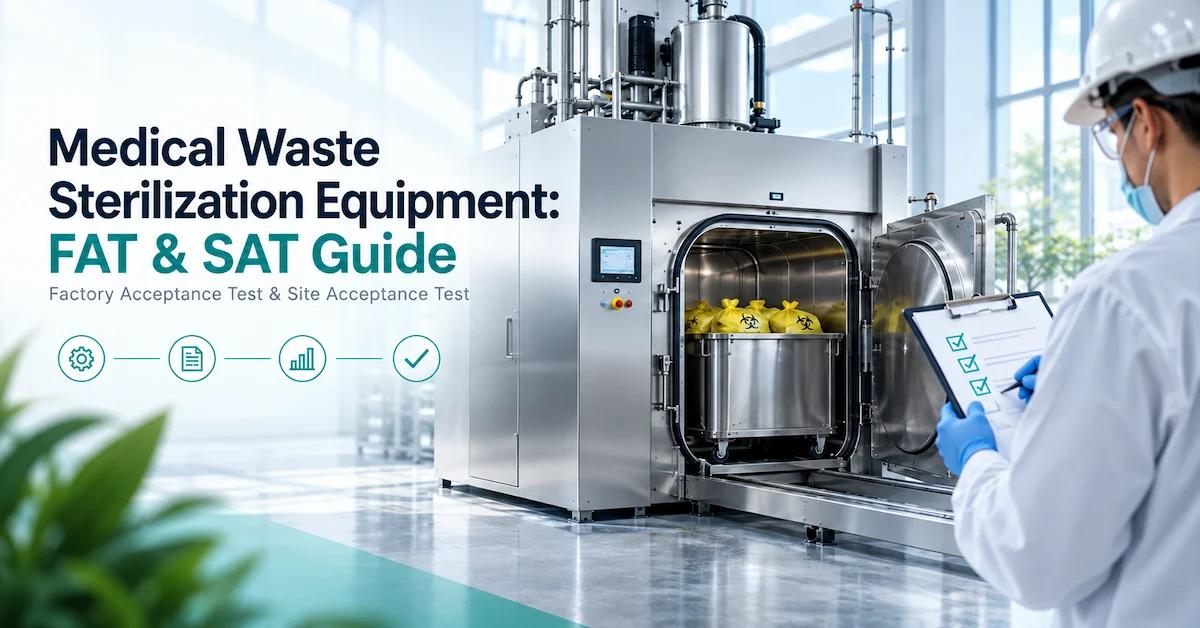
Validate the process before routine use
Temperature alone does not release a batch. Validation must connect a defined waste load, approved packaging, loading pattern, cycle parameters, biological challenge and acceptance criterion. The clinic also needs a response for interrupted or failed cycles.
Ask a supplier for:
- The model-specific validation protocol and report.
- The biological indicator organism and challenge level.
- Sensor locations and calibration schedule.
- Accepted minimum and maximum batch conditions.
- Evidence for difficult loads, including wet textiles and dense sharps containers where applicable.
- Alarm logic, data retention and failed-cycle quarantine procedure.
- Installation qualification, operational qualification and performance qualification support where required.
- Operator training records and preventive-maintenance intervals.
For FHT, add questions about blade wear, rotor speed, torque, particle-size distribution and mixing uniformity. For an autoclave, focus on air removal, steam quality, cold spots and penetration. Both methods depend on representative loads. A demonstration with a light, carefully arranged bag cannot validate a dense batch produced on oral-surgery day.
Calculate lifecycle cost, not chamber price
Equipment quotations are easy to compare and easy to misunderstand. Build a five- or ten-year model around the whole route.
| Cost group | Questions to include |
|---|---|
| Installation | Room work, delivery path, rigging, electrical upgrade, water, drainage, ventilation and commissioning |
| Operation | Electricity or steam, water, labor, record review, cleaning and residue handling |
| Compliance | Permits, validation, biological monitoring, calibration, inspections and record retention |
| Maintenance | Blades, seals, bearings, filters, sensors, service travel, remote support and spare-parts stock |
| Current route avoided | Containers, pickup fees, distance surcharges, storage space and emergency collections |
| Risk and continuity | Downtime, backup collection, overflow storage and response to a failed cycle |
Use local invoices rather than generic savings percentages. A remote dental hospital paying for long-distance collection may justify on-site equipment at a relatively modest volume. An urban clinic with weekly collection and little storage pressure may not. The honest answer can still lead to a useful inquiry: a supplier should be able to explain why a project does or does not fit.
A 30-day implementation plan
Buying equipment is not the first step. A practical first month looks like this:
Days 1-5: assign ownership
Name one clinical lead, one facilities contact and one person responsible for waste records. Collect the applicable rules, contractor requirements and existing manifests. Photograph container locations without including patients or sensitive records.
Days 6-12: map and weigh
Follow each waste stream from chairside to pickup. Run the seven-day measurement described earlier. Note door widths, elevator limits, floor loading, power, water, drainage and ventilation in any proposed treatment room.
Days 13-18: correct segregation
Move containers where staff actually need them, simplify labels and retrain the team. Repeat a short waste check. The reduction in incorrectly classified material often changes the business case before a machine is selected.
Days 19-24: compare routes
Ask the collection contractor for transparent pricing and service limits. Ask equipment suppliers for a written acceptance matrix, model data, installation interfaces, validation support, maintenance requirements and local references that can be verified.
Days 25-30: test the operating plan
Draft one normal-day schedule and one peak-day schedule. Include operator absence, power loss, failed cycles and collection backup. Send the plan to the regulator or authorized adviser before issuing a purchase order.
This sequence turns dental clinic medical waste treatment from an equipment hunt into an operating decision.
Questions dental clinic owners usually ask
Does every dental clinic need an on-site medical waste treatment machine?
No. Small or low-volume clinics may be better served by compliant segregation and licensed collection. On-site equipment is more likely to fit dental hospitals, busy surgical practices, remote sites, teaching centers or groups sharing a treatment hub. Waste weight, collection cost and local approval should decide.
Can ordinary instrument autoclaves be used for dental waste?
Do not assume so. Instrument reprocessing and regulated-waste treatment have different loading, validation, packaging, residue and permitting requirements. A clinic should use equipment specifically approved and validated for its intended waste process. Mixing the two workflows can compromise both.
Can FHT treat dental needles and scalpel blades?
WAYDO publicly lists selected sharps after proper collection among potentially treatable materials. The clinic still needs model-specific written acceptance for the exact sharps container and contents, along with regulatory approval and a validated loading method that does not expose workers.
Can extracted teeth go into the treatment system?
It depends on local rules, the intended destination and the tooth. Extracted teeth containing amalgam must stay out of heat treatment because of the mercury concern. Teeth without amalgam may still be regulated medical waste and require an approved route. Teeth retained for education have a separate handling protocol.
What is the biggest segregation error in a dental practice?
Using the infectious-waste bag as a catch-all is a common and expensive error. Clean packaging inflates treatment volume; sharps create injury risks; amalgam and chemicals make the load incompatible. Clear chairside containers and short, repeated training sessions correct more than a poster in the storage room.
Is on-site treatment cheaper than collection?
Sometimes. It depends on compatible kilograms per day, pickup charges, transport distance, utility costs, labor, maintenance, validation and backup service. Compare five- or ten-year totals. Do not base the decision on a supplier's percentage-saving claim from another country.
What should a clinic send when requesting a quotation?
Send average and peak compatible waste weights, waste categories, number of chairs, procedures performed, operating days, current collection schedule, room dimensions, door width, electrical supply, water and drainage information, preferred fixed or shared-hub setup, regulatory requirements and desired batch records. Photos of the proposed room can help if they contain no patient information.
How often should dental infectious waste be treated?
Follow local storage-time and temperature rules. Operationally, the clinic needs a schedule that prevents accumulation while producing viable batches. If the volume is too low to run the smallest unit regularly, that is evidence for collection or a shared hub rather than a reason to store waste longer.
Is non-incineration treatment automatically emission-free?
No. Avoiding combustion removes the incinerator stack from the process, but the installation still needs evaluation of ventilation, energy, wastewater, filters, noise and final residue. Ask for model-specific data and local environmental approval instead of relying on an absolute “zero emissions” statement.
Final recommendation
Good dental clinic medical waste treatment begins with a rule simple enough to use while the next patient is waiting: ordinary waste stays ordinary; infectious soft waste is sealed; sharps go directly into a rigid container; amalgam, chemicals and pharmaceuticals leave by separate routes.
Once that discipline is visible in seven days of data, the equipment decision gets easier. Keep licensed collection when volumes are low and service is reliable. Evaluate shared or on-site treatment when compatible waste is consistent, storage or transport is a real burden, and the organization can support validation and maintenance. For FHT, screen the WD05 or WD15 against kilograms per day and vessel volume, then confirm every dental input in writing.
The best system is not the one with the longest feature list. It is the one the clinic can segregate, operate, validate, service and document on an ordinary working day.