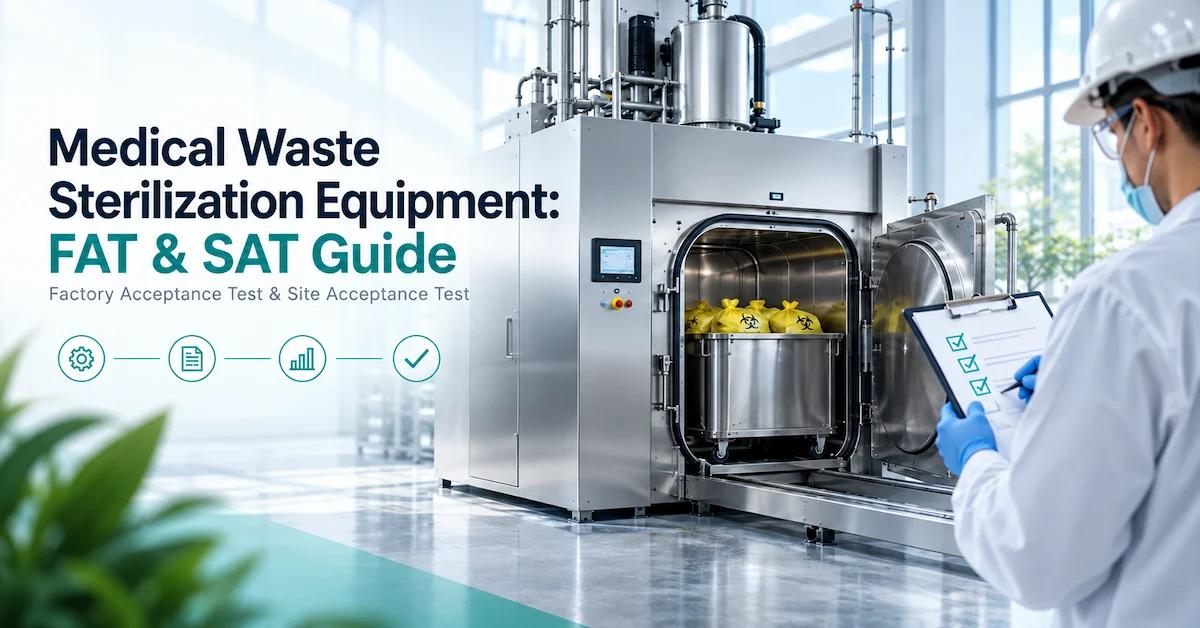

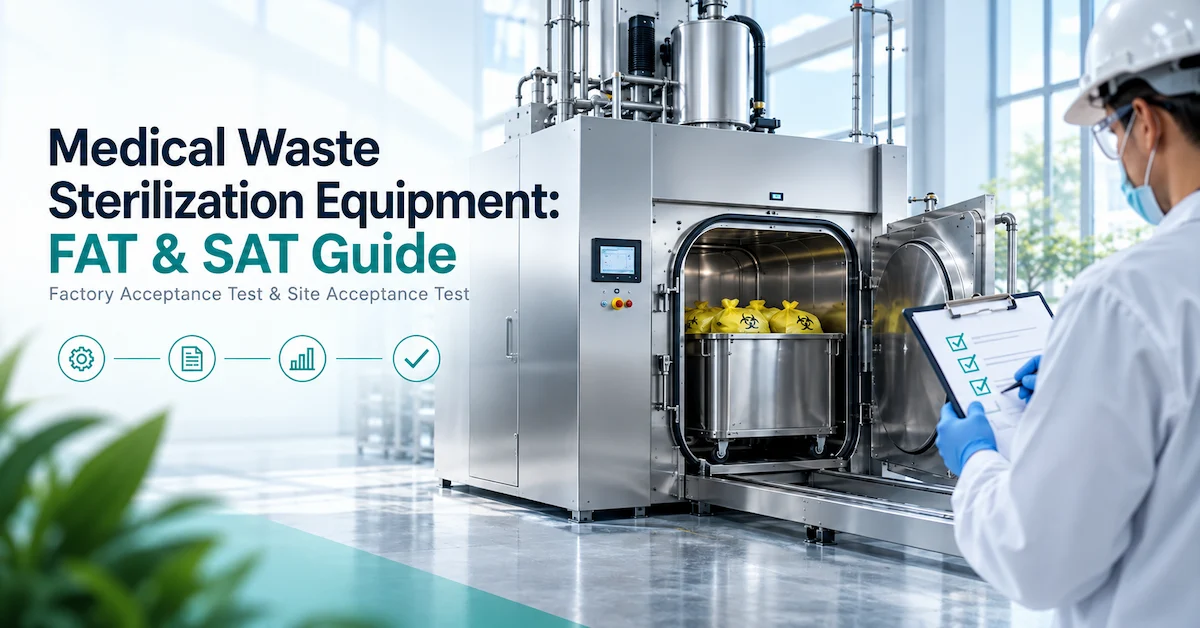
Quick answer: Accept medical waste sterilization equipment only after the supplier and hospital agree which waste is eligible, how a representative difficult load will be challenged, what constitutes a passed cycle, and what happens to a failed or unverified batch. A factory acceptance test (FAT) checks the named machine and its documented functions before shipment. A site acceptance test (SAT) checks the installed machine, utilities, safety functions and workflow. Performance qualification then challenges the actual permitted waste families at the proposed operating limits.
At a glance: write the waste boundary; freeze the installed configuration; agree the challenge load and acceptance criteria before the test; witness FAT and SAT; qualify the process with traceable samples and records; train the operators; establish a failed-load route; and release the system only after the designated hospital and regulatory signatories have reviewed the evidence. An RFQ should price all of those activities, not just the vessel.
1. Define the treatment boundary and manufacturer scope
Why does acceptance deserve its own buying decision?
A hospital may have already selected a technology and compared quotations, yet still be unable to answer a simple opening-day question: "Can this exact machine treat today's closed containers in this room, on this shift, with a result we can document?" That is the gap between a supplier's general capability and an accepted site process. The purpose of acceptance is to close it in a way that survives staff turnover, a maintenance intervention, a difficult load and an audit.
The earlier purchase decision asks whether a solution looks appropriate. Acceptance asks whether the delivered configuration works under defined conditions. A factory demonstration can show that a door interlock works, while the installed room may have a blocked loading route. A biological challenge may support microbial inactivation for one matrix, while the hospital's dense sharps container has different shielding and handling characteristics. A rated hourly capacity can look sufficient until weighing, loading, cooldown, cleaning and batch review are included. None of these observations means the technology is inherently poor. They mean the buyer needs a documented boundary for its claim.
The World Health Organization (WHO) distinguishes ordinary health-care waste from the hazardous fraction and recommends consideration of appropriate non-incineration alternatives where facilities can operate and maintain them and manage the treated output. Its health-care waste fact sheet also describes different infectious, sharps, chemical, pharmaceutical, cytotoxic, pathological and radioactive streams. The U.S. CDC's regulated medical waste guidance emphasizes containment, worker protection and category-specific treatment, and notes that medical waste need not meet the reprocessing standard for surgical instruments. These sources explain why an attractive phrase such as "sterilizes all medical waste" is not a usable site acceptance criterion for hospital medical waste sterilization.
This article focuses on the practical evidence a purchaser should request after shortlisting medical waste sterilization equipment for a hospital or shared treatment facility. For a technology-neutral procurement document, see the site's hospital RFP requirements guide. For a first-pass estimate of kilograms and operating hours, use the capacity calculation guide. Here we go further into the handover tests, records and decisions that determine whether the equipment can be released into routine use.
The manufacturer, technology and application in this guide
Zhejiang Weidun Environmental Protection Technology Co., Ltd. is based in Hangzhou, Zhejiang, China and presents its WAYDO range for infectious medical waste treatment. Its public FHT technology description and five-stage process describe loading and pre-shredding, frictional heating, a treatment phase, cooling and discharge. Its public treatable-materials page names example clinical and laboratory streams and exclusions. These are manufacturer statements useful for planning questions; they are not, by themselves, a project-specific approval, witnessed qualification record or independent certification for a buyer's load.
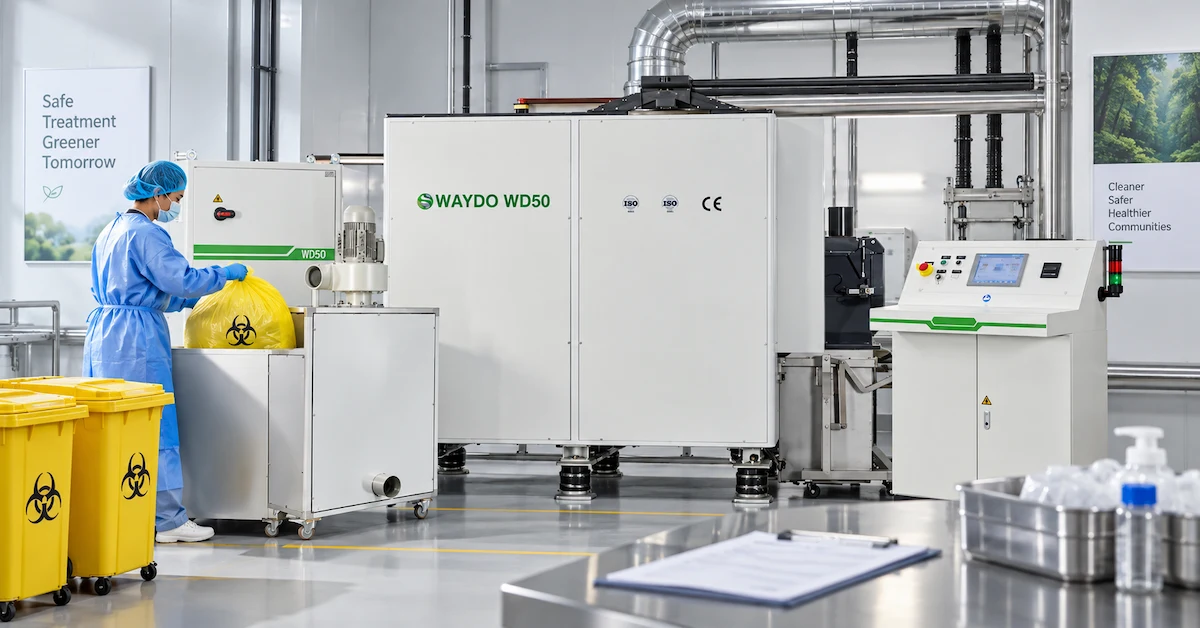
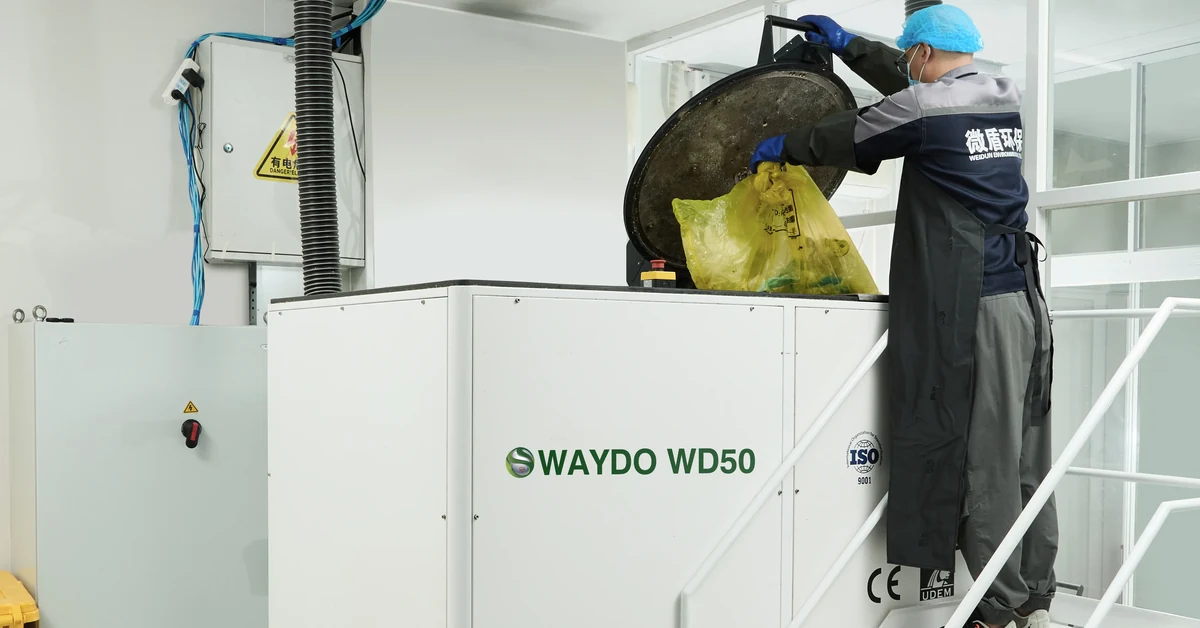
The published range includes WAYDO WD05, WD15, WD50 and WD330. A hospital buyer investigating FHT medical waste treatment equipment may use the WD50 as a configuration discussion; a small facility or regional operator may consider a different model. The correct model depends on measured mass and occupied volume, peak-day demand, waste composition, accepted packaging, operating hours, utilities and local authorization. Request a revision-controlled data sheet and a project-specific material acceptance matrix for the exact model and options quoted.
The manufacturer's public process page states a 150°C treatment phase, a "6 Log10" efficacy claim, a 25-35 minute cycle and variable volume and weight reduction figures. Do not insert those numbers into a purchase specification without obtaining the test organism, initial population, sample location, load composition, replication, method, independent laboratory report where available, and the exact model and cycle version. The same page's broad "international regulations" language is not a substitute for the receiving country's permission. Ask which statements are guaranteed for your proposed feed and which are illustrative.
The public product pages do not establish a universally applicable MOQ, delivery lead time, installed electrical demand, service response guarantee or buyer-specific qualification package. Those are RFQ questions. An engineering conversation becomes valuable when it turns a public model description into a signed, site-specific answer.
First define the treatment boundary
Before writing FAT steps, put a line around the waste that may enter the system. Define the source department; local legal classification; type of bag or container; maximum mass and occupied volume per batch; moisture and free-liquid limit; glass and metal fraction; any required source-laboratory pretreatment; and the allowed destination for treated residue. Separate "supported by current evidence" from "promising but awaiting a challenge test." A specification that merely says "hospital waste" is too wide to validate.
The boundary must distinguish microbiological risk from other hazards. Infectious dressings, disposable PPE and some laboratory materials may be plausible treatment candidates under a specific validated process. Pharmaceuticals, cytotoxic agents, chemical solvents, radioactive materials and some anatomical waste can retain their non-biological hazards after microbial treatment. They require separate assessment and often a different authorized route. Do not infer that a listing on a manufacturer's materials page overrides a hospital's biosafety rule, permit or local law.
CDC guidance gives special attention to untreated cultures and amplified microbial populations, recommending on-site decontamination for certain high-risk laboratory material, preferably within the laboratory unit where appropriate. It also highlights the injury risk from sharps and the importance of puncture-resistant containers. When reviewing infectious waste sterilization equipment, ask how the process prevents exposure and aerosol release before inactivation if it begins with shredding. Never have staff open a sharps container or sort a sealed infectious bag by hand merely to make a demonstration look easier. A challenge protocol has to fit safe, lawful handling.
| Waste family | Buyer-supplied evidence | Acceptance question | Default if unanswered |
|---|---|---|---|
| Routine infectious solids | Bag type, mass, fill and department | Is this bag configuration inside the validated load envelope? | Hold for a written limit and trial |
| Closed sharps containers | Container size, polymer, closure and metal content | May the intact container enter, and what protects staff at loading? | Use the existing authorized route |
| Laboratory cultures | Agent risk assessment and source-lab policy | Must they be inactivated before leaving the laboratory? | Do not route into the general trial |
| Wet or dense solids | Free-liquid, absorbents and nested components | What represents the least favorable heat or mixing condition? | Challenge separately |
| Medicines, cytotoxic or chemical waste | Hazard classification and current disposal route | Does the process address the non-biological hazard? | Exclude unless independently authorized |
| Radioactive or explosive material | Radiation or safety officer determination | Is any acceptance lawful and technically demonstrated? | Exclude |
The buyer should sign this matrix with infection prevention, laboratory biosafety where relevant, environmental compliance and the operations owner. The supplier should mark every line accepted, conditionally accepted, excluded or awaiting evidence. Revision control matters: a changed bag, a new department or a changed cycle may invalidate an earlier conclusion. The boundary is not a marketing list; it is the basis for the test and the later operator instruction.
2. Approve FAT, SAT and qualification gates
What does each acceptance gate prove?
Factory acceptance testing (FAT)
FAT asks, "Was the named, configured machine assembled and functionally tested before shipment?" It can cover identity, dimensions, drawings, controls, alarms, interlocks, cycle logs and a safely prepared demonstration load. It cannot prove that the customer's room, utilities, waste and personnel will behave identically. Where a factory challenge uses surrogate material, label it as surrogate material and state what inference is permitted.
Site acceptance testing (SAT)
SAT asks, "After delivery and installation, does the actual system fit and operate safely here?" It checks incoming condition, serial numbers, utility connections, access, ventilation, drainage or water requirements as applicable, emergency stop, guarding, loading and unloading, data capture and integration. A site cannot pass because a supplier emailed its factory video. A failed SAT item should have an owner and a retest record.
Installation, operational and performance qualification
Installation qualification (IQ) records the installed configuration against approved drawings and specifications. Operational qualification (OQ) checks the controls and defined operating ranges. Performance qualification (PQ) tests whether the approved process performs with defined representative and difficult loads under site conditions. These terms are helpful as a document structure, but do not assume a specific pharmaceutical validation standard automatically governs waste equipment. Agree with the local regulator and the hospital quality function what qualification framework and microbiological endpoint apply.
| Stage | Typical evidence | Witness or approver | Decision it supports |
|---|---|---|---|
| Design and protocol approval | Waste matrix, acceptance limits, sampling plan, drawing revision | Hospital quality, engineering, infection prevention, supplier | Tests can begin on a common basis |
| FAT | Serial-numbered checklist, alarms, safety checks, factory deviations | Supplier and buyer witness | Ship or hold |
| IQ/SAT | As-built drawings, utilities, safety and records tests | Site engineering and supplier | Installed system ready for process trials |
| Operational qualification (OQ) | Defined cycle limits, instrument checks, alarm challenges | Quality and technical lead | Controls perform as specified |
| PQ | Challenge loads, biological/microbial method, data and repeat runs | Qualified laboratory and site approver | Approved load families and limits |
| Release | Training, SOPs, maintenance, emergency route and closed deviations | Named hospital authority | Routine operation may start |
Write the protocol before running the test. State the machine ID, software version, option list, load family, maximum and minimum fill, container format, sampling location, target outcome, calibrated instruments, number of runs, deviation process and authorized signatories. If an acceptance criterion is first invented after a disappointing result, the exercise is no longer a fair acceptance test.
Specify what the factory must show before shipment
The factory test should start at the nameplate. Compare the model and serial number with the purchase order, packing list and controlled drawings. Photograph the machine and accessories. Check the footprint, loading height, discharge interface, guards, hoppers and service clearances against the room plan. Request the equipment's electrical and mechanical drawings, spare-parts list, maintenance schedule, recommended consumables, safety instructions and proposed operator manual. Record their revision numbers; a folder of undated PDFs is difficult to audit.
Next, witness the safety functions without placing people at risk. Test emergency stop behavior, guarded access, lid or door interlocks, restart after interruption, power recovery and applicable temperature, motor or water alarms. An alarm should be observable, recorded and tied to an operator action. Ask whether a failed or interrupted cycle can be silently re-labelled as complete, and demonstrate the control that prevents it. A user interface that merely displays a green check mark is not a batch record.
Finally, test the records pathway. Does the system retain a unique batch identifier, date and time, operator identity or role, selected program, relevant process variables, alarms, interruptions and release status? Can a supervisor retrieve and export the record after the operator logs out? Is time synchronized and protected from casual editing? What happens if a printer fails, the network drops or storage fills? Some projects need integration with a hospital information platform; others need a robust local archive. Decide before acceptance who owns the data and how long it must be retained.
A factory demonstration may show a cycle with a clean surrogate load. It should not be represented as proof that the hospital's difficult waste mix is inactivated. If the supplier offers a microbiological report, read the methods section: the machine configuration, organism, inoculum, carrier, placement, matrix, number of replicates and recovery controls must be comparable to the intended claim. Request both successful and failed trial records, not only a certificate cover sheet.
Site readiness: test the room, not just the machine
On-site medical waste sterilization changes a room and a workflow. Trace the path from collection through handover, weighing, storage, loading, treatment, residue holding and authorized removal. Mark where untreated and treated materials can cross, where a clean operator stands and where a failed load is held. Check doorways, floor loading, turning radius, lift access, maintenance clearance, electrical supply, ventilation, water and drainage against the actual model and option drawings. The supplier should identify interfaces provided by others.
Do a dry run with empty representative containers. Can staff maneuver them without opening a bag or lifting a load beyond the approved handling method? Does the loading device accommodate the container the wards actually use? Is there a place for rejected items that will not obstruct the aisle? Is cleaning access possible without dismantling safety guards? Document any room modification and retest affected interfaces. A machine that physically fits while blocking a fire route or preventing safe bin exchange has not passed an operational SAT.
Check the discharge route as carefully as the inlet. A smaller or less recognizable residue is not automatically ordinary municipal waste. Confirm a written, locally approved classification and destination, required sampling or monitoring, packaging and transport paperwork. If energy recovery is proposed, require a specific authorized receiving facility and contract; do not assume the site's waste-to-energy concept is a universal disposal permission. Include a backup pathway for periods when the equipment is offline or a batch is not released.
| Site interface | Evidence to inspect | Failure that should stop acceptance |
|---|---|---|
| Receiving and weighing | Actual container route, scale calibration, handover record | Untraceable load or unsafe movement |
| Utilities | As-built electrical and other service checks | Supply outside named limits |
| Ventilation and containment | Room assessment and equipment safeguards | Uncontrolled exposure during loading or fault |
| Controls and records | Export of real site test records | Missing batch identity or unreviewable alarm |
| Residue | Legal destination and handling plan | No permitted outlet |
| Emergency pathway | Downtime and failed-load contractor | Waste accumulates without a lawful route |
3. Challenge the process under real load
How to design a meaningful challenge load
A challenge load is not simply the heaviest bag the buyer can find. It is a deliberately chosen representation of the hardest permitted material and packaging conditions for a particular process. Mass matters, but so do occupied volume, density, nested components, water content, glass and metal, closed containers, bag thickness and mixing behavior. A light, bulky PPE load may fill the chamber before a nominal mass limit; a compact wet load may be harder to heat uniformly or discharge. The relevant worst case is established by process understanding and evidence, not by intuition alone.
For an FHT process, ask where mechanical action begins relative to inactivation, how the chamber load moves, how the temperature is measured, whether a selected display value reflects every relevant location, and how cooling changes the recorded trace. For a steam autoclave, the difficult condition may be air removal and steam penetration through the chosen packaging. For microwave or other technologies, identify their own critical variables. Do not copy a time-temperature criterion from one technology to another without a validated rationale.
Define at least three load families where relevant: routine mixed infectious solids, the bulkiest approved low-density mix, and a dense or wet approved mix. Add a closed sharps-container challenge only if the supplier and local authority propose that intact format for treatment; otherwise exclude it. If laboratory cultures require source-lab decontamination, do not smuggle them into a general hospital PQ merely because they are a convenient biological challenge. The biosafety officer should control any live biological material and the test laboratory's method.
Document how the challenge is built without exposing workers. Record bag/container brand and dimensions, material categories, mass, occupied volume, moisture estimate or measured method, placement and loading order. Photograph the prepared load where safe and lawful, without patient identifiers. Assign a unique test ID. Use the same approved configuration across repeat runs. If a run fails and the supplier changes the load, the original failure remains in the deviation file; the changed run tests a new condition.
Ask an independent competent laboratory or qualified testing team to propose the microbial challenge organism, carrier, recovery method and controls appropriate to the process and local acceptance endpoint. A stated log reduction is meaningful only with a known starting challenge, detection limit and method. "No growth" without a documented recovery control, sampling position or detection limit is not an independently interpretable result. The project's accepted endpoint should be agreed with the regulator and site quality function before the samples are collected.
Read microbial claims without over-reading them
A microbiological validation report should answer seven questions. What organism or indicator was used? What was its initial challenge level and how was it prepared? In what carrier and waste matrix was it placed? Where in the load was it positioned? What cycle and machine configuration were used? How were surviving organisms recovered and counted, including positive and negative controls? What conclusion follows, and for exactly which load family? If any answer is missing, request the complete method and raw results.
The difference between a claimed process target and a demonstrated batch result matters. A system can have a public statement of a six-log reduction in a specified study. That does not mean every material, every load size and every future site has independently achieved the same result. Conversely, a physical cycle trend that matches a validated envelope may support routine release under an approved monitoring program without re-running a full microbiological challenge for every bag. The local permit and validation plan determine frequency and decision rules.
Do not borrow indicators indiscriminately. A biological indicator commonly discussed for steam sterilization may be selected for a waste process only after its relevance to the technology and endpoint is established. The CDC's discussion of regulated medical waste concerns category-specific decontamination, not a promise that all waste must be rendered surgically sterile. Ask the qualified microbiologist to distinguish microbial inactivation, disinfection, sterilization terminology, physical shredding and visual unrecognizability. Those are different outcomes.
Record sample handling and chain of custody. A laboratory result detached from a batch ID, load photograph and cycle trace is weak evidence. Include controls for transport and recovery, the uncertainty or detection limit where reported, and a procedure for an inconclusive sample. If the laboratory's method changes between factory and site trials, explain why. The conclusion should identify accepted waste and loading limits, not merely say "test passed."
Capacity acceptance: prove the shift can clear the peak
The throughput question is operational: can the approved process clear the hospital's compatible peak-day load within the staffed treatment window while allowing for handling and record review? A manufacturer's nominal kilograms per hour can be a useful shortlist figure. It is not a guaranteed site duty for every density and container. Require a witnessed or otherwise defensible cycle schedule for the selected challenging and routine loads.
For an illustrative, not model-specific, calculation, suppose the approved compatible peak is 420 kg in an eight-hour staffed window. If the agreed validated load is 35 kg per batch and the complete door-to-door cycle, including loading, cooling, discharge and a short record check, takes 38 minutes, the arithmetic minimum is 12 batches and 456 minutes. That leaves only 24 minutes for cleaning, changeovers, rejected items and interruptions. The project would need a larger approved load, a longer staffed window, a parallel system or an off-site backup. The example deliberately does not claim that any WAYDO model has a 35 kg validated batch or a 38-minute complete site cycle.
Now test occupied volume. If a bag family reaches the accepted fill line at 22 kg, the same 420 kg requires at least 20 cycles even though the machine's mass limit has not been reached. At 38 minutes per cycle, that is 760 minutes. This is why the hospital should provide both kilograms and liters and why a single demonstration with dense material is insufficient. Treat each waste family as a separate schedule input, and use realistic shift handovers and downtime.
| Quantity | Buyer records | Supplier must show |
|---|---|---|
| Average and peak compatible mass | Daily weighing, including exceptional days | Accepted load family and feasible cycle count |
| Occupied volume | Container count, fill and dimensions | Volume or fill limit, not just kilograms |
| Complete cycle | Loading through release-ready discharge | Witnessed time and sources of variation |
| Operating window | Staffed hours and storage limit | Peak-day schedule with contingency |
| Availability | Planned maintenance and fault response | Spare parts, service and backup route |
If the proposed system needs a second shift, say so in the RFQ and lifecycle calculation. If a supplier proposes a faster cycle, ask whether that cycle is the same one used in microbial qualification and whether cooling, discharge and record review have been included. A purchased capacity that depends on skipping an acceptance step is not usable capacity.
4. Keep every batch auditable
Records, alarms and batch release
A routine treatment log should let an independent reviewer reconstruct what entered, what process ran and what left. At minimum, link the collection or handover record to the batch ID, machine and program, operator, load family, weight or count, start and end time, relevant physical trace, alarms and disposition. The site should be able to tell whether a batch was accepted, held, reprocessed under an approved rule or sent to an alternative authorized route.
Write an alarm matrix during OQ. For each alarm, describe the triggering condition, equipment response, operator instruction, whether the cycle is invalid, the clearance authority and the record field. Test representative alarms without endangering personnel. A temperature sensor fault, motor overload, open lid, interrupted power and full data storage should not all produce the same ambiguous "reset" instruction. A skipped or lost record should be a deviation, not a silent gap in the monthly report.
Release authority should be separated from running the machine where the project's risk assessment requires it. Specify whether an operator can release a normal cycle, whether a supervisor must review alarms, and who signs off a microbiological qualification result. Define the retention period according to local law and the hospital's records policy. Test a retrieval request at SAT: ask for the third test run, its load description, alarm history and export. If it cannot be retrieved, the data system is not ready.
Protect against software changes. Record the installed software and control recipe version at FAT and SAT. A later update to temperature logic, mixing speed, dwell rule, sensor calibration, container geometry or loading procedure may require change control and partial or complete requalification. Keep a baseline copy of the approved SOP and program settings. The service contract should say who can alter them and who must authorize the change.
What to do when a test fails
Failures are useful information only when they remain visible. Quarantine the affected load and residue under the site's untreated-waste precautions until an authorized decision is made. Do not mix questionable output with released material. Preserve the raw cycle trace, alarm logs, sample identifiers, operator notes and photographs. Notify the named quality and supplier contacts. Determine whether the issue is an instrumentation fault, an unsuitable load, a process failure, a sampling problem or a protocol ambiguity.
Document a deviation with an impact assessment. What other batches were run with the same configuration? Did a sensor drift before the failed test? Was the difficult material within the agreed acceptance boundary? A corrective action may involve repair, revised loading, a narrower accepted waste list, retraining or a new cycle. Each has a different qualification consequence. A replacement "good" run does not erase the first failure; the file should explain the cause and the basis for retest.
Have a lawful fallback before the first live run. The hospital's existing licensed contractor may be needed for untreated waste during commissioning, downtime or failed qualification. Specify storage limits, packaging, collection response and cost ownership. A supplier's promise to troubleshoot remotely does not itself prevent waste accumulation on the ward. Test the communication tree, especially if the hospital operates nights and weekends.
If the qualification cannot demonstrate a proposed stream, accept a narrower scope rather than asserting a universal pass. A hospital can release a machine for well-supported routine infectious solids while maintaining a separate route for other classes, provided the local authority and contract allow it. The agreement should define any price, capacity and warranty effect of the narrowed scope.
5. Compare suppliers and send an actionable RFQ
Compare technologies through the same acceptance lens
Different medical waste sterilization technology options can reach an appropriate endpoint through different mechanisms. Steam relies on the validated interaction of heat, moisture and penetration. Frictional heat treatment relies on the machine's specified mechanical and thermal process. Microwave systems and other non-incineration medical waste treatment methods have their own critical parameters and material limits. An honest comparison does not insist on identical sensor traces. It insists that each supplier identify the process variables, difficult load, measurable endpoint and evidence relevant to its mechanism. The links show particular FHT models, not every technology named in this comparison.
| Buyer question | Steam-based answer should cover | FHT-based answer should cover |
|---|---|---|
| How does the difficult material receive treatment? | Air removal, steam contact, container and packing | Mechanical mixing, particle reduction and heat history |
| What physical variables are recorded? | Cycle time, temperature, pressure and applicable phases | Cycle time, temperatures and relevant motor/process status |
| What is the boundary? | Packaging, wet/dry loads, sharps and vessel limits | Accepted feed, hard materials, free liquids and mixing limits |
| How is biological performance shown? | Appropriate challenge placements and recovery controls | Appropriate challenge placements and recovery controls |
| What happens after a fault? | Hold, investigate and approved reprocess or diversion | Hold, investigate and approved reprocess or diversion |
This is not a claim that one method is always better. A hospital comparing an autoclave and FHT should ask each bidder to price the same approved waste matrix, throughput window, civil works, training, qualification, consumables, maintenance and residue route. The WHO's preference to consider suitable alternatives to incineration does not exempt any technology from site-specific review. There may also be cases in which off-site treatment is more practical than an on-site installation.
An acceptance-oriented RFQ that attracts a serious supplier
The strongest inquiry gives a supplier enough to produce a specific answer without disclosing unnecessary patient information. Start with the hospital location and applicable authority, whether the project is on-site or a shared facility, the intended installation date and the decision stage. Provide a high-level waste matrix, seven or more representative days of mass and volume where available, an observed peak, container dimensions, operating window and room/utility plan. State any streams that are excluded by the hospital's policy.
Ask for a named model and option list, controlled drawings, feed acceptance matrix, proposed complete-cycle schedule and evidence package. Request the actual available FAT and SAT templates, a draft IQ/OQ/PQ or equivalent protocol, sample test report with redactions if necessary, monitoring and failed-load SOP, operator-training scope, spare-parts list, warranty and service coverage. Ask which tests are included in the price, who pays the laboratory, how many witness days are included and how retests are handled. Ask for an itemized installed price and realistic delivery and commissioning dates; do not accept invented generic lead times.
An inquiry should also ask for the project-specific residue route and regulatory responsibility split. Which party prepares the technical submission? Who obtains site approval? Who contracts the final receiver? Who bears the cost if the approved load range is narrower than proposed? A responsive supplier will identify assumptions and exclusions. That is more valuable than a one-page promise of "complete compliance."
| RFQ attachment | Why it improves the quotation |
|---|---|
| Waste matrix and photographs of empty containers | Narrows accepted feed and loading options |
| Daily and peak mass plus occupied volume | Makes capacity calculation testable |
| Room drawing, access route and utilities | Exposes site-work and equipment interface costs |
| Proposed acceptance endpoint and local authority | Aligns test method with permission |
| Shift schedule and storage limit | Tests real operating capacity |
| Requested documents and witness plan | Makes FAT, SAT and qualification comparable |
| Service geography and backup contractor | Makes downtime risk visible |
Do not send patient-identifiable waste photographs or clinical records to a sales inbox. Aggregate the data and remove names and labels. If measurements are not yet available, say so and request a site assessment. The Weidun services page describes capacity sizing and layout support; the buyer should confirm the scope and deliverables in writing for the proposed project.
Ready to compare a named WAYDO model? Send your permitted waste families, average and peak mass, container dimensions, room plan and jurisdiction. Ask for the feed boundary, test evidence and a priced FAT/SAT scope.
Request a Model-Specific Proposal
6. Plan handover and long-term operation
A practical four-stage handover sequence
The following schedule is a planning framework, not a promised installation duration. Actual dates depend on equipment delivery, room works, laboratory availability and authority decisions. The value of a calendar is to reveal dependencies: live waste trials cannot be scheduled responsibly before the room, training, containment and fallback route are ready.
Before delivery
Approve the waste matrix, room design, protocol, witness list and document index. Obtain the relevant drawings, certificates and prior test methods for review. Confirm the receiving and storage plan. Assign an owner to every utility and contractor interface. Decide how deviations will be logged. Do not postpone the endpoint discussion until a laboratory invoice arrives.
Arrival and installation
Photograph incoming condition, verify serial numbers and accessories, check transport damage, position the system and complete utilities. Update as-built drawings and asset records. Perform safety and dry-run SAT before introducing potentially infectious material. Train the operators in segregation, loading, alarm response, cleaning and emergency shutdown. Practice the failed-load route with an empty container.
Process trials
First establish the approved recipe and ordinary load behavior, then the agreed difficult loads. Use controlled batch IDs, calibrated instruments and the laboratory's approved sampling and recovery method. Review each run before proceeding if the protocol requires it. Hold all trial output under the agreed rule until its status is known. Capture deviations immediately, not at the end of the month.
Release and early operation
Close critical deviations, sign the approved waste envelope and SOP, archive the qualification report and create a maintenance and monitoring calendar. Run an intensified initial review period if required by the site plan. Audit several ordinary batch records against collection logs. Confirm that service contacts answer, spare parts can be obtained and the licensed backup route still exists.
| Handover artifact | Who should own it after departure | Review trigger |
|---|---|---|
| Waste acceptance matrix | Environmental and infection-prevention leads | New stream or container |
| As-built drawings and model configuration | Facilities engineering | Repair or modification |
| Qualified cycle and challenge report | Quality/technical authority | Process or load change |
| Operator SOP and training records | Operations manager | Staff or procedure change |
| Batch records and alarm log | Records owner | Routine audit or deviation |
| Maintenance and calibration plan | Engineering and supplier | Scheduled service |
| Fallback and residue contracts | Environmental manager | Contract or permit change |
Lifecycle cost belongs in the acceptance discussion
The purchase price of medical waste treatment equipment is only one part of an accepted system. The hospital may need room changes, electrical work, bins, lift options, ventilation, a laboratory challenge, witness travel, training, consumables, maintenance, replacement components, software support, calibration, periodic monitoring, residue transport and a backup contractor. The linked model is an example for a larger-duty discussion, not a site capacity commitment. An incomplete bid often appears cheapest until the first failed test or stopped line.
Request an installed and qualified price alongside a five-year operating model with stated assumptions. Use site-measured waste mass, density and shifts, not a generic cost-per-kilogram claim. Ask which spare parts are held locally, their prices and expected lead times, and whether the quoted service response covers the hospital's location. A "24/7" phone number is not the same as a technician and part arriving within a contractual period. Define the consequence of missing a response target.
Calculate the cost of interrupted capacity. If untreated waste storage is limited, a single unavailable day can require a licensed collection. Model the number of peak days, the contingency collection price and who pays while a warranty fault is being corrected. A larger machine is not automatically more resilient; it may still be a single point of failure. A smaller unit plus a proven backup route might fit a facility better. The commercial answer belongs to the actual site.
Finally, connect acceptance to final payment. A staged contract may link payment to FAT, delivery, SAT and qualified release, with clear rules for defects and delayed authority decisions. The contract should not label an unsigned vendor demonstration as "final acceptance." Procurement, legal and quality teams should agree the milestone language before signing.
Common mistakes that delay release
Treating visual residue as microbiological proof. Shredded, unrecognizable output addresses appearance and potentially handling, but the inactivation claim requires its own method and result. Conversely, a microbial test alone does not establish a lawful residue destination. Keep the claims separate.
Testing a convenient load rather than the approved worst case. A bag of light, uniform material may demonstrate machine operation but not dense nested disposables or the actual container format. Do not present the convenient load as a universal qualification. Record what remains untested.
Ignoring the source-to-machine pathway. Infection control begins before the treatment cycle. Open bags, hand-sorted sharps, uncontrolled aerosols and overflowing holding rooms defeat a good chamber test. CDC's waste guidance makes containment and handling part of the management system.
Confusing a nominal rating with a shift guarantee. Include occupied volume, loading, cooldown, discharge, quality review, cleaning and maintenance. Ask the supplier to provide a complete schedule for the observed peak day.
Leaving the laboratory to choose a method after the trial. Set challenge organisms, carriers, placement, controls, detection limits and acceptance criteria before testing. Otherwise a negative result can be ambiguous and a retest can become a negotiation.
Omitting the local legal decision. A manufacturer may have reports from another jurisdiction. They are informative but do not automatically approve on-site medical waste sterilization or reclassify residue where the buyer operates. Obtain the local route in writing.
Accepting only a summary certificate. Request the full test method, version, raw or sufficiently detailed results, deviations and exact machine/load identification. Check that the configuration shipped and installed matches the report.
Publishing unreviewed marketing claims in the SOP. A manufacturer's public phrase such as "all pathogens" is not an operating instruction. Translate evidence into a narrower list of accepted materials, cycle settings and escalation rules signed by the site's authority.
7. Questions hospital buyers often ask
Does "sterilization equipment" mean the output is surgically sterile?
No. The phrase is used widely in the equipment market, but the required microbial endpoint and wording depend on the waste category, technology and local rule. CDC notes that regulated medical waste is treated to reduce microbial load and make it safer for further handling and disposal, and that it need not meet surgical-instrument reprocessing standards. Obtain the precise process claim, test method and legal endpoint for the proposed installation. Do not infer more from the product name.
Is a factory test enough to put the unit into service?
No. FAT can verify the configured equipment's identity, controls, safety and factory documentation. It cannot prove room interfaces, actual hospital load behavior or site records. SAT, site qualification, training, a residue route and approval by the designated authority complete the handover. A small hospital may combine documents for efficiency, but it should not silently skip the questions.
How many microbiological runs are required?
There is no single global count that can be safely quoted for every medical waste treatment equipment project. The protocol should specify the number of replicates and loads based on the technology, permit, risk, test method and competent authority. Ask a qualified laboratory and the site's technical authority to justify it before trials begin. A supplier's one successful sample may not cover a changing waste mix.
Can a WAYDO system treat a closed sharps box?
The public materials page mentions sharps after proper collection, but it does not establish that every closed sharps-container type, size and fill is accepted for every model and cycle. Provide the exact container and contents and request a written acceptance decision and relevant challenge evidence. Keep the intact container on the existing approved route until that decision is made. Do not ask staff to decant sharps for a demonstration.
Can we use a manufacturer's stated 150°C and six-log claim in our contract?
Only with defined conditions and supporting evidence. The Weidun process page publishes those figures, but the contract should identify the exact model, waste matrix, loading limits, cycle recipe, monitoring location, organism and method, acceptance criterion and applicable report. The buyer should not convert a manufacturer-published general claim into a universal site guarantee without testing and local review.
What is the difference between an accepted batch and an accepted machine?
Machine acceptance means the installation and qualified process have been approved for a defined operating envelope. Batch release is the decision that a particular run met that envelope without an unresolved alarm or deviation. A machine can be accepted yet produce a held batch because of a fault or wrong load. An individual successful batch cannot cure an unapproved machine installation or unsupported waste class.
Should we choose on-site treatment rather than a licensed collector?
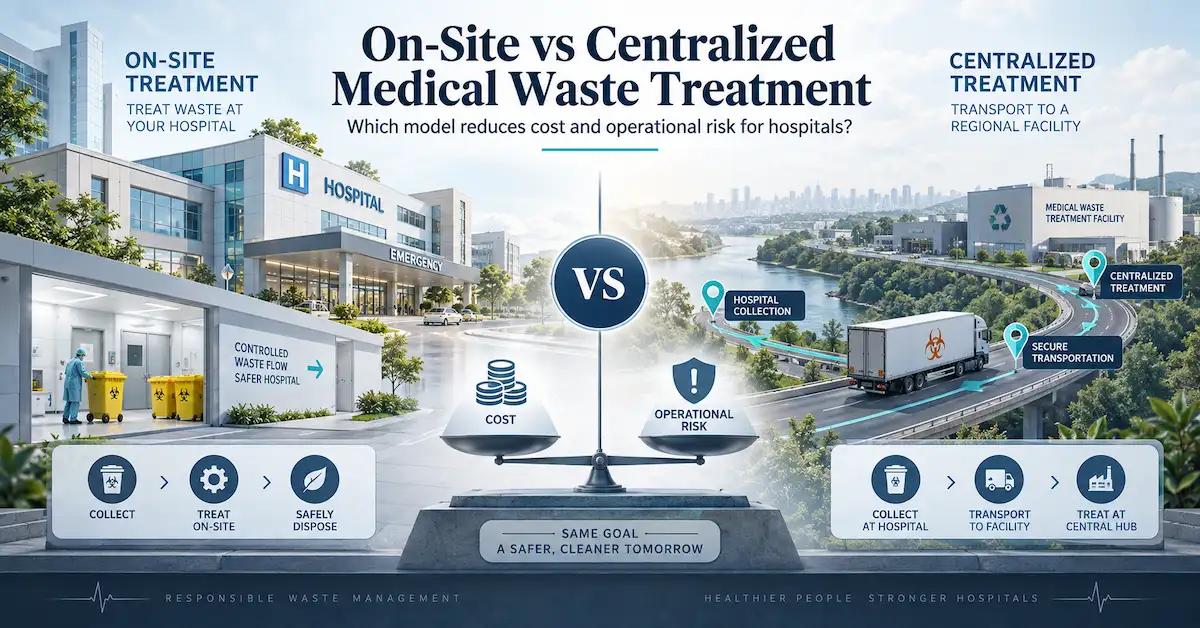
Not by default. On-site treatment can change transport dependence and record visibility, but it brings room, staffing, maintenance, validation and residue responsibilities. The on-site versus centralized guide addresses that broader service-model choice. This acceptance guide applies if a hospital or hub is seriously considering its own system; retain a licensed fallback even then.
What information produces a useful quotation?
Send location, applicable authority, intended installation room, waste families and exclusions, average and observed peak mass, occupied volume, container details, staffed window and target commissioning period. Ask for a named model, material acceptance matrix, complete-cycle schedule, FAT/SAT and qualification scope, installed price, service plan and exclusions. If data is uncertain, request a paid or scoped site assessment rather than guessing.
What should happen if a microbiological result fails?
Hold the affected output as potentially untreated, preserve the cycle and laboratory records, investigate the load and method, and use the approved contingency route. Do not relabel the batch as treated or simply repeat until a favorable result appears. Document the cause, corrective action and retest rationale, including whether earlier batches could be affected. The site's quality lead and local requirements govern final disposition.
8. Sources and next step
Sources and scope
- World Health Organization, "Health-care waste," 24 October 2024. Waste categories, segregation context and consideration of suitable non-incineration alternatives.
- U.S. Centers for Disease Control and Prevention, "I. Regulated Medical Waste," Guidelines for Environmental Infection Control in Health-Care Facilities. Containment, laboratory cultures, category-specific treatment and the distinction from surgical-instrument reprocessing.
- Zhejiang Weidun Environmental Protection Technology Co., Ltd., FHT process, treatable materials, product range and About Us. Manufacturer descriptions used to identify the company and frame model-specific questions; they are not independent acceptance evidence.
The acceptance matrices and numerical capacity example in this guide are buyer planning tools, not a published WAYDO test result, warranty or regulatory approval. Use the exact model documents, qualified test method and local authority's decision for a real installation.
Request a site-specific acceptance plan
The next useful step is not a generic brochure. For a medical waste sterilization equipment acceptance plan, send the compatible-waste matrix, a week of mass and container-volume observations, a peak-day example, the room and utility information, your jurisdiction and the target operating window. Ask Zhejiang Weidun Environmental Protection Technology Co., Ltd. for a proposed WAYDO model, written feed boundary, complete-cycle schedule, configuration drawings, available test evidence and an itemized FAT/SAT/qualification and service scope. The team can then discuss what remains to be proved at your site.