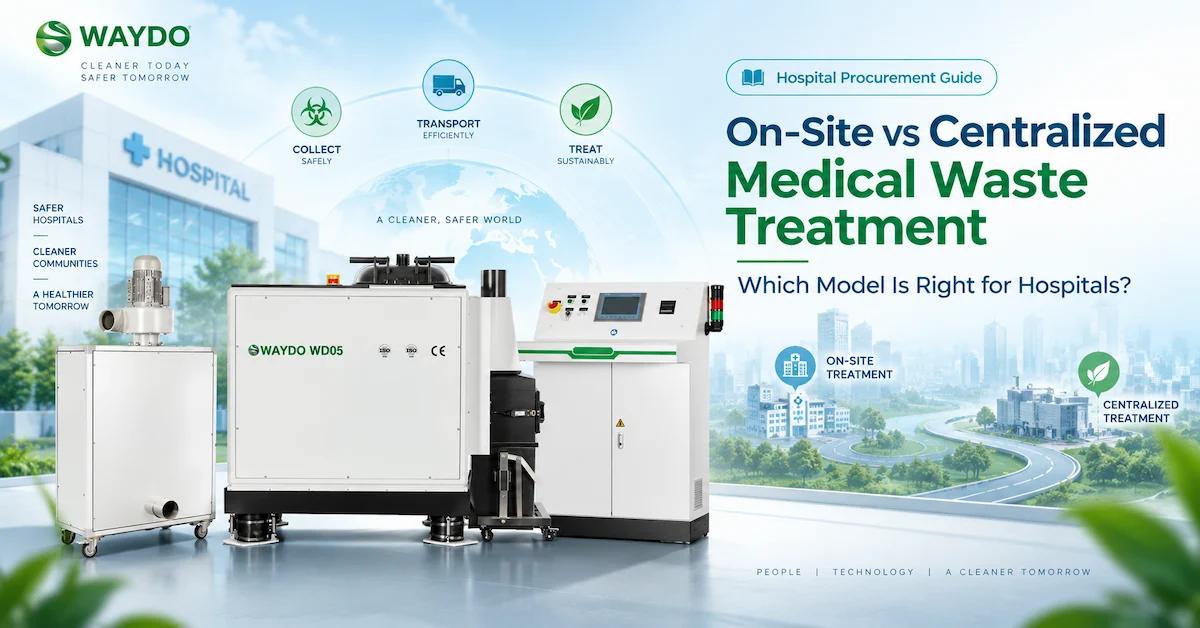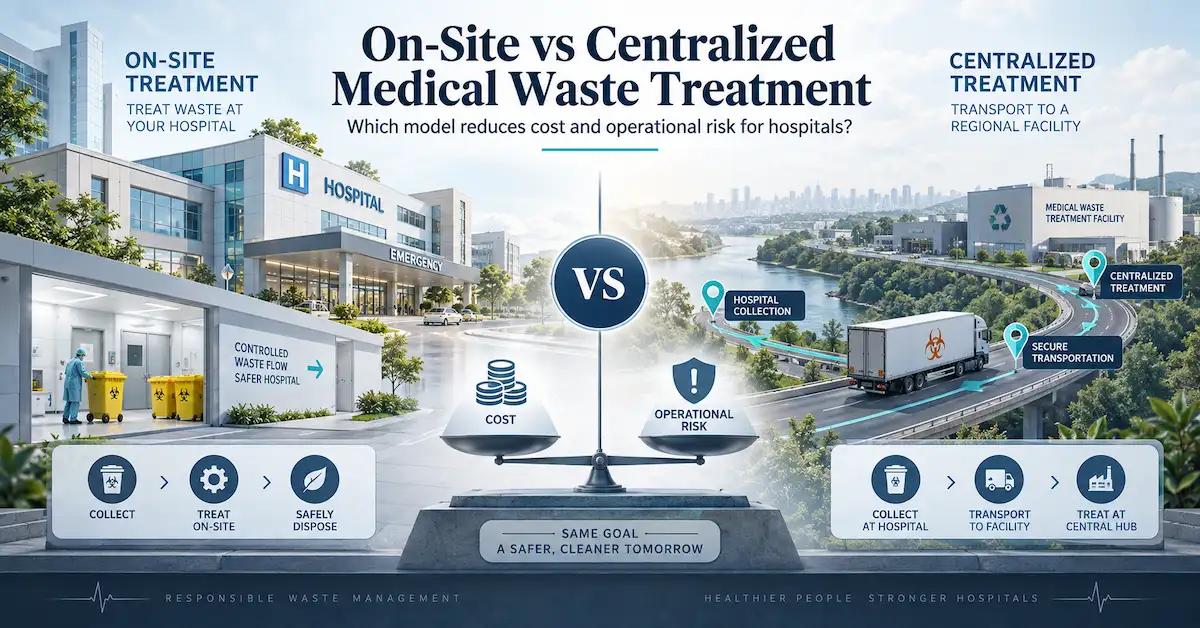

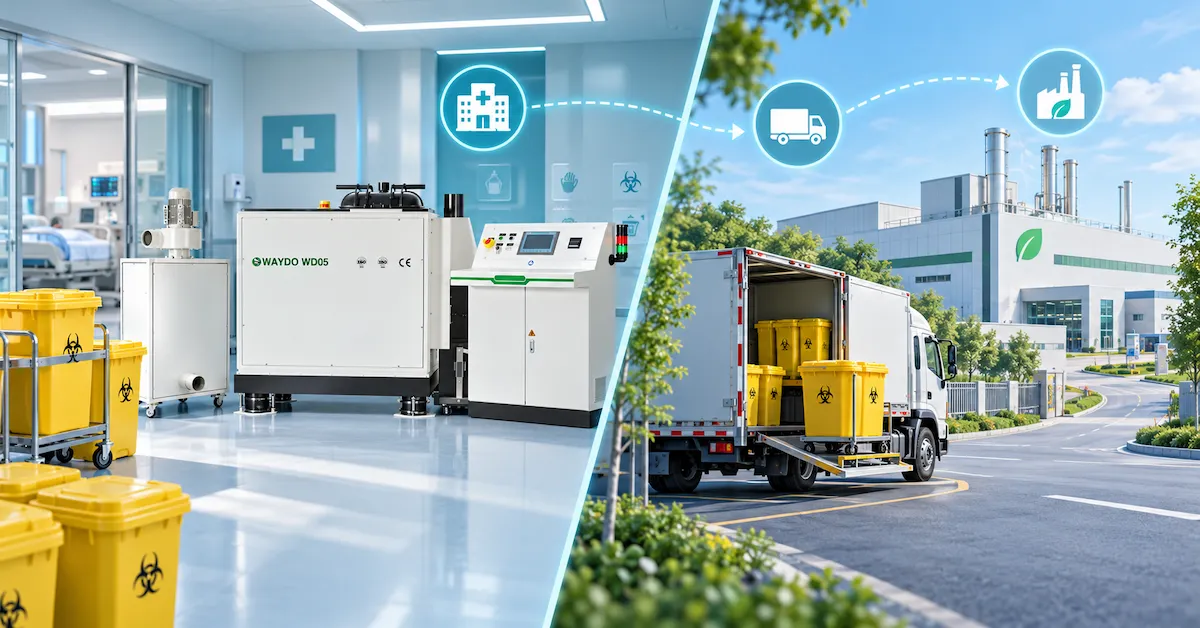
There is no universal winner. On-site treatment can be attractive when a hospital has a steady stream of compatible infectious waste, limited storage, difficult transport conditions or a strong reason to keep treatment under direct facility control. Centralized treatment can be more practical when several generators are close to a capable treatment plant and the network can provide reliable collection, receiving, treatment and backup capacity.
A hybrid model can be the better answer for a healthcare network with different site sizes or difficult geography. The important point is to compare the complete route rather than the equipment price alone.
Why treatment location changes the economics of medical waste management
Imagine a hospital with a reliable waste contractor. The collection truck arrives every afternoon, the containers leave the site and the treatment plant handles the rest. On paper, the arrangement looks simple.
Now imagine that the hospital expands, the collection route becomes longer, the waste room starts filling before pickup, and the contractor has to serve several facilities on the same route. The treatment price may not have changed at all, but the hospital's real operating risk has.
The opposite can happen with an on-site system. A hospital may buy equipment expecting to reduce transport and disposal costs, only to discover that the unit is lightly used, the operators are not available on every shift, and specialist waste still requires an outside contractor.
That is why the useful comparison is not simply: “Which treatment method is cheaper?”
A better question is: “Which operating model gives this healthcare facility the most controllable route from waste generation to final disposal?”
Generation → Segregation → Internal Storage → Collection → Transport → Treatment → Residue Handling → Final Destination
1. Which operating model should a hospital consider first?
Before requesting quotations, define the type of network you are dealing with. Most projects fall into one of three practical arrangements.
Facility-level treatment
Waste is treated at the hospital, laboratory or clinic where it is generated. The facility controls the equipment, operators and treatment schedule.
Usually worth studying when transport is difficult or the compatible waste stream is steady enough to support regular equipment use.
Shared centralized treatment
Several buildings or healthcare facilities send waste to one treatment hub. The hub may belong to the same healthcare group, municipality or another organization.
Often attractive when many generators are geographically close and the shared plant can maintain strong utilization.
Contracted off-site treatment
A licensed service provider collects waste and takes it to its own treatment facility. The hospital pays according to the commercial terms of the service.
Can remain the simplest solution for smaller generators with limited staff, space or technical support.
Hybrid network
Different sites or waste streams follow different routes. For example, a remote hospital may treat compatible infectious waste locally while smaller urban clinics use a shared hub.
Particularly useful when one network has very different site sizes, waste profiles or transport conditions.
| Decision factor | On-site | Centralized | Hybrid |
|---|---|---|---|
| Untreated waste travel | Usually shorter | Usually longer | Can be optimized by site |
| Capital responsibility | Facility or owner | Hub owner | Shared |
| Operator responsibility | Local team | Central team | Depends on route |
| Transport dependency | Lower for accepted waste | Higher | Selective |
| Scale advantage | Depends on utilization | Strong potential | Can be targeted |
| Failure exposure | Local equipment failure | Network disruption | More routes, but more governance |
The table is a starting point, not a scoring result. A rural hospital may value transport reliability more than capital efficiency. A city hospital located close to a mature centralized plant may reach the opposite conclusion.
2. When on-site medical waste treatment makes practical sense
On-site treatment becomes interesting when the waste route itself is causing a problem.
Consider a hospital in a remote region. The waste contractor may cover the area only on certain days. Heavy rain can affect the road. The temporary storage room has limited capacity. The hospital may also want to reduce the amount of untreated infectious waste leaving the facility.
In this situation, treating compatible waste closer to the source can change the workflow. Instead of waiting for the next collection, the hospital can schedule treatment around its own waste generation.
The same logic can apply to a large medical campus. If several departments produce compatible waste throughout the day, a local treatment room can become part of the internal waste process rather than an isolated piece of equipment.
The advantages are real, but they come with responsibilities.
- Someone must be responsible for daily operation.
- Operators need clear instructions for accepted and excluded materials.
- Failed or interrupted cycles need a quarantine procedure.
- Preventive maintenance has to be scheduled rather than postponed.
- Treatment records must remain available for review.
- Treated residue still needs an authorized destination.
- The hospital needs a backup route when the equipment is unavailable.
On-site treatment removes some external dependencies, but it does not remove the need for professional waste management.
It may be the wrong choice when compatible waste volume is extremely low, when the majority of the waste requires specialist treatment, or when the facility cannot provide the room, operators and maintenance support.
3. When centralized medical waste treatment is more attractive
Centralization solves a different problem: underutilization and fragmented technical resources.
A small clinic may produce too little compatible waste to justify dedicated equipment. Ten clinics located within a reasonable collection area are different. Together they may create a steady enough stream to support a properly operated treatment hub.
The central facility can concentrate trained operators, maintenance knowledge, spare parts and treatment records. That can be valuable when individual healthcare facilities do not have engineering staff.
There is another side to the calculation.
The waste now has to move. Someone has to collect it, load the vehicle, drive the route, receive the containers, reconcile the manifest and move the material into the treatment area. Every one of those steps costs money and creates another opportunity for delay.
Centralization is therefore strongest when the network has:
- enough generators to keep the plant well utilized;
- predictable collection schedules;
- practical transport distances;
- adequate receiving and storage capacity;
- trained plant operators;
- reliable treatment capacity during peak periods; and
- a documented backup arrangement.
A central plant can also become a single point of failure. If one facility serves an entire healthcare network, a major outage can create a problem for every generator at once.
“What happens to our waste if your main treatment line is unavailable tomorrow?”
The answer should be specific. “We have an emergency plan” is not enough. Ask where the waste goes, how much can be accepted, who arranges transport and how quickly the alternative route can start.
4. Why a hybrid model is sometimes the most realistic solution
Healthcare networks are rarely uniform. A hospital group may contain a 600-bed hospital in a city, three community clinics, a laboratory campus and two remote facilities. Forcing all of them into one treatment model may be less efficient than giving each site an appropriate route.
A hybrid arrangement could look like this:
Remote hospital
Treat a defined compatible infectious fraction locally where transport is difficult and the site can support the equipment.
Urban clinics
Send compatible waste to a shared treatment hub where collection routes are short and predictable.
Specialist streams
Keep radioactive, flammable, chemical or other excluded streams on their appropriate regulated routes.
Emergency capacity
Retain a contracted external route for periods when local treatment equipment is under maintenance or demand temporarily rises.
The advantage is flexibility. The drawback is governance. Every route needs consistent segregation rules, records, responsibilities and training.
For a healthcare group, the best model may therefore be a network design rather than a single equipment decision.
5. Start with the waste, not the number of hospital beds
Bed count is convenient because it is easy to obtain. It is also a weak substitute for measured waste when the purpose is to select treatment capacity.
Two hospitals with the same number of beds can have very different waste profiles. A surgical hospital, teaching hospital, rehabilitation center and outpatient medical campus may operate very differently.
Before comparing equipment, build a waste map.
At minimum, record:
- average compatible waste mass per day;
- peak compatible waste mass;
- occupied container volume;
- largest practical batch;
- moisture or free-liquid conditions;
- sharps and glass content;
- container types;
- current storage time;
- excluded waste categories; and
- current transport and disposal arrangements.
Build a written acceptance matrix
| Status | Meaning | What procurement should do |
|---|---|---|
| Accepted | Supplier confirms the material is within the proposed process. | Include it in the design basis. |
| Conditional | Material can be processed only under specified conditions. | Put those conditions into the technical schedule. |
| Excluded | Material remains on another treatment or disposal route. | Keep the external cost in the TCO. |
| Pending | More information or testing is needed. | Do not count it as approved capacity yet. |
WEIDUN's public material guidance lists examples of infectious clinical, laboratory and disposable healthcare materials, while also identifying exclusions such as radioactive materials and flammable or explosive compounds. The exact acceptance boundary should still be confirmed for the proposed model, load and local regulatory environment.
This step prevents one of the most expensive mistakes in treatment planning: buying capacity for waste that the selected system should never receive.
6. Calculate practical capacity instead of brochure capacity
A published kilograms-per-hour figure is useful for screening models. It should not be treated as a guaranteed daily production figure.
Suppose a hospital has 240 kg of compatible waste to process during a six-hour treatment window.
240 kg ÷ 6 hours = 40 kg/hourThat looks straightforward until the real shift is drawn on paper. Operators have to load the system, start the process, monitor it, unload the treated material, inspect the output, clean the work area, record the batch and occasionally deal with a problem.
The same applies to centralized plants. A treatment line can have enough nominal capacity while the receiving area cannot cope with the morning arrival of multiple vehicles.
Use both mass and volume
Waste density can change the result dramatically. Ten kilograms of lightweight protective materials may occupy much more space than ten kilograms of dense, wet material.
A hospital should therefore ask suppliers to consider:
- kilograms per batch;
- occupied volume per batch;
- maximum realistic batch size;
- complete cycle time;
- loading and discharge time;
- available operator hours;
- planned maintenance; and
- required contingency capacity.
WAYDO models for initial screening
| LOST model | Published processing capacity | Published vessel volume | Initial project discussion |
|---|---|---|---|
| WAYDO WD05 | 18 kg/h | 150 L | Smaller facilities and compact decentralized applications |
| WAYDO WD15 | 40 kg/h | 170 L | Medium facilities or shared campus applications |
| WD50 WANTED | 115 kg/h | 450 L | Higher-volume hospitals, campuses or local hubs |
| WAYDO WD330 | 280 kg/h | 670 L | Larger centralized or institutional projects |
These are manufacturer-published screening figures. They are not a guarantee of daily output for every waste mixture. Confirm the current technical sheet, capacity-test conditions, configuration and accepted load before approving a model.
7. Do not confuse treatment location with treatment technology
On-site and centralized describe where treatment takes place. FHT, steam autoclaving and other technologies describe how treatment is carried out.
These are separate decisions.
A hospital could use steam treatment on site. A regional facility could use FHT. A commercial service provider could use a different validated process. Procurement should therefore evaluate location and technology independently before combining them in the final business case.
| Technology / route | What the buyer should investigate |
|---|---|
| Steam autoclave | Steam quality, air removal, penetration, pressure, temperature, load pattern and validation of difficult loads |
| Frictional Heat Treatment | Waste compatibility, particle reduction, heat profile, cycle conditions and model-specific validation |
| Microwave or other thermal process | Feed preparation, moisture, temperature distribution and process controls |
| Chemical treatment | Chemical compatibility, concentration, contact time and residual handling |
| Licensed external service | Collection, treatment evidence, custody records, residue destination and emergency arrangements |
8. Where FHT fits into an on-site or centralized project
WEIDUN describes Frictional Heat Treatment, or FHT, as a non-burning process in which mechanical shredding and mixing generate heat inside the treatment vessel. The published process sequence includes loading, shredding and mixing, frictional heating, treatment, cooling and unloading.
The public FHT information describes a treatment phase around 150°C, approximately 25–35 minutes of cycle time, and a manufacturer-stated 6 Log10 microbial reduction under the referenced STAATT Level IV criterion. It also publishes volume and weight reduction figures.
Those numbers are useful when a buyer is building a shortlist. They should not be copied into a hospital acceptance specification without checking the actual model, waste load, measurement method and supporting test documentation.
The procurement team should ask where the temperature is measured, which load was tested, how the critical condition is established, and what record is produced for each routine batch.
FHT can therefore be considered in both facility-level and centralized projects. The location does not change the basic procurement questions: What waste goes in? What process conditions are demonstrated? What comes out? How is the result documented? Where does the treated material go?
9. Compare five- or ten-year cost, not the first quotation
This is where many comparisons become misleading.
A centralized provider may quote a treatment fee per kilogram. An equipment supplier may quote a machine price. Neither number represents the complete cost of the route.
On-site cost categories
- Equipment purchase and delivery
- Room preparation and utility connections
- Installation and commissioning
- Qualification and validation
- Operator labor
- Electricity, water and consumables where applicable
- Preventive maintenance and wear parts
- Training and records management
- Treated-residue handling
- External disposal for excluded waste
- Backup treatment during downtime
Centralized cost categories
- Containers and internal storage
- Collection labor
- Vehicles and drivers
- Fuel, insurance and transport-related costs
- Treatment fees
- Minimum pickup or service charges
- Distance, emergency or fuel surcharges
- Rejected-load handling
- Final disposal charges
- Contract administration
Put the two routes into the same spreadsheet and use the same time horizon.
On-site TCO = installed capital + labor + utilities + maintenance + validation + residue route + backup route + excluded-waste service Centralized TCO = storage + collection + transport + treatment fee + surcharges + contract management + emergency costs + final disposalThen run at least three cases:
- Lower-than-expected utilization
- Normal expected utilization
- Peak or growth scenario
This matters because an on-site system can look excellent when it is used every day and much less attractive when it operates only a few batches per week. A centralized service can have the opposite problem: attractive treatment rates but expensive transport and emergency collection when the network becomes less predictable.
10. Transport and storage can change the answer
Transportation is easy to overlook because it often appears as a routine service rather than a major technical cost. For a centralized model, however, it becomes part of the treatment system.
Ask how long waste normally remains at the generator. Then look at the actual route from the waste room to the treatment plant. Distance is only one variable. Pickup frequency, road reliability, vehicle availability, traffic and storage limits can be just as important.
Questions for centralized treatment
- How often is each site collected?
- What is the normal and maximum collection interval?
- How much waste can the vehicle carry?
- What happens if the vehicle breaks down?
- What happens if the plant cannot receive the load?
- How are rejected or incorrectly segregated loads handled?
- How is the handover recorded?
- Who carries responsibility during each transfer?
Questions for on-site treatment
The internal route deserves the same attention. Departments still need a controlled way to move waste into storage and then into the treatment room. The hospital should map container movement, staff responsibilities, cleaning procedures, access control and the route used when the machine is unavailable.
11. Validation should be agreed before the purchase order
A treatment system can run perfectly during a demonstration and still leave important questions unanswered. Procurement should define the evidence required before the equipment is released for routine use.
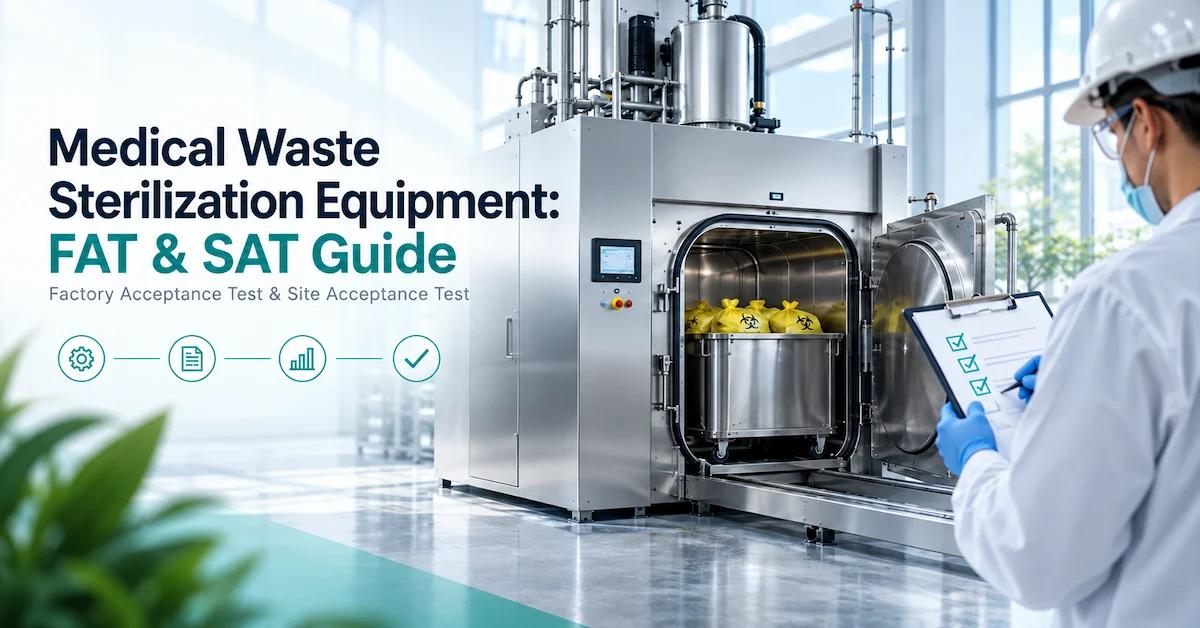
Three stages are commonly separated during equipment acceptance:
| Stage | Main purpose | Buyer should ask |
|---|---|---|
| FAT | Factory-level inspection of the specified equipment and documented functions | Does the machine match the agreed configuration? |
| SAT | Verification after installation at the actual site | Does the installed system operate correctly with site utilities? |
| Performance Qualification | Demonstration under the defined operating conditions and representative waste loads | Does the process meet the agreed endpoint for the intended waste? |
The most useful test is usually not the easiest load. If a hospital routinely handles wet dressings, mixed plastics, tubing or selected sharps, the qualification plan should explain how those important conditions will be represented.
The buyer should document:
- waste family being tested;
- container type;
- load mass and volume;
- loading pattern;
- critical process parameters;
- test method;
- acceptance criteria;
- failed-test procedure; and
- responsibility for retesting.
For networked systems, records should also allow the hospital to identify the source of a load, treatment batch, operator or responsible party, depending on the actual workflow and regulatory requirements.
12. The service model matters more than most equipment buyers expect
The easiest time to think about maintenance is before anything breaks.
Ask the supplier how preventive maintenance is organized, which parts are considered wear parts, how remote support works, how spare parts are supplied and what happens when the local operator cannot resolve an alarm.
WEIDUN's public service information describes site assessment, solution design, operator training, preventive maintenance, remote diagnostics, spare-parts supply, monitoring and deployment support. For an actual project, each item should be translated into a deliverable and a contractual responsibility rather than left as a general service statement.
| Service topic | What to put into the RFQ |
|---|---|
| Training | Operator roles, training hours, emergency procedures and competence records |
| Preventive maintenance | Maintenance intervals, scope and responsibility |
| Spare parts | Recommended stock, pricing and supply route |
| Remote support | Support hours, communication method and escalation procedure |
| On-site service | Technician availability and response expectations |
| Software / records | Data retention, export, user permissions and audit requirements |
13. Build the downtime plan before you need it
Every treatment model eventually encounters an interruption. The cause might be equipment maintenance, a power issue, operator absence, a failed cycle, a vehicle problem or a road closure.
Instead of asking whether downtime will happen, calculate what the hospital needs to do when it happens.
Required contingency volume = peak accepted daily waste × credible outage daysThe contingency can be handled through controlled storage, another treatment unit, another treatment plant, a licensed contractor or a combination of these.
On-site example
If a hospital normally treats compatible waste locally but the unit is unavailable for two days, the backup contractor should already be identified. The hospital should know the maximum amount that can be stored, the collection procedure and the expected response time.
Centralized example
If a regional plant is responsible for eight hospitals and one treatment line goes offline, the operator needs to explain how the remaining capacity is allocated. If the plant has no spare capacity, the backup route needs to be defined before the outage.
This is one of the reasons a slightly more expensive system can be the better purchase. A low price does not compensate for a waste room that reaches its storage limit during an extended failure.
14. Use the same scorecard for every option
Procurement teams often compare suppliers using different assumptions. One proposal focuses on equipment. Another focuses on treatment cost. A third includes transport and service. The resulting comparison looks precise but is not actually like-for-like.
Use the same evidence categories for every option.
| Criterion | Evidence to request |
|---|---|
| Waste compatibility | Written accepted, conditional and excluded material matrix |
| Capacity | Measured mass, volume, peak batch and actual operating window |
| Treatment performance | Applicable validation documents and test conditions |
| Installation | Layout, access, utilities and site responsibilities |
| Staffing | Operator coverage and training plan |
| Maintenance | Service schedule, spare parts and support response |
| Transport | Collection frequency, route, vehicle and contingency |
| Traceability | Batch records, manifests, exceptions and release procedure |
| Residue | Written acceptance from the intended downstream destination |
| TCO | Five- or ten-year model with assumptions |
| Continuity | Backup route and credible outage scenario |
If an essential document or site condition is unresolved, mark it as open. The procurement committee should know what still needs to be proved.
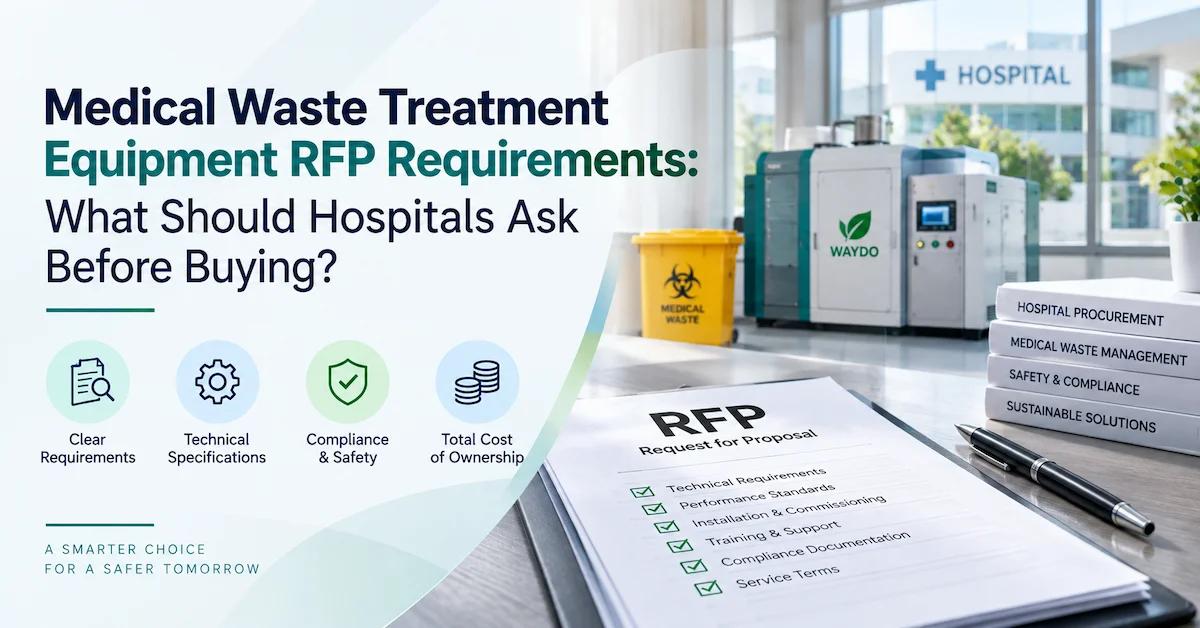
15. What should hospitals include in an RFQ?
A good RFQ does not need to be enormous. It needs to give every bidder the same useful information.
- Facility type, location and number of sites.
- Current waste categories and segregation procedure.
- Average and peak compatible waste mass.
- Occupied container volume and largest realistic batch.
- Container types and relevant moisture conditions.
- Waste categories that must remain on separate routes.
- Current collection frequency and transport distance.
- Available operating hours and staffing pattern.
- Room dimensions, access route and utility information.
- Required treatment endpoint and validation expectations.
- Treated-residue destination and acceptance requirements.
- Training, maintenance and spare-parts expectations.
- Required records and data retention.
- Backup treatment requirements.
- Commercial terms, delivery scope and exclusions.
Ask suppliers to label their evidence
A useful procurement convention is to distinguish between information that is already published and information that still needs to be proven.
| Status | Meaning |
|---|---|
| Published | Stated in the supplier's public material |
| Proposed | Included in the project quotation |
| Verified | Supported by project testing or reviewed documentation |
| Open | Requires site review, testing or additional documentation |
| Excluded | Outside the proposed process or commercial scope |
This small distinction prevents marketing information from quietly becoming a contractual performance guarantee.
16. A practical evaluation process for a hospital project
Step 1: Map the existing route
Follow the waste from the department to the final destination. Record where it is weighed, stored, handed over, transported and treated. Interview the people who actually perform the work rather than relying only on the written procedure.
Step 2: Measure the waste
Use at least seven representative days where possible. Capture average and peak mass, occupied volume and the largest realistic batch. Identify specialist waste separately.
Step 3: Check the room
Measure doors, ceiling height, floor conditions and maintenance access. Confirm electrical supply, ventilation, drainage and any other technology-specific requirements.
Step 4: Compare three routes
Even when the hospital prefers on-site treatment, price the current centralized route and a realistic backup route. This gives the business case a reference point.
Step 5: Issue a common RFQ
Give shortlisted suppliers the same waste data and site information. Ask them to state assumptions instead of filling gaps with optimistic estimates.
Step 6: Test the difficult case
The easiest waste load should not be the only basis for the technical decision. Identify the waste family that creates the most operational concern and ask how it will be evaluated.
Step 7: Build the TCO
Put capital, labor, transport, utilities, maintenance, validation, residue handling and contingency into one model. Use local costs where possible.
Step 8: Close the backup plan
Do not approve the project until the team knows where waste goes when the selected route stops.

Frequently Asked Questions
Is on-site medical waste treatment always cheaper than centralized treatment?
No. On-site treatment can be financially attractive when a facility has enough compatible waste to use the equipment properly and when transport or external treatment costs are significant. Centralized treatment may be more economical for smaller generators or dense healthcare networks. The correct comparison is five- or ten-year total cost, not the equipment quotation alone.
What is the main advantage of centralized medical waste treatment?
Centralization can concentrate equipment, operators, maintenance resources and technical expertise in one location. This can improve utilization when many generators are close enough to share the treatment plant. The additional collection and transport route must be included in the business case.
What is the main advantage of on-site medical waste treatment?
The hospital can treat compatible waste closer to where it is generated. This can reduce dependence on external collection for that portion of the waste and give the facility more direct control over scheduling and treatment records.
Can a hospital use both on-site and centralized treatment?
Yes. A hybrid network can use local treatment for selected compatible waste at some sites while other facilities use a shared treatment hub or licensed external provider. Specialist waste can remain on separate authorized routes.
Should equipment capacity be selected from hospital bed count?
Bed count can provide an initial reference, but it should not be the final sizing basis. Actual compatible waste mass, occupied volume, peak batch size and available treatment hours are more useful for equipment selection.
Can published kilograms-per-hour capacity be treated as daily output?
No. Published hourly capacity is a screening figure. Practical output also depends on loading, cycle preparation, cooling, discharge, cleaning, documentation, staffing, maintenance and waste density.
Can every type of hospital waste go into one treatment system?
No. Waste streams should be classified before treatment. Radioactive, flammable or explosive materials and other specialist streams may require different handling. Pharmaceutical, chemical, cytotoxic, pathological and liquid materials should not be added to a general treatment load without written confirmation and appropriate local authorization.
What should be requested before buying a medical waste treatment system?
Request the current technical data sheet, waste acceptance matrix, capacity definition, utility requirements, layout information, validation evidence, FAT and SAT plan, training scope, maintenance plan, spare-parts information, warranty terms, data-record requirements and backup route.
Is FHT suitable for centralized treatment projects?
FHT can be considered for centralized projects as well as on-site applications where the waste is compatible and the proposed system is properly configured. The exact model and capacity should be selected from measured waste data and the planned operating window.
What is the biggest procurement mistake when comparing treatment models?
Comparing different cost boundaries. One supplier may quote only equipment while another includes transport, operation or service. Before comparing prices, normalize scope, waste compatibility, capacity, validation, installation, maintenance, residue handling and contingency.
Conclusion
The right choice between on-site and centralized medical waste treatment depends on the hospital's actual waste stream, geography, staffing, transport route, validation requirements and lifecycle cost.
On-site treatment can reduce dependence on external transport and give a facility more direct control. Centralized treatment can make better use of specialist staff and larger treatment assets. For healthcare networks with very different sites, a hybrid model may provide the strongest balance.
Before approving a project, confirm five things: what waste will actually be treated, what practical capacity is available, how treatment performance will be verified, what happens during downtime, and where the treated output will ultimately go.
For WAYDO FHT projects, WD05, WD15, WD50 and WD330 provide published capacity points for initial discussion. They should be treated as starting points rather than automatic model recommendations.
The best proposal is not necessarily the one with the largest machine or lowest treatment fee. It is the one that clearly shows the complete operating route, the evidence behind its technical claims, the responsibilities of each party and the plan for the day when normal operation is interrupted.