
Quick Answer: Start with the bags and containers your hospital actually generates. Record their average and peak mass, occupied volume, packaging and exclusions, then set a locally acceptable treatment endpoint. Give bidders the same room plan, utilities and operating window. A useful response says exactly which loads a named model can treat, shows the validation record, and prices installation, qualification, staff training and service. Keep failed loads and downtime in the RFP; an attractive machine price is irrelevant if the ward's waste cannot be cleared or the residue has no lawful destination.
Search intent: RFQ intent and commercial investigation. This is a working procurement checklist for a hospital that is preparing a technical request for proposal, not a generic description of treatment technologies.
Introduction: why a hospital RFP needs more than a machine specification
A hospital can receive three quotations that appear to describe comparable treatment equipment and discover, only after award, that they cover different waste. One supplier has priced the treatment vessel without the loading system. Another includes installation but not performance qualification. A third accepts routine infectious solids but has not confirmed closed sharps containers, wet loads or the final disposal route. The price table alone will not reveal those differences.
The problem is not solved by asking each bidder to “meet international standards.” A usable request for proposal names the generating departments, classifies the waste, shows actual weights and container volumes, identifies a difficult representative load, and states what the hospital will accept as evidence of treatment. It also assigns ownership of utilities, permits, training, spare parts and a backup route. A bidder that excludes an intact sharps box in writing has given the hospital more useful information than one that ticks “all waste” and offers no test record.
Procurement can use the response matrix here; infection prevention and quality should sign off the waste boundary and release rules; engineering and facilities should test the physical assumptions. The article also uses Zhejiang Weidun Environmental Protection Technology Co., Ltd.'s WAYDO frictional heat treatment (FHT) range as a concrete example. Its published ratings are a shortlist aid, not evidence that a particular hospital load has been validated.
The World Health Organization's 2019 overview of technologies for infectious and sharp healthcare waste explicitly frames technology choice around technical, financial and environmental requirements. The U.S. CDC's regulated medical waste guidance likewise describes treatment, storage and transport as connected controls. Neither source turns a supplier brochure into a site permit; local law and the hospital's risk assessment remain decisive.
What are medical waste treatment RFP requirements?
Medical waste treatment RFP requirements are the documented conditions a supplier must satisfy to supply, install, validate and support a treatment route for specified healthcare waste. They include technical performance, material acceptance, safe workflow, site interfaces, records, service, legal scope and commercial terms. The RFP should ask for both an answer and the document that proves the answer.
The equipment may use steam, microwave, frictional heat, another approved non-incineration method, or a different locally authorized process. The RFP is technology-neutral where the outcome can be stated neutrally, but it must be technology-specific where a process has its own critical parameters. An autoclave bidder should explain air removal and steam penetration through the worst load. An FHT bidder should explain material movement, particle reduction, temperature history and how the most difficult accepted mix was challenged. A single line reading “150°C, 30 minutes” does not make those mechanisms interchangeable.
For procurement purposes, distinguish four documents. The user requirement specification (URS) states what the hospital needs. The supplier proposal describes a particular solution and its deviations. The contract technical schedule freezes the accepted configuration and responsibilities. The qualification protocol establishes how the installed system will be tested. If the first document is vague, the later documents tend to inherit the ambiguity.
An effective RFP also identifies what is not in scope. Chemical, cytotoxic, pharmaceutical, radioactive, anatomical and bulk liquid waste may need separate authorized routes. A biological treatment cycle does not remove another hazard merely because the waste came from a clinical department. Ask the supplier to classify every proposed material as accepted, accepted subject to stated conditions, not accepted or pending a witnessed test.
The manufacturer, product and application entities
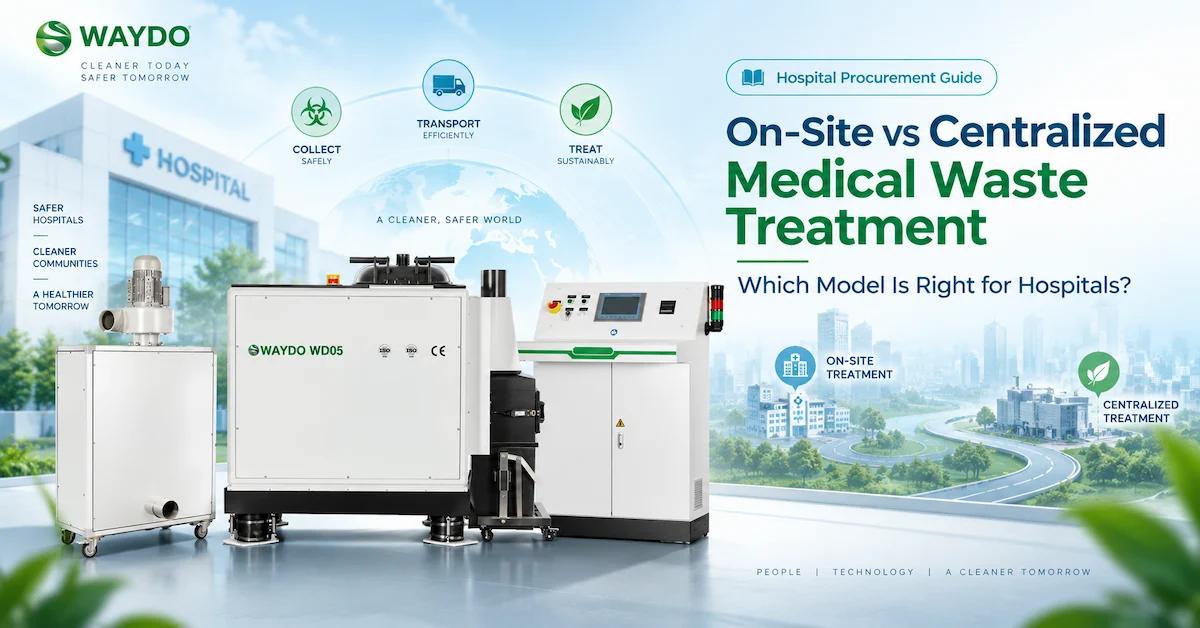
Zhejiang Weidun Environmental Protection Technology Co., Ltd. lists a contact address in Hangzhou, Zhejiang, China and markets the WAYDO medical-waste treatment range. Its process page describes a frictional heat treatment sequence involving shredding, mixing, heating, cooling and discharge. The named products are WD05, WD15, WD50 and WD330. A hospital, laboratory or shared healthcare-waste project can consider a compatible model only after checking its waste mix, local authorization, installation and residue route. See the company's About Us, products, services and contact pages for its own account of its activities.
The manufacturer's public figures are WD05: 18 kg/h, 150 L; WD15: 40 kg/h, 170 L; WD50: 115 kg/h, 450 L; and WD330: 280 kg/h, 670 L. Those are manufacturer-published nominal figures. If a buyer has 500 kg to clear in one shift, dividing 500 by 115 does not establish that a WD50 will finish in 4.35 hours. Loading, cooling, cleaning and the volume of a light, bulky bag all matter. Ask for the tested feed, complete cycle, options and shift calculation in the quotation.
The company publishes a FHT process description and treatable-materials list. Buyers should obtain the revision-controlled model data sheet and waste acceptance matrix before making either page a contract exhibit. The website does not publicly establish a universal minimum order quantity, model-specific electrical consumption, guaranteed delivery time, spare-part prices, site permit or named hospital case study for this particular RFP. Request those documents; do not invent them.
Step 1: define the procurement outcome before naming a model
Write one paragraph that states the result the hospital expects. For example: “Provide an authorized, validated, maintainable treatment system for the infectious-solid waste families listed in Annex A, with traceable batch release, a defined rejected-load route and an accepted final destination for treated residue. The system shall clear the measured peak-day compatible load during the specified operating window, with the availability and backup arrangement in Annex B.”
That sentence still needs measurable annexes. An RFP for a single hospital is different from one for a network hub receiving vehicles from several sites. Say which it is. Then state whether the price must cover collection, room works, installation, regulatory submissions and long-term operation, and give the desired commissioning window. Fix the currency, delivery point, bid validity and tax treatment. Ask the bidder to put exclusions in one signed schedule; “by others” scattered through a proposal is difficult to cost.
Give the draft to the people who will live with the system. Infection prevention should challenge the proposed waste boundary; environmental services can count and weigh the real containers; facilities can walk the proposed delivery path with a tape measure; quality can specify who releases a batch. Procurement and finance then have an agreed basis for competition and the lifecycle model. One named project owner should resolve a conflict such as “the larger machine clears the peak, but cannot pass through the existing doorway” before bids are scored.
Step 2: build the waste acceptance matrix
The waste matrix is the most important technical attachment in medical waste equipment procurement requirements. Collect data at the point of generation, not by opening sealed bags in a treatment room. Use at least seven representative operating days and record a known peak event separately. Name the department, container, average and peak mass, approximate occupied volume, moisture, glass and metal fraction, and any second hazard. A sharps box and a loosely filled PPE bag can have equal mass and very different behavior in a treatment vessel.
| RFP waste family | Hospital examples | Buyer data to provide | Supplier answer required |
|---|---|---|---|
| Routine infectious solids | Dressings, gowns, swabs and contaminated disposables | Bag type, bag mass, fill level, moisture and daily peak | Accepted load family, packaging and maximum validated batch |
| Laboratory cultures and disposables | Plates, tubes, pipettes and culture containers | Agent risk assessment, vessel geometry, glass fraction and pretreatment rule | Whether inactivation must occur in the source lab and what FHT load is allowed |
| Closed sharps containers | Needles, blades, slides and broken glass | Container material, closure, size, metal/glass fraction | Written acceptance or exclusion for the intact container |
| Wet or dense solids | Absorbents, tubing and fluid-contaminated sets | Free-liquid limit, density, nested components and packing pattern | Conditional limit and evidence from a comparable challenge load |
| Bulk liquids | Blood, culture broth and process liquids | Vessel size, volume and added chemicals | Separate treatment method or explicit validated acceptance |
| Chemical/pharmaceutical/radioactive | Fixatives, cytotoxic agents, drugs and tracers | Hazard identification and current licensed route | Explicit exclusion or independently documented lawful pathway |
| Pathological/anatomical | Tissues and anatomical remains | Local classification, storage requirement and destination | Written legal and technical determination, not a general claim |
| Ordinary non-hazardous | Clean wrap, paper and packaging | Current segregation error rate | Keep it out of the treatment demand calculation |
After the walk-through, send the matrix to every bidder and require a response against each row. Do not allow “all medical waste” in place of a marked answer. Require a signed material-compatibility schedule, revision number and the conditions under which acceptance changes. Make the contract require re-evaluation when waste composition, container or source department changes materially.
For high-consequence microbiological material, coordinate with the biosafety officer. CDC guidance identifies special precautions for amplified cultures and stocks; some must be inactivated close to the source under the applicable protocol. That decision is not made by changing a product brochure's “treatable” label. It belongs in the laboratory risk assessment and local approval.
Step 3: size the actual duty, not the hospital bed count
Bed count is a rough context clue. Operating hours, clinical specialties, segregation, disposable-use patterns and laboratory work determine the compatible load. Ask the hospital to report kilograms and occupied liters, because low-density materials may fill a vessel long before the nominal mass is reached. A regional hospital may have a moderate average load and a severe Monday peak after a weekend collection gap.
The RFP should include three demand cases: current average, observed peak and a plausible expansion scenario. State the maximum number of days the facility may hold untreated waste, the treatment shift length and the staffing assumption. Do not divide peak kilograms by published kg/h and stop there. Subtract time for receiving, weighing, loading, cycle completion, cooldown, unloading, record review, cleaning, preventive maintenance and breaks. Ask each bidder to return a batch-by-batch schedule for the peak day, including the maximum accepted load volume.
| Capacity term | Buyer definition | Evidence the bidder must return |
|---|---|---|
| Nominal hourly rating | Public model figure used only for an initial shortlist | Test condition, waste composition and calculation method |
| Validated batch | Largest load proven for a specified material family and cycle | Protocol, batch mass and volume, container, indicators and pass criteria |
| Practical shift throughput | Accepted kilograms completed and released within the staffing window | Time-and-motion schedule including all non-processing steps |
| Peak-day capacity | Output during the buyer's measured high-demand day | Demonstration schedule, resource plan and backlog calculation |
| Growth provision | Added capacity needed after a defined trigger | Additional shift, module, model change or second-line plan |
| Outage capacity | Route for material generated during failure | Signed backup agreement, storage allowance and response time |
The bid should disclose whether a rate assumes continuous feed, multiple operators, automatic loading, optional bins or utility performance that is not part of the base offer. A vessel's published volume is not necessarily its validated fill limit. Separate those figures in the comparison spreadsheet.
Step 4: write technology-neutral performance requirements
The hospital should state the required outcome and allow a credible bidder to explain how its technology achieves it. The tender may require a locally approved microbial inactivation endpoint, documented validation on the accepted worst-case load, an alarmed process, batch traceability and a residue condition accepted by the disposal contractor. It should not demand a temperature copied from one competitor's brochure unless local approval specifically requires that parameter.
Technology-specific details then appear in the compliance response. A steam supplier should address steam quality, air removal, fluid depth and the challenge location. A FHT supplier should show the relevant temperature profile, rotor and mixing behavior, particle reduction and the declared limits for wet or dense loads. A microwave bidder should explain feed preparation, moisture and field uniformity. Under every approach, the hospital should ask where the least-exposed portion of its real load is and how the validation protocol tests it.
WHO's technology overview provides a neutral reference for comparing installation needs, capacities, consumables and environmental considerations of infectious and sharp-waste technologies. The RFP should name the jurisdiction's actual rules and authority having jurisdiction rather than substitute WHO guidance for a local permit. The CDC's environmental infection-control recommendations similarly refer to treatment methods approved by the relevant authority.
Step 5: specify the system, interfaces and room
A purchase of a treatment system is not complete when a machine arrives at the loading dock. Walk the route from truck to treatment room and record the narrowest door, turns, lift rating and floor-loading constraints. Ask for a general arrangement drawing with the equipment mass and lifting points. On the same revision, mark the electrical connection and peak draw, water and drain points, ventilation and exhaust, heat and noise, operator working space, maintenance access and the residue-bin exit. For every interface, write “hospital,” “supplier” or “priced option” next to the responsible party.
These medical waste treatment system specifications should be returned as a model-specific, revision-controlled schedule. A general brochure may help a shortlisting discussion, but it cannot define a construction interface or guarantee installed throughput.
Ask the bidder to mark the battery limits on one drawing. The point at which the supplier's power cable ends and the hospital's distribution begins can be a major variation order. The same applies to exhaust ducts, drains, network ports, floor reinforcement and fire-protection systems. Request installed equipment dimensions and the working envelope for loading, maintenance, emergency access and removal of large components.
State how untreated bags enter the room and how treated residue leaves without crossing incompatible traffic. Explain whether a sealed container is loaded whole, whether the operator must handle it manually, how spills are contained, and where a failed batch is quarantined. If an automatic loader, residue bin or exhaust-filter module is optional, ask the bidder to price it as a separate line and show the impact of excluding it.
The supplier's layout is a proposal, not final site engineering. The hospital's facilities and infection-control teams should review the plan before construction, and an authorized local professional should approve work where required. A rendered service room cannot prove ventilation, regulatory classification or fire compliance.
Step 6: demand an evidence package, not adjectives
This is the section that separates a high-quality medical waste equipment technical evaluation from a feature checklist. For every significant claim, require a document with a model, revision, date, test load and signatory. A statement that the equipment is “safe,” “sterile” or “compliant worldwide” is not a substitute.
↗ Request the Model-Specific Evidence Pack
| Claim or requirement | Minimum evidence to request | What the evaluator should check |
|---|---|---|
| Published capacity | Current model data sheet and test method | Was the rate measured on a comparable material and complete cycle? |
| Inactivation performance | Full report, protocol and indicator details | Does it cover the exact model and a defensible worst-case load? |
| Temperature and cycle control | Sensor map, calibration and sample cycle export | Do alarms detect a process that departs from the validated window? |
| Emissions and worker exposure | Test report and applicable design controls | Which conditions, sampling points and operating loads were tested? |
| Material compatibility | Signed acceptance/exclusion matrix | Are sharps containers, wet loads, glass and second hazards covered? |
| Electrical and utility demand | Model-specific schedule and site drawing | Are peak loads and optional accessories included? |
| Maintenance interval | Manual, wear-part list and service schedule | Which parts are locally stocked and what is their replacement lead time? |
| Digital traceability | Sample batch report and user-role demonstration | Can the hospital identify source, operator, alarms and release decision? |
| Certification or patent | Numbered certificate and scope document | Does it apply to the offered model and claim, not merely the company? |
| Customer reference | Permission-based reference and scope | Is the comparable site willing to discuss uptime and service? |
WAYDO's public FHT process page describes a roughly 25-35 minute cycle, an operating temperature around 150°C, a claimed 6-log microbial reduction under the stated criterion, and potential volume reduction. Record these as manufacturer-published screening statements. Require the full model-specific test report, load composition, endpoint, method and independent or witnessed evidence before turning any claim into an acceptance guarantee. A different waste mix may not reproduce a headline figure.
The same rule applies to claims of reduced environmental impact or operating cost. Ask for metered electricity and water per batch at the declared load, consumables, exhaust treatment, maintenance and the residue's permitted destination. “No incineration” describes the process class; it does not by itself quantify carbon, emissions or final-disposal savings.
Step 7: require a transparent FHT option response
For buyers investigating an FHT medical waste treatment solution, include a technology appendix that asks the bidder to describe the sequence of loading, size reduction, mixing, heating, holding, cooling and discharge. Request the equipment drawing and the measurement points that establish a complete cycle. Ask whether the chamber can accept the hospital's closed containers without reopening them, what conditions invalidate a batch, and how output is captured without creating a new exposure.
The WAYDO product range includes fixed, mobile and project-configured possibilities described on its site. A hospital tender should require the specific configuration offered, including loading, filtration, collection and data options, rather than assuming every feature appears on every model. A supplier's response should identify which items are standard, optional, customer-supplied or not available. Also ask how the machine is cleaned, isolated for service and restarted after an interruption.
For hospital waste treatment equipment selection, a lower-capacity model may be preferable when waste volumes are modest and the site can process it daily. A larger unit may suit a multi-building hospital only if its batch volume, operators, utilities and maintenance plan fit the room. Do not turn the manufacturer's indicative bed-count ranges into tender pass/fail conditions. Actual measured accepted waste and validated daily output are stronger decision inputs.
Step 8: define validation, FAT, SAT and batch release
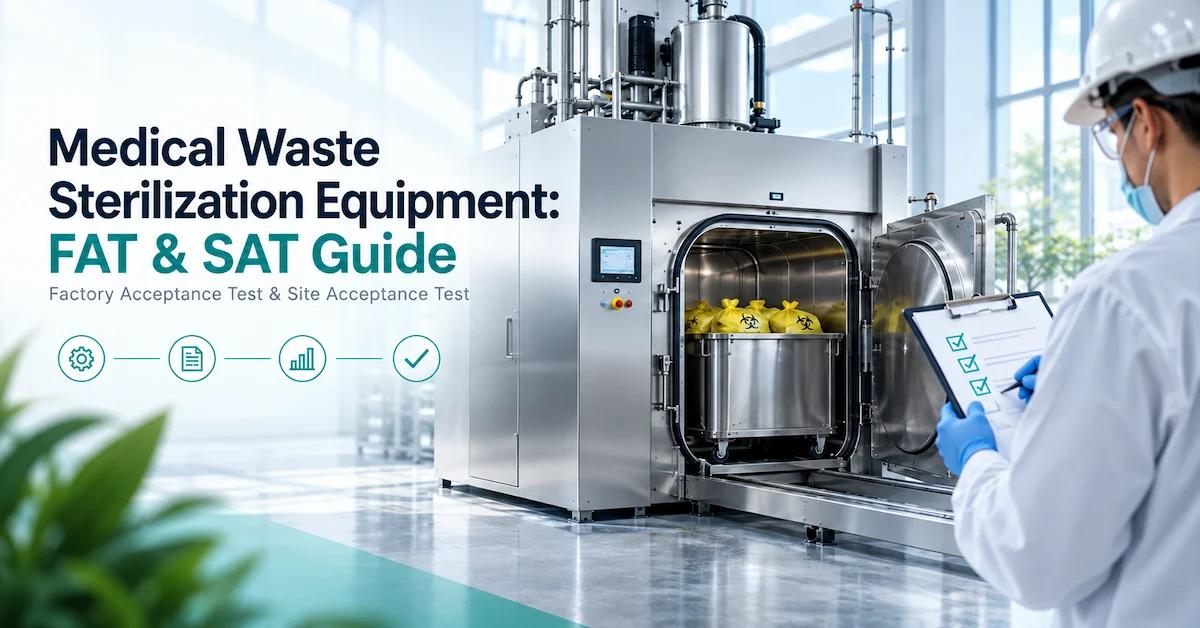
Qualification is not an afterthought added to a purchase order. The RFP should state what must be proven before shipment, after installation and during performance testing with the hospital's selected loads. A factory acceptance test (FAT) can verify construction, interlocks, controls, alarms, software and a demonstration cycle at the supplier's facility. It may not prove that the future hospital's utilities or difficult waste load will behave the same way. Site acceptance testing (SAT) verifies the installed interfaces and system functions. Performance qualification (PQ) tests the declared load families and acceptance criteria under site conditions.
Ask bidders to provide a draft validation master plan with protocol ownership. The hospital and its regulator should agree on the challenge method before award where possible. The protocol should specify material mix, mass, volume, containers, moisture, packing, biological indicator or other accepted challenge, placement, critical process parameters, replicate runs, acceptance criteria, sample handling, deviation management and signatures. It should identify how a failed or interrupted cycle is isolated and safely reprocessed or removed.
| Gate | Minimum deliverable | Acceptance owner |
|---|---|---|
| Design review | Frozen configuration, drawings, utilities, risk register and acceptance matrix | Hospital project, facilities and infection prevention |
| FAT | Witness plan, interlock and alarm tests, sample records and deviations | Hospital engineering/quality or appointed inspector |
| Installation qualification | As-built drawing, asset IDs, utilities, calibration and manuals | Facilities and quality |
| SAT/operational qualification | Functional tests on installed equipment, roles and data export | Engineering, operator lead and quality |
| Performance qualification | Worst-case accepted loads and documented endpoint | Biosafety/infection prevention and quality |
| Go-live | Training, SOPs, maintenance, spare parts, residue route and backup contract | Hospital accountable manager |
| Routine release | Batch review, alarms, indicators where required and disposition | Authorized hospital or plant personnel |
Do not allow the contract to say “FAT passed” as if that automatically means routine clinical waste can be loaded. Retain a hold point until the required site qualification, staff training, authorization and residue acceptance are complete. Define who pays to repeat a test after a supplier failure and who pays if the buyer changes the agreed waste load.
Step 9: make service and continuity measurable
The maintenance offer should let the hospital build next year's rota and budget. Ask for the interval and estimated downtime of each routine task, the parts consumed, tools required and the stock to keep on site. Name the local or regional technician, the route for remote access, software-update responsibility and the parts that must travel internationally. “24/7 support” may mean a telephone answer at midnight; write separate clocks for remote diagnosis, technician dispatch and restoration.
Specify the hospital's maximum acceptable untreated-waste backlog and what happens if treatment is interrupted by power loss, an alarm, an absent operator or a damaged part. The hospital may use temporary compliant storage, a second unit, a shared hub or a licensed contractor. Obtain a signed backup arrangement where the local rules require one. The contractor's available capacity and response time matter more than simply naming it in a continuity plan.
Record the warranty start trigger, exclusions, service visits, consumables, software support period and the price basis for later years. Ask for planned replacement intervals for blades or other wear parts, but do not publish an interval that the offered model and load have not substantiated. If the supplier claims a maintenance-free period, ask which tasks remain with the operator.
Step 10: qualify the supplier and the delivery chain
Medical waste treatment supplier qualification should separate the company's identity from the performance of the specific project. Check legal registration, factory or assembly role, quality-system scope, product design responsibility, export capability, subcontractors, field-service coverage and financial ability to honor the contract. If a certificate is offered, request its number, issuer, validity and scope. A logo on a website is not enough to determine whether a test covers the model in the bid.
Request an organized factory evidence pack: a current photo of the offered configuration, serial-number and traceability method, critical-component sourcing policy, inspection and factory test checkpoints, packing method, preservation for sea or land freight, dispatch inspection, installation responsibility, and named contacts for technical clarification and claims. Where permissible, arrange a remote live factory walk-through or witness FAT. Photographs should show the actual assembly stage or product; a marketing rendering should be identified as such.
Minimum order quantity, delivery time and packaging are commercial fields. The public WAYDO site does not establish one universal MOQ or lead time for all configurations. Ask the bidder to state whether a single-unit order is accepted, what triggers production, the quoted manufacturing and shipping schedule, export packing specification, shipping dimensions and insurance. For a high-value hospital tender, separately price spare-parts kits and the commissioning visit.
Reference checks should be proportionate. Ask for a site using the same model and a similar waste mix, if disclosure is permitted. A useful call asks about operator workload, actual batches per shift, validation delays, spare-part availability and service response. Do not publish a hospital name, performance result or testimonial without the customer's permission and a verifiable record.
Step 11: compare proposals with a two-stage scorecard
Use a non-negotiable gate before a weighted score. A bid that cannot legally treat the declared waste, cannot meet the required endpoint, cannot be installed safely in the room, or has no workable residue and backup route should not win because its price is low. Mark those as pass, condition to close by a stated date, or fail. Document the reason and give bidders a fair clarification window.
For bids that pass, establish weights before reviewing prices. The example below is a starting framework, not a universal purchasing rule. Adjust it for the site's waste, geography and institutional policy.
| Scored area | Example weight | Evidence, not sales language |
|---|---|---|
| Waste compatibility and validated endpoint | 25 | Model-specific matrix and challenge evidence |
| Practical peak-day capacity and workflow | 15 | Batch schedule, physical layout and operator task study |
| Safety, records and regulatory fit | 15 | Interlocks, sample record, permits and release procedure |
| Service, spares and continuity | 15 | Response commitment, parts, training and backup route |
| Installed and five-year cost | 20 | Normalized price schedule and stated assumptions |
| Supplier delivery and documentation | 10 | Factory evidence, FAT plan, references and project schedule |
Ask each evaluator to cite a page and revision of the bid for every score. Meet to reconcile large differences between infection prevention, facilities and purchasing; their disagreements usually expose a missing assumption. Run a sensitivity analysis: would the ranking change if electricity rises, throughput is 25% lower than expected, or the only local technician is unavailable? A small change in a fragile model can matter more than a modest purchase-price difference.
Step 12: calculate the installed and operating cost
A medical waste treatment project proposal should show a price breakdown that the hospital can compare with licensed off-site disposal. Request separate amounts for the base equipment, options, freight, insurance, taxes, civil and utility interfaces, installation, FAT witness, SAT, PQ, training, initial spares, software, warranty and annual maintenance. Do not force a bidder to hide unknown site work inside a low equipment line. State an allowance or request a survey and revised firm price.
Use the same waste mass and the same five-year period for every option. Include staff time for weighing, loading, cycle review, residue handling and administrative records. Include power, water, process consumables, indicators, calibration, wear parts and planned shutdown. Keep the specialist disposal cost of excluded streams in both cases. Do not subtract all contractor invoices from the on-site model when only a portion of the waste moves in-house.
Five-year net cost = installed project cost + five years of labor, utilities, service, validation, residue and backup - avoidable external treatment charges
This formula is deliberately transparent rather than sophisticated. Finance may add discount rate, depreciation, tax and escalation assumptions. The key is to expose assumptions about utilization and excluded waste. Ask the bidder for a spreadsheet with editable inputs, not a single return-on-investment percentage. A model that promises savings only at full nominal hourly capacity is unlikely to survive the first year of real operation.
A copyable medical waste treatment RFP template
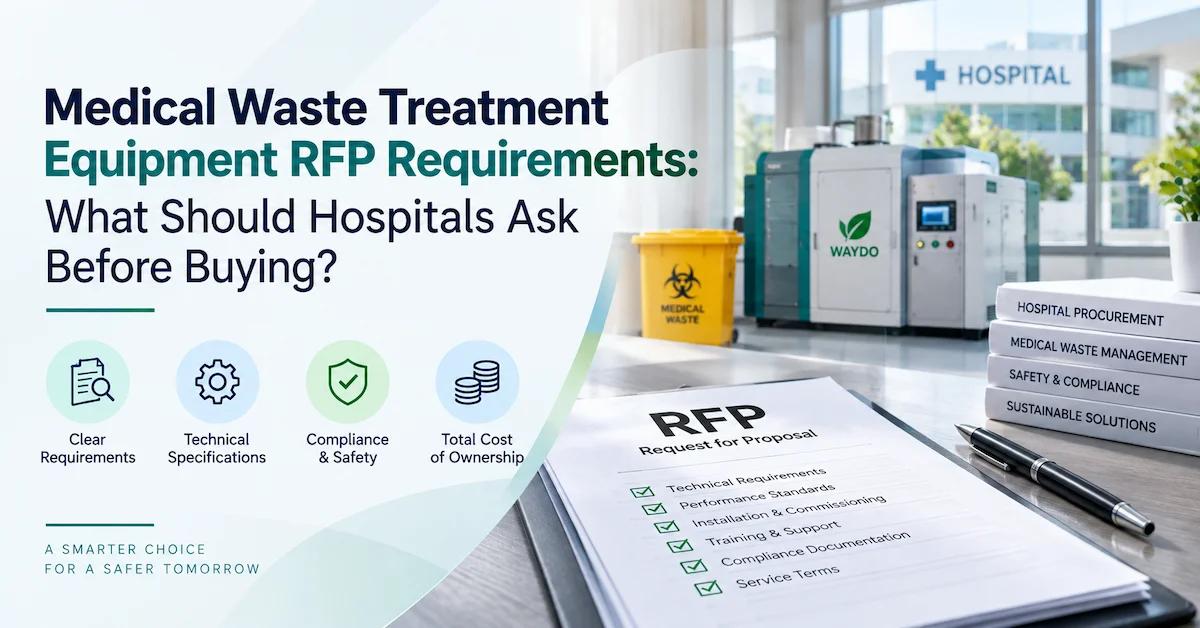
The following medical waste treatment RFP template can be inserted into the buyer's own procurement document. Replace bracketed fields with local data and attach the referenced schedules. It is intentionally written as questions and deliverables, not as a pre-award endorsement of one supplier.
| RFP field | Buyer entry | Required supplier response |
|---|---|---|
| Project location and owner | [Hospital, city, country, accountable department] | Local service, delivery and permit assumptions |
| Facility and application | [Single hospital / campus / shared hub] | Offered configuration and reference layout |
| Waste scope | [Annex A: category, source, container and hazard] | Signed accepted/conditional/excluded matrix |
| Quantity | [Average kg/day, peak kg/day, occupied volume] | Practical batch and shift schedule |
| Operating window | [Hours/day, days/week, staffing] | Demonstrated cycle schedule and manpower |
| Treatment objective | [Locally approved endpoint and challenge] | Model-specific protocol, report and guarantee |
| Room and utilities | [Annex B: plan, power, water, drain, ventilation] | Drawing, loads, clearances and interface list |
| Residue destination | [Approved receiver and terms] | Output description and residue handling |
| Traceability | [Required fields, retention and export format] | Sample batch report, permissions and audit trail |
| Safety and downtime | [Maximum backlog and emergency route] | Interlocks, alarms, failure procedure and backup |
| Qualification | [FAT, IQ, OQ, SAT, PQ witness requirements] | Test plan, responsibility and cost allocation |
| Service | [Response and restoration targets] | Local capability, spare list, warranty and rates |
| Commercial | [Currency, Incoterm, tax, payment, validity] | Itemized firm price, options, exclusions and lead time |
| Submission | [Deadline and document format] | Compliance matrix with evidence and deviations |
Add a response convention: C = complies with cited evidence; P = partially complies with limitation and remedy; N = does not comply; T = test pending. A blank cell is not agreement. For each P or T, ask for the person responsible, completion date, price impact and hold point. Make this matrix a signed contract annex after negotiations.
↗ Send Your RFP Matrix for a Technical Response
The RFP's opening page should invite questions before the deadline. Buyers sometimes discover that two standards conflict or that a sample bag is unrepresentative only when a competent bidder asks. Publish clarifications to all bidders so the process remains comparable.
Contract language that protects both sides
The negotiated technical schedule should identify the offered model, serializable components, accepted materials and containers, maximum validated batch, cycle and outcome, utility conditions, output condition, training, service, documentation and excluded items. Attach drawings and test protocols by revision. If the supplier promises a particular throughput, say whether it is nominal hourly, peak shift or sustained output and define the test that proves it.
Set milestone payments against deliverables rather than dates alone. Typical gates include approved design, factory completion, delivery, installation, SAT, PQ and final handover. The contract should explain what happens when the hospital delays utilities or changes the waste mix, as well as what happens when the equipment fails an agreed test. Define retest responsibility, cure period and the hospital's right to use the backup route while the issue is resolved.
Address information security if the system records department names, users or networked batch data. Ask who owns the records, how long they are retained, whether an offline export is possible, how remote support is authorized and what happens at the end of the service contract. A touchscreen is not an audit trail unless the hospital can retrieve and understand the underlying batch history.
For imported equipment, confirm the exact Incoterm and physical point of delivery. Packaging, lifting, customs clearance and transit insurance can be expensive and are easy to leave between contracts. Ask for an export packing plan and dimensions early enough for the facilities team to verify the path into the room.
Evidence gaps to close before publication or award
An RFP article can show a real product and a useful framework, but it cannot replace the factory's private records. The table below deliberately separates published evidence from items that require a direct request. This distinction is important to both buyers and search readers.
| Evidence item | What is publicly supportable now | What the hospital should request |
|---|---|---|
| Company identity | Manufacturer name, Hangzhou contact address and public product range | Legal entity and contract-signing details |
| Product image | Public WD50 product image, adapted here for presentation | Current configuration photo and serial/option list |
| Nominal capacity | Public model figures on product pages | Load-specific capacity and witnessed schedule |
| FHT process | Manufacturer's published process description | Model-specific control diagram and validation report |
| Treatable materials | Public illustrative material list | Signed hospital-specific acceptance matrix |
| MOQ | Not established as a universal public figure | Written quantity terms for this configuration |
| Lead time | No universally applicable public commitment | Manufacturing, FAT, shipping and installation dates |
| Packing | General logistics service is described | Export packing method, dimensions, weight and insurance |
| Certification/test | Broad website statements exist | Numbered certificate, scope, issuer and full report |
| Hospital case | No named comparable case verified for this article | Permission-based reference with model and waste mix |
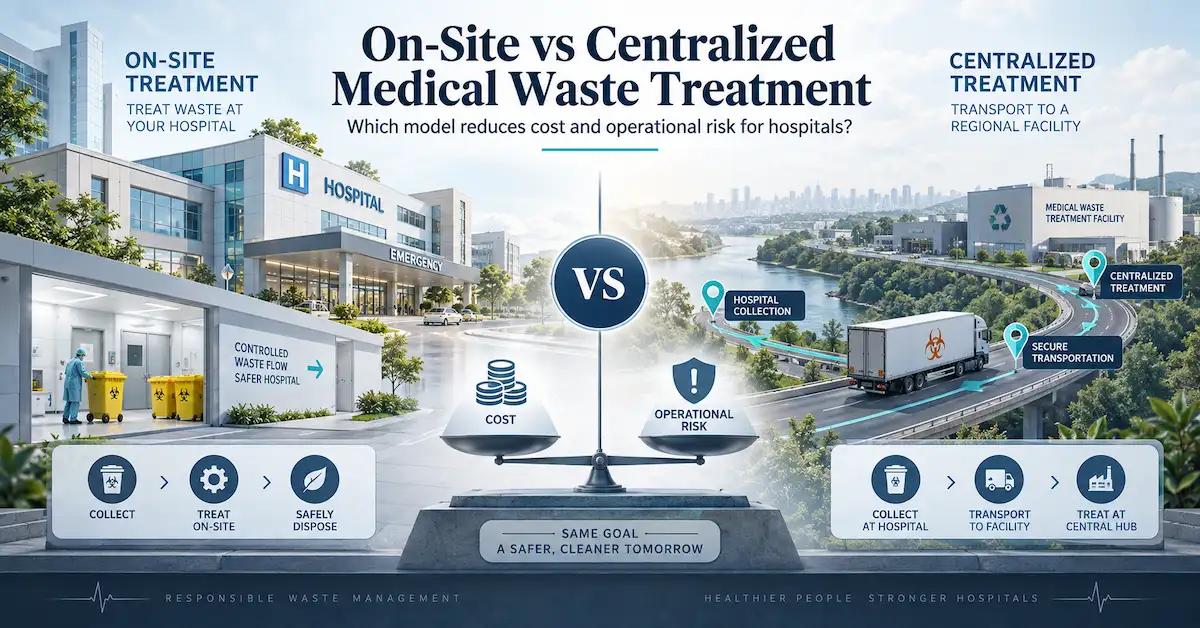
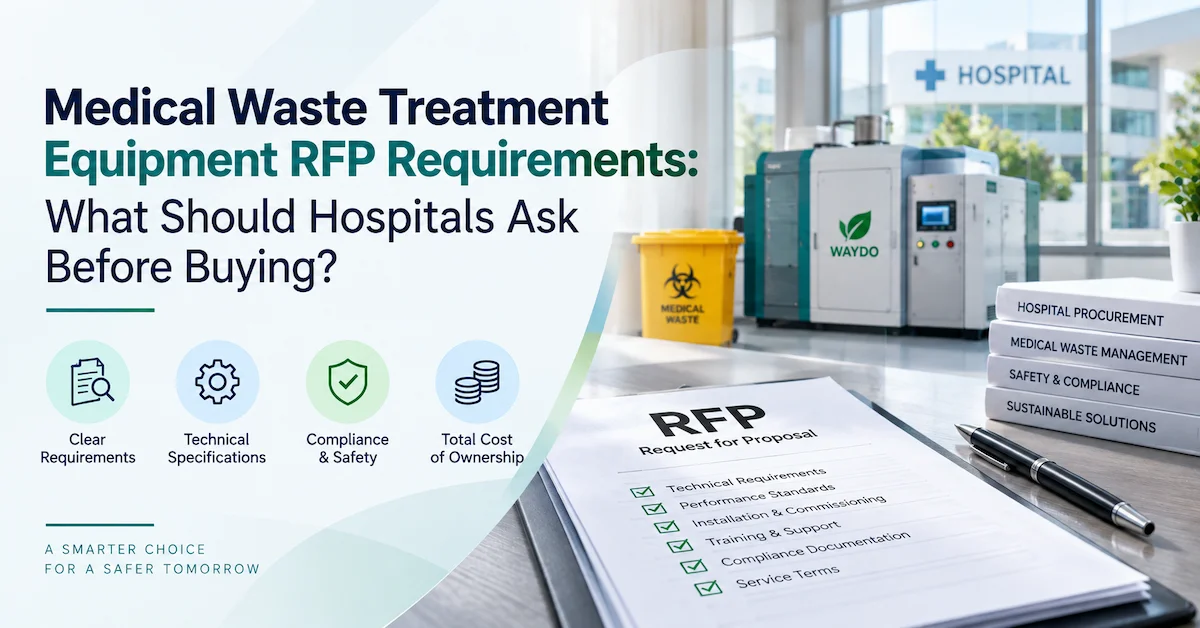
The two hospital-room images in this article are conceptual visualizations derived from the product photograph. They show a possible operating context, not a factory photo, installed project or customer testimonial. Do not re-caption them as “our hospital installation.” This is a trust requirement as much as an editorial nicety.
FAQ: questions buyers ask before sending an RFQ
How detailed should the waste list be?
Detailed enough to define an accepted batch. “Infectious waste, 500 kg/day” omits container type, glass, sharps, moisture, source and peak distribution. Provide a categorized matrix with average and peak mass and occupied volume, plus the largest difficult batch. The supplier may still request samples under a safe protocol. Do not open sealed bags simply to improve a tender spreadsheet.
Can a hospital specify FHT by name?
Yes, where its procurement rules allow a technology-specific tender and its risk assessment supports it. It should still state the required endpoint, material acceptance, evidence and competition rules. Where a technology-neutral tender is required, ask all bidders to explain process-specific critical variables while holding them to the same outcome and site constraints.
What does “6-log reduction” prove?
It describes a reduction in a specified challenge organism under defined test conditions. It is not proof that every item in every bag was treated, that another chemical hazard vanished, or that the residue may automatically enter ordinary refuse. Request the full protocol, organism or indicator, initial population, sample placement, load, replicates, acceptance criteria and model tested.
Should price or technical score decide the award?
Use legal and safety gates first. Among compliant bids, apply the published weighting and then check total installed and operating cost. A low bid that omits validation, site work, spares or backup can be a higher-cost project. Conversely, an expensive offer should not win on vague “premium quality” claims without evidence.
How should the RFP handle an excluded waste stream?
Keep the excluded stream in a separate lawful route and cost model. Require the supplier to state the exclusion visibly. For chemical, pharmaceutical, cytotoxic, radioactive or pathological material, seek the appropriate specialist advice and local authorization rather than treating a thermal unit as a universal disposal solution.
What should an operator see after a failed cycle?
The machine should present an understandable alarm and preserve the record. The SOP should stop routine release, identify and quarantine the batch, define authorized review and a safe reprocess or alternate route. Test this sequence during acceptance, including a simulated power interruption. A “cycle complete” indicator alone is insufficient.
Can the supplier guarantee a delivery date and MOQ?
Only through its written project quotation and contract. Public web pages do not establish a universal lead time or minimum order quantity for every WAYDO configuration. Ask whether one unit can be ordered, what engineering approval starts production, when FAT can be witnessed, how it will be packed and which shipping or customs assumptions affect arrival.
What makes an inquiry useful to the manufacturer?
Provide the hospital location, average and peak compatible kg/day, bag and sharps-container types, largest batch, excluded streams, room plan, utilities, target treatment endpoint, desired commissioning window and local residue route. State whether the project is new-build, retrofit, mobile or shared campus. With those details, the supplier can respond to a real engineering brief rather than send a generic brochure.
Final RFP readiness check and next action
Before issuing the tender, make sure the hospital can answer five questions: What exact waste will enter? What is the measured peak duty? What evidence proves the required endpoint? What will happen to a failed batch or stopped machine? Where will every output and excluded stream go? If any answer is missing, the project is not yet ready for a firm like-for-like price comparison.
Use the acceptance matrix, response convention and qualification gates in this guide as a starting draft. Ask each bidder to return model-specific documents and deviations. A serious supplier should be willing to tell the hospital both what the system can treat and what it cannot, identify the site inputs it needs, and put its service obligations in writing.
For an initial WAYDO review, send the waste matrix, daily and peak volumes, room and utility details, location and desired commissioning period. Request the appropriate model data sheet, a proposed treatment route, a written acceptance matrix, a validation plan, an itemized installed price and a named support arrangement. The contact route below is an inquiry, not a claim that the project or its local authorization has already been approved.