What Is Frictional Heat Treatment for Medical Waste?
Frictional Heat Treatment, or FHT, is a non-burning process that uses mechanical shredding and mixing to generate heat within compatible infectious medical waste. In WEIDUN’s FHT technology, physical destruction and thermal treatment take place in the same vessel. The design does not require an external steam boiler, chemical disinfectants or a pressure vessel.
The important distinction is that FHT is more than a shredder. Making waste smaller changes its physical form; achieving a specified microbial reduction requires controlled treatment conditions and supporting validation. A useful evaluation therefore considers three separate outcomes: how the material is broken down, how treatment performance is demonstrated, and how the resulting residue will be handled.
For hospitals, laboratories and healthcare project buyers, the question is not simply whether FHT can generate heat. It is whether the complete system matches the facility’s waste, workload, infrastructure and downstream arrangements.

How Does a Frictional Heat Treatment Medical Waste System Work?
Mechanical movement becomes heat
Inside the treatment vessel, a rotor shreds and mixes the accepted material. Mechanical work generates frictional heat as processing continues. Shredding is therefore part of the heating process, rather than only a separate operation performed after treatment. WEIDUN explains this relationship between the rotor, waste and treatment chamber in its medical waste equipment buying guide.
Heating develops into a controlled treatment stage
WEIDUN’s published sequence moves from loading and pre-shredding into heating and a controlled thermal stage. Its FHT process description identifies a 150°C treatment stage and explains that moisture in the waste contributes to a moist-heat environment. The complete cycle then includes water-injection cooling and discharge. These stages describe the equipment concept; operating settings and loading instructions must come from the approved documentation for the installed model.
Integration changes the equipment arrangement
Combining shredding and thermal treatment means a project may avoid transferring material between separate machines for those two operations. That is the practical attraction of the integrated design. However, incoming collection, loading, maintenance and residue handling still need their own arrangements. Evaluate the whole working area, not just the treatment vessel shown in a product photograph.
What Do the Published FHT Performance Figures Mean?
WEIDUN publishes several process-level indicators. The table below follows its FHT process page; these figures should be checked against the selected model, representative waste and agreed acceptance conditions.
| Technical indicator | WEIDUN’s published process information | What procurement should establish |
|---|---|---|
| Treatment temperature | 150°C treatment stage | Exposure conditions and measurement locations |
| Microbial reduction | Manufacturer-stated 6 Log10 | Test method, organism, load and supporting report |
| Cycle duration | Approximately 25–35 minutes | Which stages and loading conditions are included |
| Volume reduction | Up to 80% | Waste composition and measurement method |
| Weight reduction | Up to 30% | Input/output measurement and moisture basis |
| Cooling method | Water injection | Required supply and associated discharge arrangements |
A six-log reduction mathematically means reducing a measured population by a factor of one million. It does not, by itself, establish the same result for every organism or every loading condition. Similarly, the quoted cycle duration should not automatically be treated as the exposure time at the target temperature.
Keep volume and weight reduction separate when assessing the output. Less storage volume is not the same as an equal percentage reduction in disposal cost. Before using either figure in a proposal, establish what was measured and how the receiving contractor charges.
Which Medical Waste Streams Should Be Assessed for FHT?
WEIDUN’s treatable materials guide includes contaminated dressings, disposable protective equipment, selected plastic and glass consumables, tubing and dialysis components. It also lists sharps following proper collection. These categories provide a starting point for assessment, not blanket approval for any bag originating from a hospital.
For a frictional heat treatment medical waste project, describe the actual contents, containers and liquid content. A written acceptance matrix should identify approved materials, loading restrictions and excluded objects. WEIDUN explicitly excludes radioactive materials and flammable or explosive compounds. Pharmaceutical, chemical, cytotoxic and unusual pathological streams should be identified separately rather than presumed suitable; the company’s treatment comparison guide also warns that these may need different treatment routes.
A laboratory, for example, should distinguish contaminated disposable consumables from chemicals used in the same department. The location where waste is generated is not enough to define its treatment requirements.
When Is FHT Worth Evaluating for a Healthcare Facility?
WEIDUN presents its equipment for hospitals, laboratories and treatment facilities, with fixed, mobile and custom integration formats available through its medical waste treatment solutions. The right starting point depends on the problem the buyer is trying to solve.
For a hospital facilities team, evaluate whether the proposed installation provides a workable schedule for eligible waste without overloading staff or the treatment room. A laboratory should place waste compatibility and treatment evidence ahead of nominal capacity. A healthcare group may place more emphasis on consistent reporting and responsibility across several sites. An engineering contractor needs clear equipment interfaces and a defined installation scope.
FHT deserves consideration when integrated shredding and thermal treatment address an actual operating need. It should not be selected solely because the machine fits an available space. A facility with irregular quantities, unresolved residue disposal or insufficient operating support should compare those constraints with its existing service before purchasing.
How Is FHT Different From Conventional Steam Treatment?
The central difference is how heat is delivered. Conventional medical-waste autoclaving uses steam under pressure, while FHT generates heat through mechanical processing within the waste. A conventional autoclave may require additional shredding, although hybrid autoclave designs can integrate that function. It would therefore be inaccurate to say that no autoclave can shred waste or that every steam-based installation needs the same equipment arrangement.
WEIDUN’s autoclave and frictional heat treatment comparison examines these differences in infrastructure, validation, output and maintenance. For a buyer, the useful comparison is between complete configurations. Establish what each proposal includes, which utilities it needs and how the local team will maintain it. The absence of an external steam boiler is a design distinction—not proof that every FHT project will have the lowest total cost.
Which WAYDO Model Should Enter Your Shortlist?
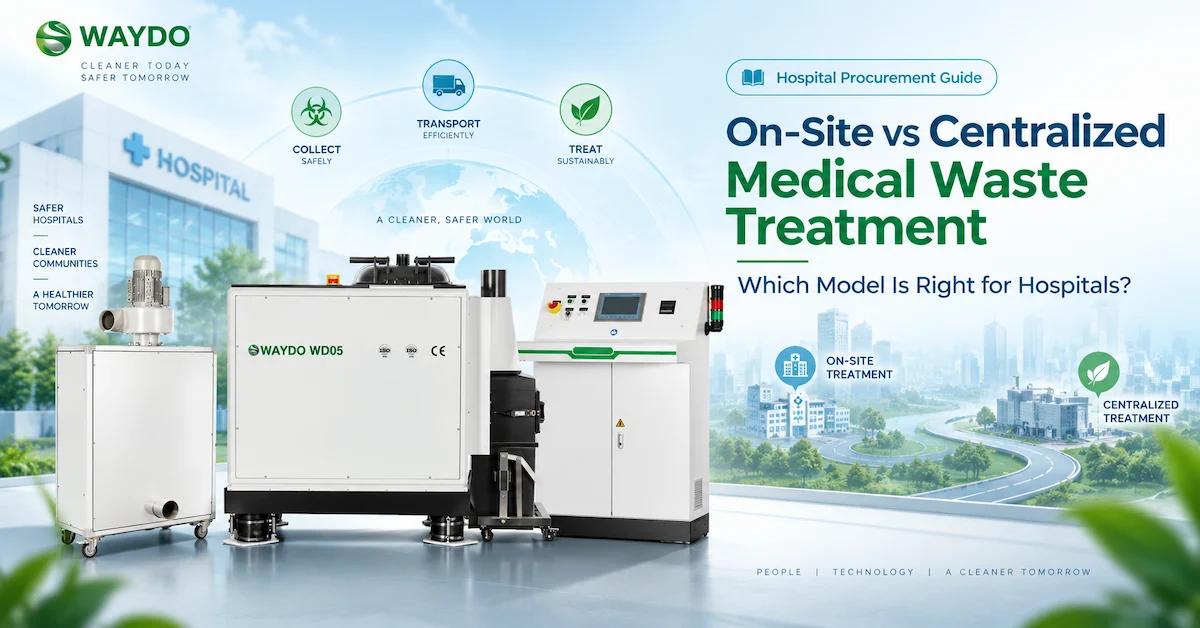
WAYDO is the equipment series used in WEIDUN’s FHT offering. The published range provides four capacity options:
| Model | Published processing capacity | Published vessel volume | Relative position in the range |
|---|---|---|---|
| WAYDO WD05 | 18 kg/hour | 150 L | Lowest listed hourly capacity |
| WAYDO WD15 | 40 kg/hour | 170 L | Capacity step above WD05 |
| WAYDO WD50 | 115 kg/hour | 450 L | Higher-throughput option |
| WAYDO WD330 | 280 kg/hour | 670 L | Highest listed hourly capacity |
These are manufacturer-published figures, not a guarantee of output with every waste mixture. Vessel volume is also not necessarily the approved loading volume. Obtain the current technical sheet and the basis for the hourly capacity before approving a model.
Operating time makes a substantial difference to the requirement. As a simple illustration, 240 kg divided across six productive hours requires an average of 40 kg/hour; processing the same quantity in three productive hours requires 80 kg/hour. This calculation does not include reserve capacity or establish equipment suitability. It shows why daily waste mass alone is insufficient. WEIDUN’s capacity-planning guide likewise emphasizes actual waste measurement and operating conditions rather than selection by bed count alone.
What Should the Installation and Equipment Review Cover?
A practical review starts with the movement of containers through the room. Mark the incoming holding position, loading access, discharge area, operator route and maintenance clearances. Add the equipment delivery route and the required utility connections. WEIDUN lists automatic loading, removable residue bins and exhaust filtration as options; the quotation should identify which are included rather than leaving the configuration implicit.
The equipment review should be equally specific. Request the chamber and rotor material specifications, wear-part identification, maintenance-access requirements and available manufacturing inspection records. During acceptance, check the agreed construction details, guarding, seals and accessible joints against the specification. These are recommended procurement checks, not claims that every material grade or inspection result is already disclosed in the public catalogue.
Do not translate “no external steam boiler” into “no site work.” Electrical supply, cooling water, ventilation and any discharge requirements still need to be addressed in the project design.
How Should Treatment Performance and Quality Be Verified?
Separate three types of evidence. First, obtain treatment-validation information covering the proposed model, accepted materials and loading conditions. Second, establish the routine records that operators will review during use. Third, confirm the documents and approvals required for the destination project. A company qualification, a microbial-reduction report and permission to operate a facility answer different questions.
WEIDUN’s monitoring and technical support services include batch reports, treatment records, alarm tracking and traceability functions. Ask to see the proposed record format and agree who reviews incomplete cycles, authorizes subsequent handling and retains the documentation. Treat this as part of commissioning, alongside training and the approved operating procedures.
A useful procurement deliverable is a written acceptance plan prepared before shipment. It should state what will be demonstrated, which records will be supplied and how outstanding findings will be resolved. This avoids relying on an impressive operating demonstration without a shared definition of acceptance.
What Happens to Medical Waste After FHT Processing?
Treatment and final disposal are separate decisions. Identify the receiving facility, output acceptance requirements, packaging and transport arrangements before committing to equipment. Shredded appearance should not be used as the sole basis for deciding where the material can go.
WEIDUN’s waste-to-energy information describes a possible downstream route into refuse-derived fuel, or RDF. That route involves additional preparation, which may include removing metals and inert materials, adjusting moisture and producing a consistent fuel. It is not an automatic consequence of completing an FHT cycle.
The FHT machine does not itself generate electricity. Any resource-recovery proposal needs an actual receiving arrangement and the relevant acceptance conditions. For financial evaluation, treat unconfirmed RDF revenue as a separate possibility rather than including it in the base-case return.
What Determines the Cost of a Frictional Heat Treatment Project?
The purchase price is only one part of the comparison. WEIDUN’s medical waste treatment cost guide identifies capacity, configuration, installation and ongoing operating requirements as important cost factors. A project budget should distinguish the initial investment from recurring expenditure and identify what is excluded from the equipment quotation.
For your own comparison, include site preparation, utilities, commissioning, operator time, maintenance, replacement parts, treatment verification and residue handling. Use the same cost categories when evaluating the existing service. Otherwise, one option may appear cheaper simply because some costs have been left outside the calculation.
Consider the charging basis carefully. A contractor charging by kilogram does not necessarily reduce its invoice in proportion to the space saved in a collecting bin. Fixed collection fees may also remain. Request a project-specific estimate supported by your waste quantities, utility prices and existing invoices rather than a universal payback claim.
How Can WEIDUN Support Configuration and Delivery?
WEIDUN’s project services cover waste assessment, capacity sizing, layout planning, training, maintenance, spare parts and deployment coordination. Its solution range also includes custom modules for integration with existing infrastructure. These services provide a basis for a technical discussion, but the responsibilities and commercial scope should be confirmed for the actual location.
For customization or OEM/ODM enquiries, describe each requested change separately: loading arrangement, equipment interface, reporting function, branding or design modification. Custom integration should not be assumed to include every private-label or design-ownership requirement. Obtain written confirmation of feasibility, verification work, cost and delivery implications.
To begin, send the project country, waste categories, average and peak daily quantities, available operating hours and a basic floor plan. Ask for a proposed configuration, utility requirements, documentation package, itemized price and delivery milestones. Request an FHT feasibility review and WAYDO model recommendation before treating a catalogue model as a finalized project solution.
Frequently Asked Questions
Is frictional heat treatment the same as incineration?
No. WEIDUN describes FHT as a non-burning process. It uses mechanical processing to generate heat and integrates that heating with shredding, rather than burning waste. The process overview above links to the relevant technology description.
Is FHT simply a medical waste shredder?
No. Shredding changes physical form, while the FHT process also includes controlled thermal treatment, cooling and discharge. The resulting particle appearance is not a substitute for evidence that the specified treatment conditions were achieved.
Does FHT require chemical disinfectants?
WEIDUN’s published FHT design does not require chemical additives for the treatment process. That statement should not be extended into a claim that the whole facility needs no cleaning materials or other maintenance consumables.
Does the system need electricity and water?
Yes. Mechanical heat generation still requires energy input, and WEIDUN’s published process includes water-injection cooling. Request the selected model’s electrical requirements, cooling-water information and associated installation details.
Does 6 Log10 mean every batch is automatically acceptable?
No. It describes a reduction level under specified measurement conditions. Acceptance also depends on the applicable process, load and verification requirements. Agree on routine records and the response to interrupted or incomplete treatment during commissioning.
Can every material listed as medical waste be processed together?
No. Define an approved waste matrix for the project. Department names and general waste descriptions do not establish compatibility, and a material’s presence on a broad website list should not replace model-specific confirmation.
Is a larger WAYDO model always the better choice?
No. Compare capacity with the actual waste stream, productive operating hours and anticipated peaks. A larger catalogue figure does not resolve installation, staffing or disposal constraints. The appropriate model is the one supported by the project assessment.
How long does an FHT project take to deliver?
Obtain a project-specific schedule. Manufacturing, shipping, site preparation, commissioning and readiness to operate are separate milestones. Confirm when each period starts and which approvals or information the buyer must provide.
What should the quotation say about maintenance?
Request the wear-part list, maintenance responsibilities, recommended spare-parts package, warranty scope and diagnostic arrangements. Establish who performs local service and which costs remain with the facility rather than relying on a general after-sales statement.
Can treated residue be sold as RDF immediately?
Not automatically. The proposed receiving facility must accept the material, and further preparation or testing may be needed. Confirm that route before assigning revenue to it; the FHT treatment cycle alone does not establish a commercial fuel specification.
Conclusion
Frictional heat treatment for medical waste combines mechanical destruction and thermal processing in an integrated equipment cycle. For healthcare buyers, its value is not just the ability to generate heat without an external steam boiler, but the opportunity to combine functions within a defined treatment workflow. Selecting the right installation still requires a clear waste profile, verified performance, suitable capacity, workable site conditions and a confirmed route for the residue. Contact WEIDUN to assess your waste stream, compare WAYDO models and develop a project-specific FHT proposal.