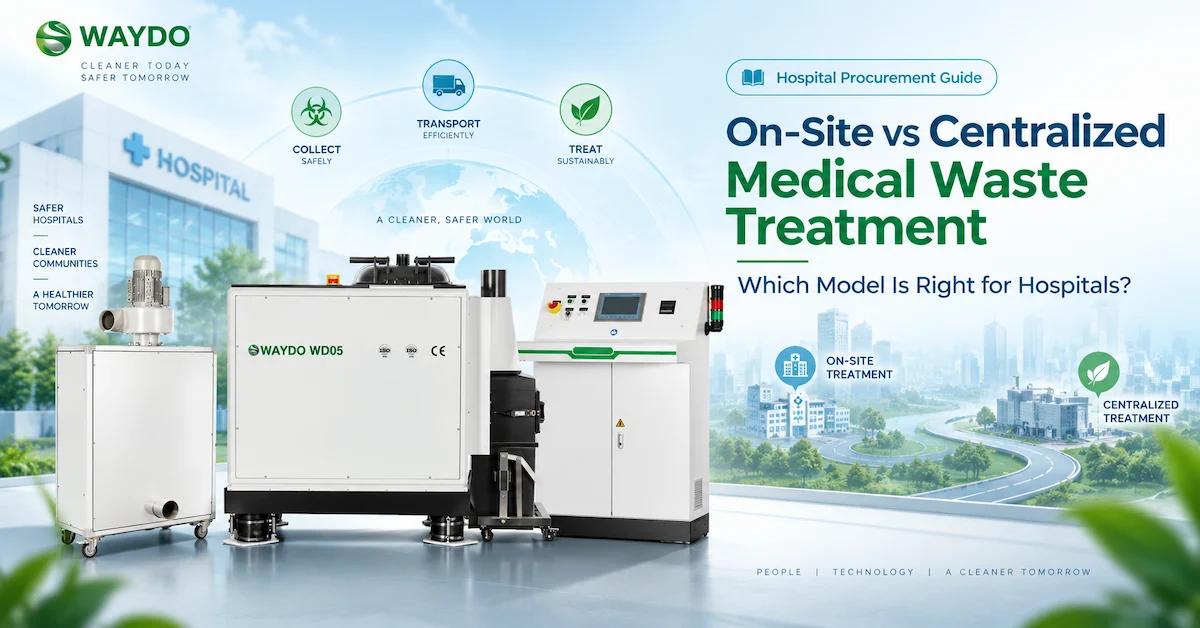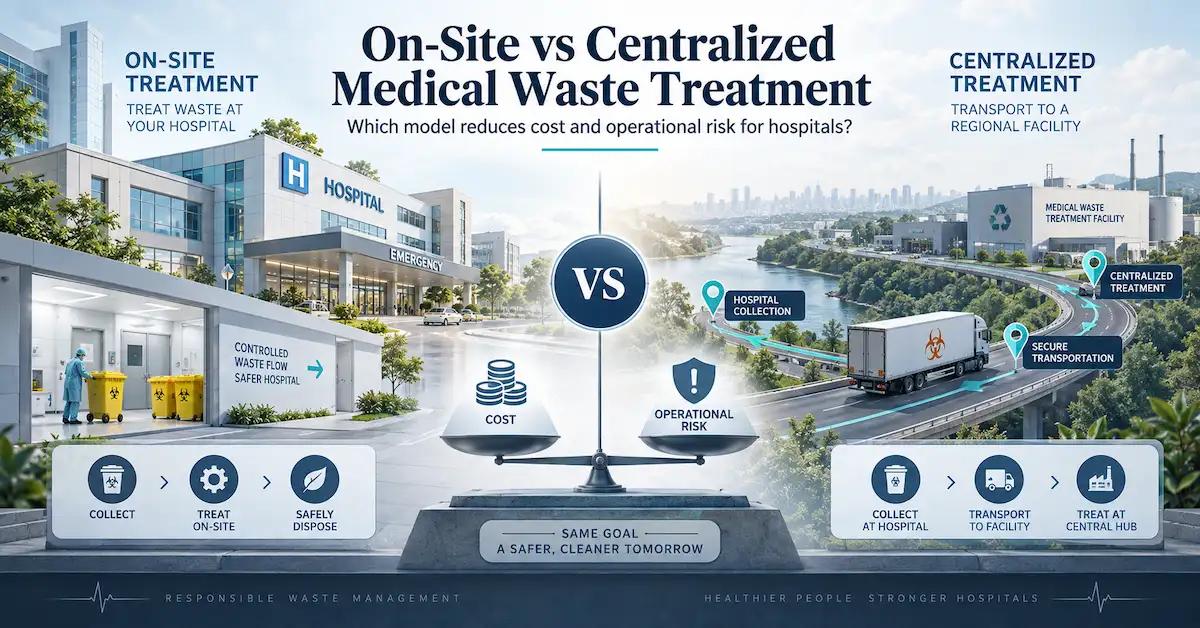

An on-site medical waste treatment system processes eligible infectious waste at the healthcare facility rather than sending it elsewhere untreated. In WEIDUN’s FHT design, shredding and thermal treatment take place in the same vessel, followed by cooling and discharge.
The heat comes from mechanical friction—not combustion. WEIDUN’s Frictional Heat Treatment technology combines these operations in one treatment cycle without an external steam boiler or a pressure vessel.
For a hospital buyer, understanding the machine is only half the decision. The other half is practical: which waste can enter it, how much it can handle during the available shift, what the room needs, and where the residue will go.

1. What Changes When Treatment Moves On-Site?
The main change is control over where and when eligible waste is treated. The project still needs a collection route, trained operators, treatment records and an agreed downstream destination.
WEIDUN’s approach connects department collection, weighing and handover with on-site processing. Its medical waste management overview presents equipment and traceable records as parts of the same workflow.
For procurement planning, consider three different needs:
Hospitals: Match daily and peak waste quantities to staffing, treatment hours and the available room.
Laboratories and diagnostic facilities: Define the waste composition carefully before discussing capacity.
Healthcare groups and project contractors: Establish site-by-site requirements, reporting needs and responsibility for installation and service.
An on-site medical waste treatment system deserves closer evaluation where those responsibilities can be assigned. For a small, irregular waste stream, compare the complete operating commitment with the existing collection service before investing.
2. Which Waste Should Be Included in the Project?
WEIDUN’s treatable materials guide lists contaminated dressings, disposable protective equipment, tubing, dialysis components and selected laboratory consumables. It also lists sharps after proper collection.
Use these categories to begin the discussion—not as approval for every mixed clinical bag.
Request a written acceptance matrix for the proposed model. It should identify permitted materials and containers, loading limits, restrictions on liquids and excluded objects. Keep pharmaceutical, chemical, cytotoxic and unusual pathological streams outside the standard infectious-waste proposal until their appropriate treatment routes are established.
Radioactive materials and flammable or explosive compounds are explicitly excluded from WEIDUN’s published FHT acceptance list.
For procurement purposes, a useful description is “contaminated dressings, disposable PPE and approved tubing, approximately X kilograms per day.” “All hospital waste” is too broad to support equipment selection.
3. How an On-Site Medical Waste Treatment System Works
WEIDUN’s FHT process description sets out five equipment stages. The explanation below is for project evaluation; installed equipment must be operated according to its approved instructions.
Loading and pre-shredding
Eligible waste enters the chamber manually or through a specified automatic loading arrangement. The rotor begins breaking down the material.
Before ordering, confirm accepted container types, batch limits and loading access. Include the loading arrangement in the quotation rather than leaving it as an installation-day decision.
Frictional heating
Continued shredding and mixing convert mechanical energy into heat inside the vessel.
No external steam boiler does not mean no utility requirements. Request the electrical load and consumption information for the selected configuration.
Controlled thermal treatment
The published process describes a 150°C treatment stage. Moisture within the waste contributes to a moist-heat environment.
Ask for the validated exposure conditions and representative loading data. A displayed temperature is one process measurement, not a complete acceptance report.
Cooling
Water is injected to cool the treated material.
This makes cooling-water requirements part of the site review. Confirm the connection, consumption and any associated discharge arrangements before finalizing the room layout.
Discharge
The machine discharges shredded residue into the collecting arrangement.
Define the next steps during commissioning: record review, batch identification, handling and transfer to the agreed destination. Do not base a release decision solely on the material’s appearance.
4. FHT Specifications: Read the Figures With Their Conditions
WEIDUN publishes the following process-level figures. They are a starting point for technical review, not unconditional guarantees for every model or waste mixture.
| Parameter | Published FHT information | What to confirm for your project |
|---|---|---|
| Treatment temperature | 150°C treatment stage | Exposure conditions, measurement locations and load limits |
| Cycle duration | Approximately 25–35 minutes | Included stages, loading conditions and total turnaround time |
| Microbial reduction | Manufacturer-stated 6 Log10 | Test organism, method, representative load and supporting report |
| Volume reduction | Up to 80% | Waste composition and input/output measurement method |
| Weight reduction | Up to 30% | Moisture basis and representative measurements |
| Heat generation | Mechanical friction | Model-specific electrical requirements |
| Cooling | Water injection | Supply requirements and discharge arrangements |
The temperature, duration and reduction figures above follow the published FHT process information; the heating principle is described in the technology overview linked earlier.
For an on-site medical waste treatment system, keep the distinction between published performance and project acceptance evidence clear. Six-log reduction means a million-fold reduction in the measured population; that number alone does not establish the outcome for every organism or load.
5. Which WAYDO Model Matches Your Treatment Demand?
The WAYDO range provides four published capacity options. Compare them against the accepted waste stream and operating window—not the model name or hospital bed count alone.
| Model | Published processing capacity | Vessel volume | Published equipment dimensions, mm |
|---|---|---|---|
| WAYDO WD05 | 18 kg/hour | 150 L | 1,700 × 800 × 1,900 |
| WAYDO WD15 | 40 kg/hour | 170 L | 1,590 × 780 × 1,995 |
| WAYDO WD50 | 115 kg/hour | 450 L | 2,475 × 1,200 × 2,780 |
| WAYDO WD330 | 280 kg/hour | 670 L | 2,475 × 1,200 × 3,080 |
These are manufacturer-published figures. Confirm the current datasheet, configuration and capacity-test conditions before purchase.
Vessel volume is not necessarily the approved loading volume. Equipment dimensions are not the complete working footprint: loading, collection bins, servicing and access require their own space.
The practical comparison is therefore not just “which model is larger?” It is “which model meets our demand under the conditions we can actually provide?”
6. Calculate Capacity From the Available Working Hours
Consider an illustrative facility generating 180 kg of accepted waste per day. It schedules six treatment hours and assumes 75% of that window is productive.
Its initial throughput calculation is:
180 kg ÷ (6 hours × 0.75) = 40 kg/hour.
These are planning assumptions, not measured WAYDO results or a recommended universal allowance.
A published 40 kg/hour rating would only match this calculation. It would not establish reserve capacity for heavier days, changes in waste composition or planned downtime.
When sizing an on-site medical waste treatment system, check the basis of the supplier’s hourly rating. Loading, cooling and turnaround may already be included; applying another allowance without checking could count the same time twice.
Before selecting a model, agree on peak demand, future workload and a contingency route when the equipment is unavailable.
7. Plan the Room Around the Workflow
Start with a marked-up room drawing rather than a rectangle representing the machine.
Include incoming containers, the loading position, residue collection, operator movement and maintenance access. Check the delivery route as well: doorways, corridors and lifting arrangements need review before shipment.
WEIDUN’s system configurations and accessories include fixed installations, mobile units and custom modules, plus options such as automatic loading, removable collecting bins and exhaust filtration.
Specify which of these belong in your proposal. A fixed hospital installation and a containerized project should not share an assumed utility or ventilation plan.
For an on-site medical waste treatment system, request electrical, cooling-water, ventilation and any drainage requirements together. For the equipment itself, ask for chamber and rotor material specifications, wear-part details, guarding arrangements and service clearances.
Have the intended maintenance team review component access and replacement procedures before approving the installation—not after the first repair.
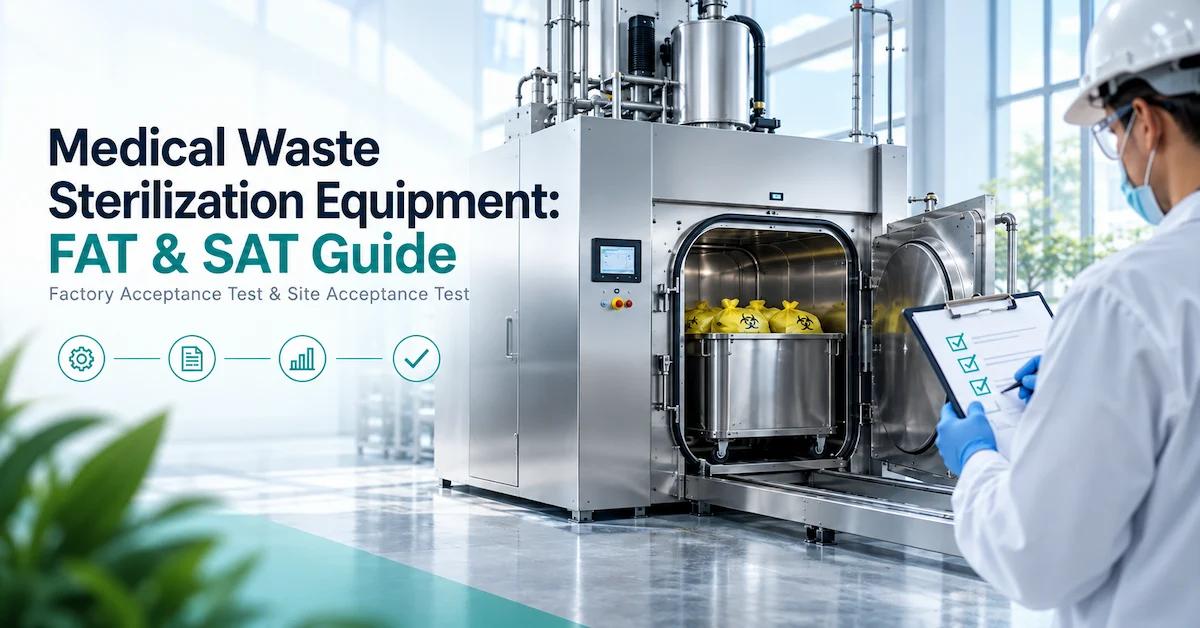
8. What Should Buyers Verify Before Acceptance?
Organize the evidence request around three questions.
Does the treatment evidence cover our load? Request model-specific validation documents identifying test methods, operating conditions and accepted materials. Keep equipment performance evidence separate from documents about company qualifications.
Can the facility demonstrate what happened in each batch? Review sample cycle records, alarms and the proposed batch-release procedure. Agree on responsibility for interrupted or incomplete cycles.
Is the project ready for its intended location? Confirm the applicable installation, operating and downstream disposal requirements with the responsible parties before purchase.
For an on-site medical waste treatment system, a general brochure should not replace this evidence package. Request manufacturing inspection records and any relevant project references that WEIDUN is authorized to share.
Use commissioning to establish the approved operating procedures, training scope, recordkeeping and acceptance criteria in writing.
9. Where Does the Treated Residue Go?
The equipment completes a treatment cycle, but the project still needs a destination for the output.
Agree on the residue’s acceptance criteria, packaging, transport and receiving facility before committing to equipment. Do not assume that shredded material automatically qualifies for unrestricted disposal.
WEIDUN’s treated-waste-to-RDF pathway describes further processing that may include separating metals and inert material, adjusting moisture and creating a consistent fuel.
That is a downstream option, not an automatic result of installing FHT equipment. The receiving facility’s specifications and applicable approvals still need confirmation.
FHT does not itself generate electricity. Keep potential RDF revenue out of the base financial calculation until an actual acceptance arrangement exists.
10. What Determines the Cost of On-Site Treatment?
Compare the current waste-management arrangement with a complete proposed operating budget.
Separate the initial investment—equipment, installation, utilities and commissioning—from recurring expenditure such as electricity, water, labor, maintenance, replacement parts and residue handling.
An on-site medical waste treatment system may change external treatment requirements, but any saving needs to be tested against actual charging arrangements.
For example, an 80% reduction in volume does not mean an 80% reduction in a bill charged by weight. A fixed collection fee may remain even when less material is collected.
For a lifecycle comparison, include annualized capital cost and use the same cost categories for both alternatives. Calculate cost per kilogram using material successfully treated, not only the machine’s theoretical maximum.
Request an itemized proposal with operating assumptions. That gives procurement and finance teams something they can check against invoices, staffing plans and local utility prices.
11. Installation, Customization and Ongoing Support
WEIDUN’s project implementation and after-sales services include waste assessment, capacity sizing, layout planning, operator training, maintenance, spare parts and deployment coordination. The published service scope also includes batch reporting, alarm tracking and multi-site monitoring.
Confirm what is included for your location and configuration.
For a customized installation, separate mechanical integration, loading automation, software requirements and any OEM/ODM request. Ask for written confirmation of the scope, verification work, ownership arrangements where relevant, and additional cost.
Also separate manufacturing time from the full project schedule. Shipment, site readiness, commissioning and authorization to operate are different milestones. Obtain a dated proposal rather than relying on a generic lead-time statement.
Long-term support should be equally specific: name the wear parts, warranty exclusions, diagnostic process and responsibility for local labor. A service promise is most useful when it explains what happens after an alarm or breakdown.
12. What to Send for a Model Recommendation
Start with your project country, waste categories, average and peak daily quantities, and available treatment hours. Add the room dimensions, utility information and planned residue destination when available.
The first enquiry does not need a finished engineering package. Label estimates clearly and identify the information still being measured.
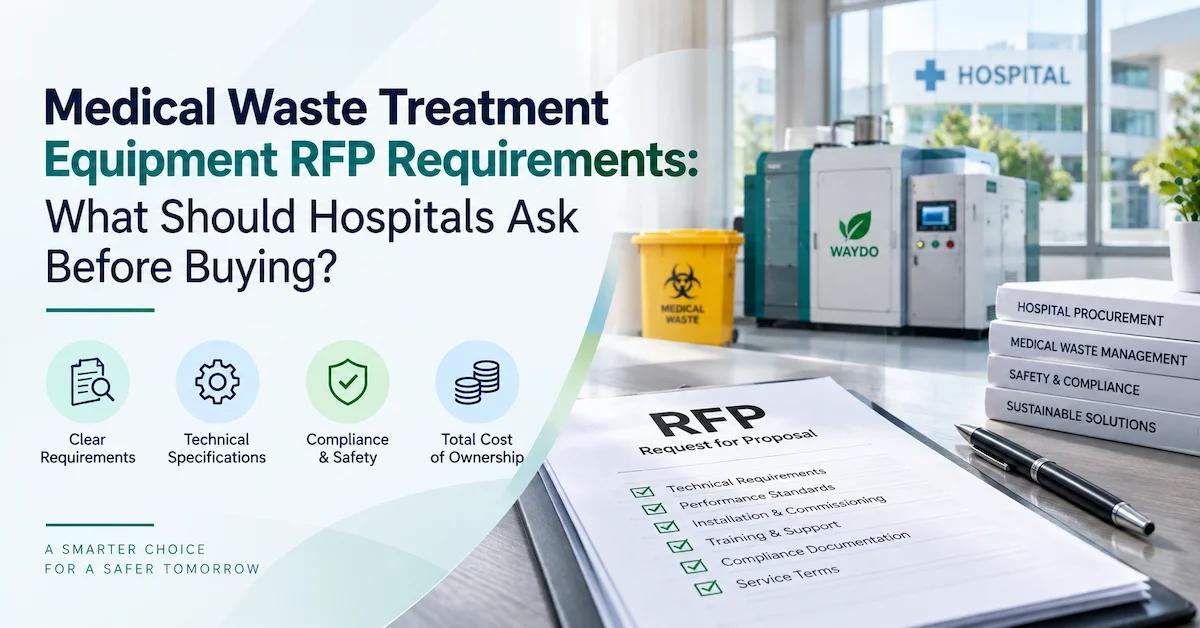
Ask WEIDUN to respond with a model recommendation, waste-acceptance assumptions, required utilities, installation scope, validation documents and an itemized quotation.
Request a WAYDO model recommendation and site assessment.
A proposal built around those inputs is easier to evaluate than a machine price supplied without a waste profile or operating schedule.
13. Frequently Asked Questions
Is an on-site medical waste treatment system an incinerator?
Not necessarily: “on-site” describes the location. WEIDUN’s FHT equipment uses mechanical friction and thermal treatment rather than burning the waste. This article describes that FHT workflow, not every on-site technology.
Does WEIDUN FHT require an external steam boiler?
The published design does not require an external steam boiler or pressure vessel. Electrical supply and cooling-water arrangements still need to be confirmed for the selected model.
Can sharps and dialysis waste be included?
WEIDUN lists properly collected sharps and selected dialysis components among its treatable materials. Obtain written confirmation covering your actual items, containers and liquid content before including them in the load specification.
Can pharmaceutical or chemical waste be added to an infectious-waste batch?
Do not assume that it can. Identify these streams separately during assessment and obtain an appropriate treatment plan. A general medical-waste description is not enough to authorize a mixed load.
How long does one FHT cycle take?
WEIDUN publishes approximately 25–35 minutes. Confirm the load conditions and included stages before using that range in a daily-throughput calculation.
Can a small clinic use the system?
Evaluate accepted waste quantity, staffing, space and total operating cost first. A small facility should compare a suitable equipment proposal with its existing service rather than deciding from capacity alone.
How much installation space is needed?
Use the selected model’s dimensions as the starting point, then add loading, bins, maintenance access and utility connections. Request a layout based on the actual room and equipment delivery route.
What happens when a batch is interrupted?
Follow the installed system’s approved procedure and technical-support instructions. Define isolation, record review and any authorized reprocessing route during commissioning. Appearance alone should not determine whether the material is released.
Is automatic loading or remote monitoring included?
WEIDUN lists automatic loading as an option and offers monitoring-platform integration. Confirm the supplied hardware, software, reporting functions and commercial scope in the quotation rather than assuming every feature is standard.
How can a buyer obtain an accurate price and schedule?
Provide the waste profile, capacity requirement, project location, site conditions and required accessories. Request separate details for equipment, installation, training, support and delivery milestones so the proposal can be evaluated properly.
Conclusion
An on-site medical waste treatment system should be selected as part of a working hospital process, not as an isolated machine purchase. WEIDUN’s FHT approach combines shredding, frictional heating, controlled treatment, cooling and discharge in one equipment cycle.
The value of that approach depends on the fit: accepted waste, verified performance, sufficient capacity, a workable room layout, trained operators and a defined residue destination.
Start with those requirements, then compare WAYDO models and the support needed to keep the project operating. Clear technical inputs make both the equipment recommendation and the financial evaluation more useful.