
Quick Answer: Start an on-site vs centralized medical waste treatment study with the route, not the machine. Measure the accepted waste, map every handover and price a real outage. Treating at the hospital keeps the untreated journey short, although the hospital must provide the room, operators and service. A central plant spreads technical resources across more generators, while collection vehicles and custody records become part of daily performance. Compare both routes over five to ten years and keep excluded waste in the budget.
Introduction: one waste stream, three possible operating models
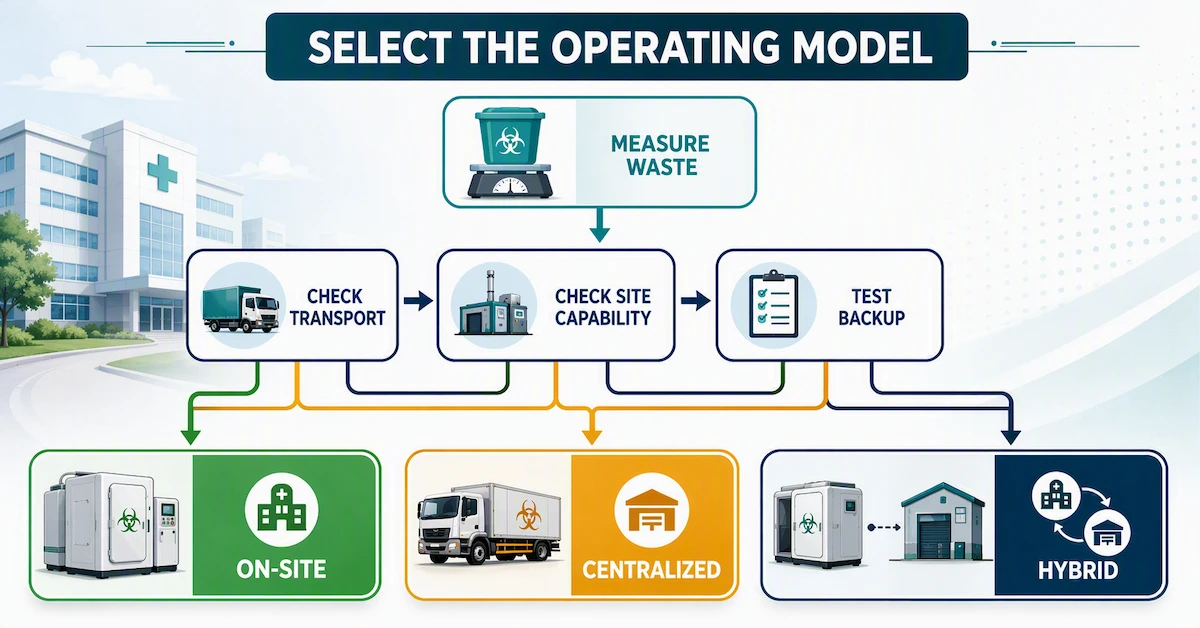
A bag leaving a hospital ward can take three quite different journeys. It might reach a treatment room down the service corridor, cross the campus to a shared utility building, or leave in a licensed collector’s vehicle for a regional plant. Even when those destinations use similar thermal equipment, the bag passes through different hands, waits in different stores and creates a different trail of records and invoices.
Hospital management, infection prevention, engineering and purchasing all see a different piece of that journey. Bring those views together early. Otherwise, a compact unit may spend most of its life idle, a shared plant may receive more waste than it can clear, or several hospitals may discover that one disrupted road is their only route out. The workable answer has to reflect how the network runs on an ordinary day and on its worst credible day.
This guide compares cost and day-to-day performance without assuming that one model always wins. It also explains where a hybrid network makes more sense than a strict either-or decision.
What is on-site vs centralized medical waste treatment?
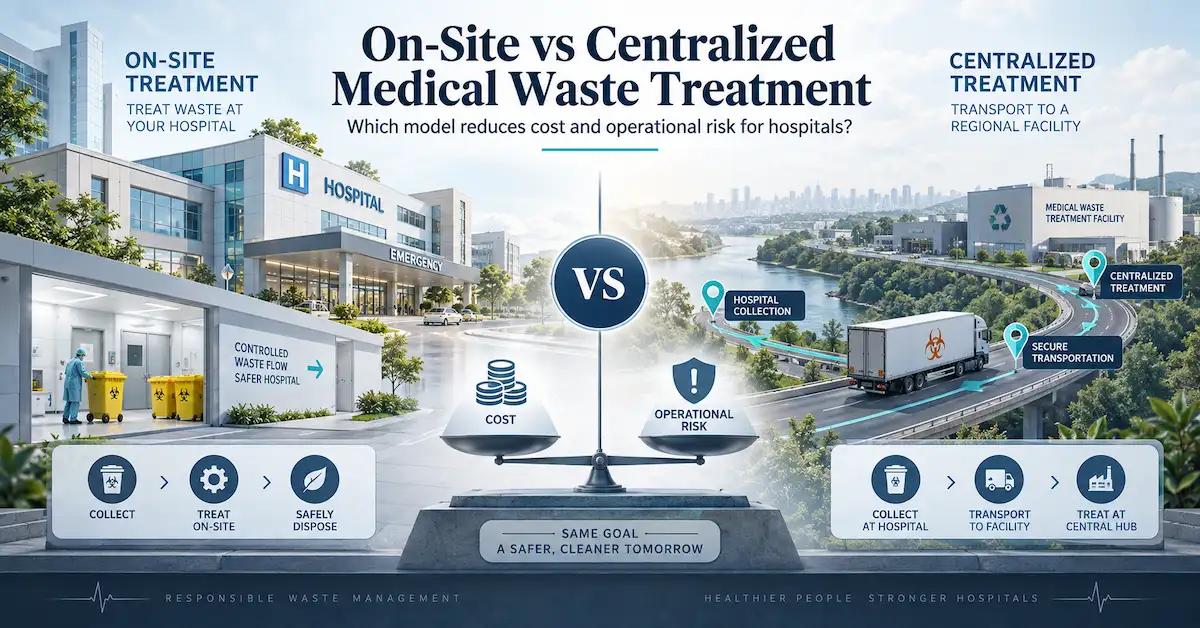
On-site vs centralized medical waste treatment is a planning comparison between treating eligible healthcare waste at or near its point of generation and consolidating waste from several departments or facilities at one larger treatment location.
Three models should be kept separate:
- A unit at the generating facility: the clinic, hospital or laboratory runs an authorized process on its own premises.
- A hub shared inside a network: waste from several buildings or hospitals meets at one plant owned by their organization, municipality or health system.
- A contracted plant beyond the site: a licensed waste company collects the containers and carries out treatment under a commercial agreement.
The second and third models are both centralized, but their contracts and accountability differ. A hospital group may own its shared hub and retain operational control. With an external commercial plant, the generator still has duties for segregation, packaging and records, while treatment and transport responsibilities are divided by law and contract.
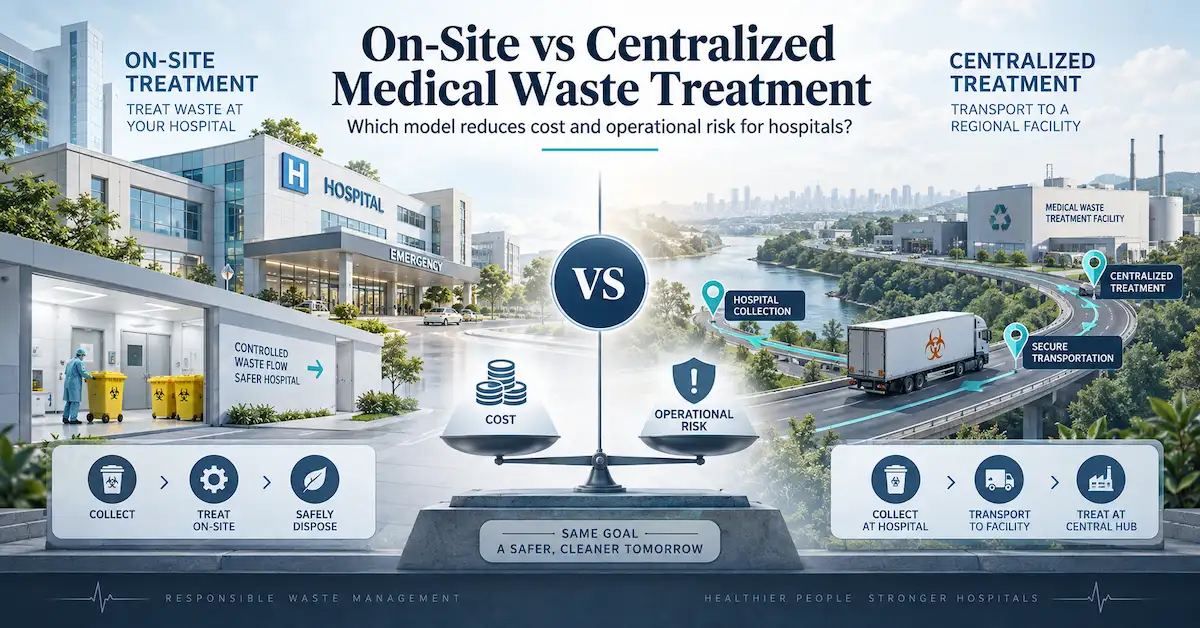
The purpose of each model is the same: move accepted waste from generation to a validated treatment step and then to an authorized final destination without exposing workers, patients or the public to avoidable risk.
A direct comparison for hospital decision-makers
The following table is a screening tool. Local law, geography and the actual waste mix control the final decision.
| Decision factor | Facility-level on-site treatment | Shared or commercial centralized treatment |
|---|---|---|
| Untreated-waste journey | Short internal route, often within one controlled site | Longer route with collection, loading, road transport and receiving steps |
| Scale | Equipment is sized for one facility or a small cluster | Larger plant can aggregate volume from many generators |
| Capital responsibility | Generator normally funds the equipment and room | Plant owner funds the central system; generators may pay service or network charges |
| Operator model | Hospital or clinic trains its own operators | Specialist plant team operates the treatment process |
| Storage pressure | Frequent treatment may reduce holding time | Waste may wait for a scheduled pickup or transfer window |
| Resilience | A single small unit needs a backup contractor or second route | A larger plant may offer redundancy, but transport failure can still stop collection |
| Traceability | Direct batch control within the facility | Requires strong manifests, custody records and receiving reconciliation |
| Expansion | Additional shifts, a larger unit or another local unit may be needed | Capacity can be shared, but network growth can overload the hub |
| Best first fit | Remote sites, steady compatible loads, transport constraints or strict internal control needs | Dense service areas, reliable roads, many small generators or a well-run regional network |
Do not score the table by counting which column has more advantages. Weight each factor. A remote hospital may assign far more importance to transport reliability than a city clinic located ten minutes from a licensed plant.
When on-site medical waste treatment is the stronger fit
Put on-site medical waste treatment on the shortlist when the infectious-solid load is steady enough to plan and the facility can genuinely look after an industrial system. The case becomes more interesting at a remote hospital where the collector misses dates, a rainy-season road closes, the waste store fills quickly or policy calls for prompt inactivation before a container goes off the premises.
In practical terms, the site may gain:
- Fewer handovers of untreated infectious waste.
- Shorter holding time between generation and treatment.
- Direct access to cycle records and alarm history.
- The ability to schedule treatment around the facility’s peak load.
- Reduced dependence on long-distance collection for accepted materials.
- Faster containment of a temporary surge when adequate spare capacity exists.
Those benefits come with obligations. The facility becomes responsible for trained operators, preventive maintenance, calibration, validation, failed-load quarantine and an approved residue route. It also needs a legal backup path when the unit is unavailable. Ownership transfers work; it does not make the work disappear.
An on-site system is a weak choice when the accepted fraction is tiny, most waste carries chemical or radioactive hazards, the treatment room cannot support the utilities, qualified operators are not available or the facility cannot maintain the system. In that setting, a dependable specialist service may be safer and cheaper.
When centralized medical waste treatment is the stronger fit
Centralized medical waste treatment combines waste from multiple generators at one treatment plant. This model can make skilled staff, validation resources, maintenance capability and spare equipment available at a scale that individual clinics cannot justify.
It tends to work well when:
- Many small generators operate within a practical collection radius.
- Roads and licensed transport services are reliable throughout the year.
- The central plant has enough receiving, cold or controlled storage and treatment capacity for peak arrivals.
- The operator can reconcile every manifest with the received load and treatment batch.
- The network includes alternate vehicles, treatment capacity and emergency storage.
- The final disposal route is integrated with the central facility.
Centralization can lower treatment cost per kilogram by spreading capital, technical staff and validation over more waste. The advantage is not automatic. A long collection radius, half-empty trucks, repeated small pickups, traffic delays, fuel, transfer stations and damaged containers can consume the scale benefit.
A centralized medical waste disposal facility also concentrates operational consequences. If the plant stops and no alternate route exists, many hospitals may be affected at once. The design basis should therefore include redundant treatment capacity, preventive maintenance windows, maximum receiving storage and a documented overflow agreement.
On-site vs off-site medical waste treatment: where the risks move
The phrase on-site vs off-site medical waste treatment describes more than the location of a machine. It describes where untreated waste is handled and who controls each handover.
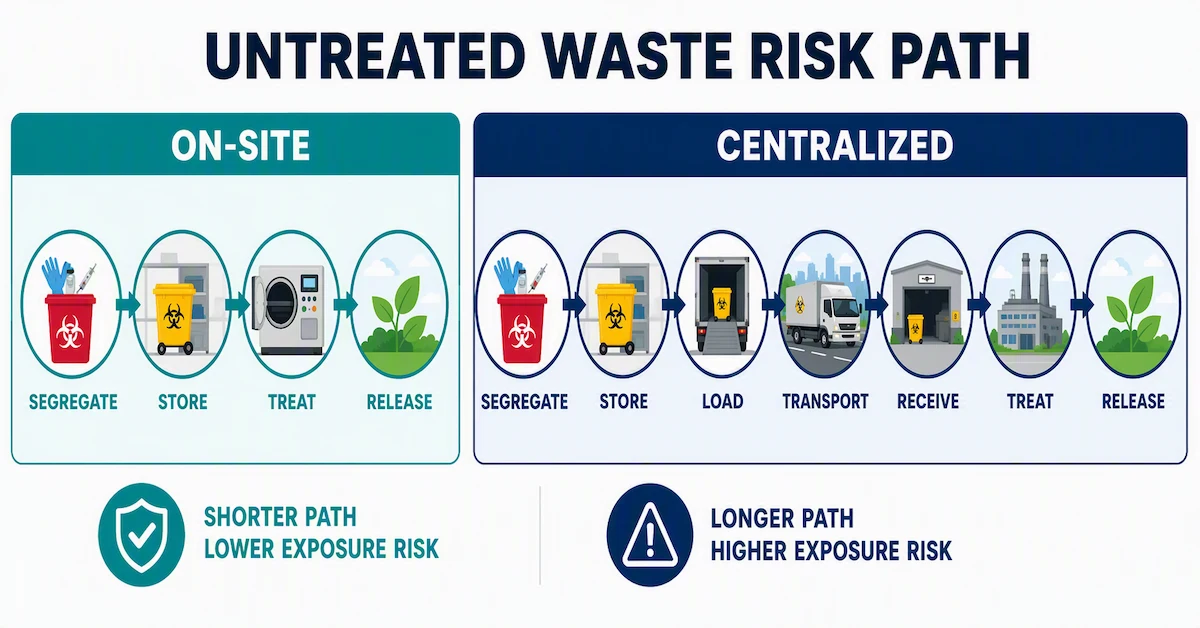
For on-site treatment, the main handling points are segregation, internal collection, temporary storage, loading, treatment, release and residue removal. For off-site treatment, add vehicle loading, public-road transport, unloading, receiving inspection and reconciliation at the remote plant. Those extra stages can be managed safely, but they must be visible in the risk assessment.
CDC guidance says regulated waste awaiting treatment should be stored in suitable containers and controlled areas, and that off-site movement should use closed, impervious containers where treatment is not available at the generation site. WHO guidance similarly treats classification, segregation, storage, transport, treatment and final disposal as one connected pathway.
The practical question is not “Is transport dangerous?” It is “What controls make this particular transport route dependable?” Review:
- Container strength, closure and compatibility with the waste.
- Labels that remain legible, manifests that reconcile, and a custody record for every transfer.
- Vehicle design, cleaning, spill equipment and security.
- Route distance, road condition, weather and traffic interruptions.
- Maximum pickup interval and storage time at each generator.
- Receiving hours, rejected-load procedure and emergency contact.
- Insurance, transporter authorization and incident reporting.
Medical waste treatment cost comparison
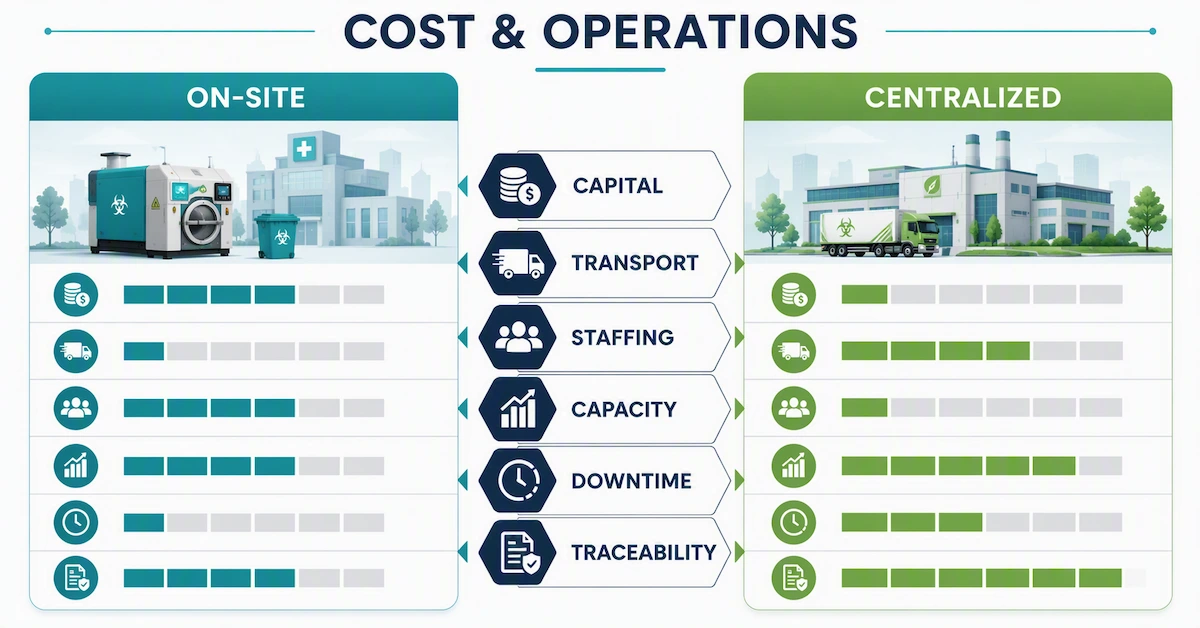
A fair medical waste treatment cost comparison uses the same waste scope and time horizon for both models. Comparing an on-site machine price with a centralized service fee produces a distorted result because the two figures include different responsibilities.
On-site cost structure
An on-site model may include:
- Equipment, freight, import costs and insurance.
- Room preparation, electrical work, drainage and ventilation.
- Commissioning, qualification and operator training.
- Electricity, water, cleaning materials and process consumables.
- Direct labor for movement, weighing, loading, review and discharge.
- Calibration, indicators, revalidation and compliance records.
- Preventive maintenance, wear parts and repair response.
- Treated-residue containers, transport and final disposal.
- Backup collection during maintenance, failure or peak demand.
- Specialist disposal for all excluded waste.
Centralized cost structure
A centralized model may include:
- Generator containers and internal storage.
- Collection charges or network vehicle ownership.
- Driver labor, fuel, insurance, permits and vehicle cleaning.
- Transfer station or receiving labor where applicable.
- Treatment fee by kilogram, container, pickup or contracted minimum.
- Manifest administration and rejected-load charges.
- Peak, emergency, distance or fuel surcharges.
- Final disposal charges not included in the treatment fee.
- Internal governance or contract-management cost.
Use an auditable TCO calculation
On-site TCO = installed capital + operating labor + utilities + maintenance + validation + residue route + backup route + excluded-waste service
Centralized TCO = containers + storage + collection + transport + treatment fee + surcharges + contract management + rejected-load and emergency costs
Run both calculations for five or ten years. Use present local invoices, not a generic saving percentage. Then test a low-volume year, the expected year and a peak year. A route that wins only under perfect utilization is not a resilient business case.
| TCO question | Why it changes the result | Evidence to request |
|---|---|---|
| What fraction is actually compatible? | Excluded material keeps its current specialist cost | Seven-day waste audit and written acceptance matrix |
| How often will the unit or truck run? | Half-empty cycles and pickups raise unit cost | Batch schedule, route plan and utilization assumption |
| What happens during downtime? | Emergency storage or collection may be expensive | Backup contract, response time and quarantine limit |
| Who owns final disposal? | Treatment does not always include residue transport | Written acceptance and price from the destination |
| How fast will volume grow? | Early oversizing wastes capital; late undersizing creates backlog | Three demand cases and expansion trigger |
| Which costs escalate? | Labor, fuel, service and disposal may rise differently | Escalation assumptions stated by cost category |
Request an On-Site vs Centralized Cost Review
Operational comparison: control, staffing and daily workflow
Cost is only half the decision. The operating model has to work on a difficult Monday morning, during a public holiday and after a maintenance alarm.
Daily control
With on-site treatment, the hospital can see incoming weights, cycle status and residue release directly. Problems can be investigated while the source department and waste are still close. Centralized treatment gives the generator less control over treatment timing but may provide a mature specialist team and a broader quality system.
Staffing
A facility-level unit needs trained coverage for every planned shift plus absence and turnover. The job includes more than pressing start: an operator checks material compatibility, builds the load, responds to alarms, reviews the record and keeps failed material under control. A central plant can support dedicated operators, maintenance staff and quality reviewers, although the collection crew and receiving team also need training.
Maintenance
Small on-site systems may depend on one service provider and a limited local parts stock. Central plants can carry more spares and schedule major work across multiple treatment lines. However, a failure at a single centralized line can affect an entire network if the plant lacks redundancy.
Records
On-site records connect the generator, batch and release inside one organization. Centralized records must connect generator IDs, manifests, received weights, rejected items, treatment batches and the residue route. A digital system helps, but data fields and exception handling should be specified before procurement.
Capacity planning and resilience
Capacity should be calculated from accepted waste, not total healthcare waste. Ordinary refuse, recyclable packaging, chemicals, pharmaceuticals, radioactive material and other excluded streams should not inflate the treatment requirement.
For each generator, record at least seven representative days:
- Compatible kilograms per shift.
- Occupied volume by container type.
- Largest practical batch.
- Sharps, glass and moisture content.
- Peak events and likely growth.
- Excluded waste and its separate route.
For an on-site system, calculate the available treatment hours after loading, release, cleaning and maintenance. For a central plant, add collection timing, receiving throughput, unloading space and the arrival pattern of vehicles. Ten trucks arriving at the same hour can create a receiving bottleneck even when the treatment machines have enough nominal daily capacity.
Resilience needs its own calculation:
Required contingency volume = peak daily accepted waste × credible outage days
The answer can be covered by safe storage, a second unit, another network plant, a licensed contractor or a combination. The backup should be contracted and tested. A telephone number in an emergency plan is not proof that a provider has capacity during a regional disruption.
Comparing hospital medical waste treatment options
The main hospital medical waste treatment options include steam autoclaving, frictional heat treatment, microwave or other thermal processes, chemical treatment for selected streams, licensed off-site services and authorized incineration for materials that require it. Location and technology are separate choices: a hospital can own an autoclave, a regional center can operate FHT, and a commercial provider can use either technology.
| Treatment route | Typical role in an on-site model | Typical role in a centralized model | Key purchasing question |
|---|---|---|---|
| Steam autoclave | Facility or campus treatment of validated loads | Large central autoclave with high batch volume | Are steam supply, air removal and the difficult load validated? |
| Frictional heat treatment | Integrated size reduction and heating for compatible solids | Higher-capacity line serving several generators | Is the exact waste mix accepted and validated for the model? |
| Microwave or another thermal process | Site-specific use where utilities and feed preparation fit | Regional plant with specialist preparation and controls | What moisture, particle size and process uniformity are required? |
| Chemical treatment | Selected liquids or compatible materials | Specialist line for defined waste streams | What concentration, contact time and residue hazard remain? |
| Incineration | Uncommon at small sites; may serve special authorized streams | Regional treatment for certain pathological or pharmaceutical waste | What emission, ash and permit controls apply? |
| Licensed collection only | Backup or route for excluded waste | Core service connecting generators to a treatment plant | What is included in the fee, and what happens after a rejected load? |
No single route should receive every bag labeled “medical waste.” Segregation and a written acceptance matrix remain necessary under both operating models.
Where a decentralized medical waste treatment system fits
A decentralized medical waste treatment system uses several smaller treatment points rather than one large hub. It can be appropriate for a dispersed healthcare network, islands, remote districts, difficult roads or facilities that must inactivate selected waste before transport.
Decentralization can reduce route distance and dependence on one plant. It also multiplies training, validation, spare-parts and oversight needs. Standardizing equipment, procedures, indicators and data fields across sites helps control that burden. A network should avoid creating many isolated machines with different practices and no shared maintenance plan.
A hub-and-spoke design is often more practical. Remote hospitals treat a defined infectious fraction locally. Small nearby clinics send compatible waste to those hospitals under an authorized local route. Special waste still moves to a regional specialist. The result is not purely decentralized or centralized; it is designed around risk and geography.
How WAYDO FHT can support either model
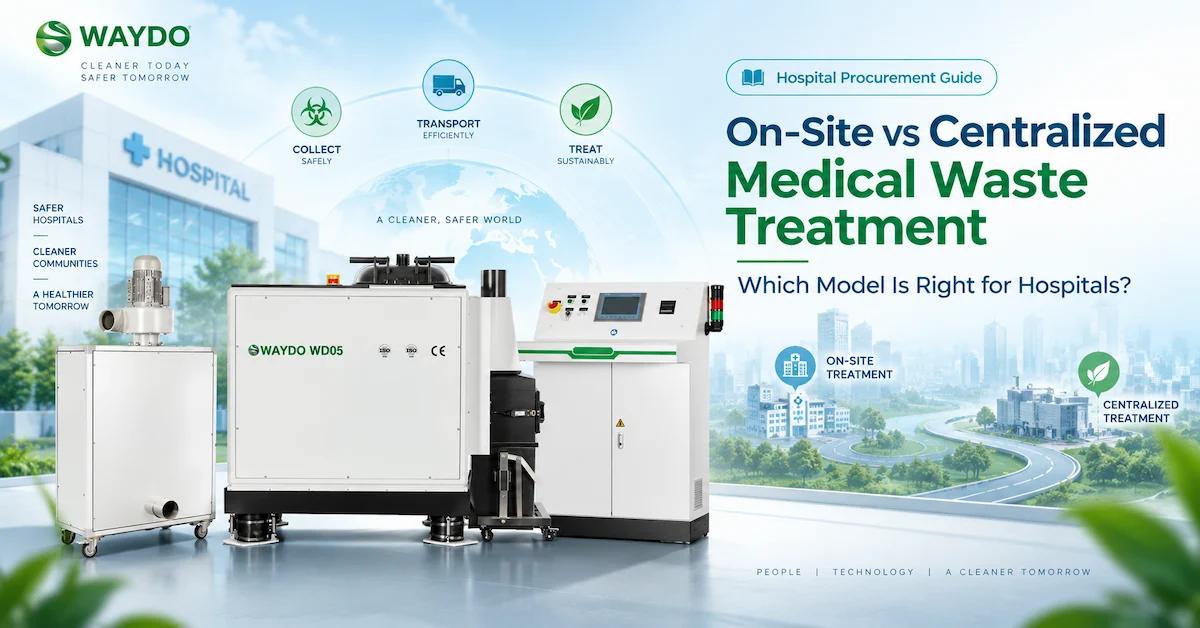
WAYDO describes Frictional Heat Treatment as a non-incineration process that combines shredding, mixing and thermal treatment in one vessel for compatible waste. The public process page describes a temperature around 150 C, a cycle of roughly 25–35 minutes, a claimed 6 Log10 microbial reduction under the referenced STAATT Level IV criterion, and volume and weight reduction claims. These are manufacturer-published screening figures. Model-specific validation, local approval and the final residue route still need confirmation.
WAYDO’s product range can be screened for different network positions:
| Model | Published capacity | Vessel volume | Possible network role for initial screening |
|---|---|---|---|
| WAYDO WD05 | 18 kg/h | 150 L | Individual facility or compact decentralized site |
| WAYDO WD15 | 40 kg/h | 170 L | Larger facility or shared campus treatment room |
| WAYDO WD50 | 115 kg/h | 450 L | Hospital group, institutional campus or local hub |
| WAYDO WD330 | 280 kg/h | 670 L | Higher-volume centralized project |
Published hourly capacity is not guaranteed daily throughput. Material density, loading, cycle preparation, cooling, discharge, review, maintenance and staffing affect practical output. Vessel volume is also not the same as validated load volume. Ask WAYDO to evaluate the actual waste matrix and planned schedule.
Send Your Waste Volume for Model Screening
A medical waste treatment system selection scorecard
Good medical waste treatment system selection turns assumptions into weighted criteria. Agree on the weights before speaking to suppliers so that a low equipment price cannot quietly override a transport or compliance risk.
| Criterion | Suggested evidence | On-site question | Centralized question |
|---|---|---|---|
| Waste compatibility | Written accepted, conditional and excluded material matrix | Can the site segregate and load it consistently? | Will every generator follow the same acceptance rules? |
| Capacity | Measured mass, volume, peak batch and operating schedule | How many real cycles fit in a shift? | Can receiving and treatment handle simultaneous arrivals? |
| Validation | Model-specific protocol, challenge and acceptance criteria | Who reviews and releases the batch? | How is each generator linked to treatment evidence? |
| Logistics | Route map, storage limit and handling study | Is internal movement closed and controlled? | Are vehicles, manifests and pickup intervals reliable? |
| Continuity | Outage scenario and signed backup arrangement | Where does waste go when the unit stops? | Which plant takes the network load after a central failure? |
| Service | Parts list, maintenance plan and response commitment | Is technical support close enough? | Can the plant maintain redundant lines without stopping intake? |
| Cost | Five- or ten-year TCO with stated assumptions | Is utilization high enough to justify ownership? | Do distance and surcharges erode scale savings? |
| Final destination | Written residue acceptance | Will the local destination accept the output? | Is final disposal included and traceable? |
Score every option from one to five, multiply by the agreed weight and attach the evidence. If a bidder cannot document an essential requirement, do not solve the gap by giving it a low numerical score; mark it as a condition that must be closed before award.
Questions to include in the RFQ
Send on-site equipment suppliers and centralized service providers the same base information:
- Facility list, operating hours and geographic coordinates.
- Waste categories, containers, added hazards and present segregation rules.
- Average and peak compatible mass and volume for each site.
- Current storage limits, pickup schedule and incident history.
- Required treatment endpoint and validation standard.
- Local transport, treatment and residue requirements.
- Growth forecast, emergency demand and maximum tolerated outage.
Then ask model-specific questions.
For an on-site proposal, request equipment layout, utilities, throughput assumptions, staffing, validation, maintenance, wear parts, warranty, data records and backup service. For a centralized proposal, request route frequency, vehicle specification, collection windows, manifest workflow, rejected-load handling, plant capacity, redundant lines, treatment evidence, emergency collection and price escalation terms.
Require both bidders to identify exclusions. A clear “not accepted” is more useful than a vague promise that all medical waste can use one route.
A 60-day evaluation plan
Days 1–10: map the current waste route
Follow waste from representative wards, laboratories and clinics to its destination. Record containers, handovers, storage time, transport distance, invoices, rejected loads and incidents. Keep ordinary refuse and specialist hazardous streams separate.
Days 11–20: measure compatible waste
Weigh and estimate occupied volume for at least seven representative days. Note the largest batch and arrival pattern. Correct obvious segregation errors, then measure again because the equipment requirement may change.
Days 21–30: define three network options
Model a facility-level treatment route, a shared hub and a licensed external service. Include a hybrid option if geography or waste compatibility points in that direction. Draw every handover and name the organization responsible for it.
Days 31–42: request evidence and build TCO
Issue the same data to shortlisted suppliers and providers. Normalize capital, delivery, labor, utilities, collection, maintenance, validation, disposal and backup cost over the same period. Record every assumption beside the number.
Days 43–52: test failure scenarios
Ask what happens after a power outage, broken vehicle, failed indicator, road closure, staff shortage and seven-day treatment interruption. Verify storage capacity and call the proposed backup provider rather than assuming availability.
Days 53–60: confirm authorization and award conditions
Confirm treatment approval, transport licenses, residue acceptance, worker controls and reporting duties with the relevant authority. Make unresolved validation, site work or contract issues explicit conditions before purchase or service commencement.
Frequently asked questions
Is on-site treatment always cheaper than centralized treatment?
No. On-site economics improve when a facility has a steady compatible load, high transport cost and enough staff to use the equipment well. Centralized treatment may cost less for many small generators located close to a reliable plant. The comparison must include installation, labor, maintenance, collection, excluded waste, final disposal and downtime.
Is centralized treatment the same as off-site treatment?
Not always. A centralized plant may sit on a hospital campus or belong to a healthcare group, so some generators remain inside the same organization. Off-site usually means waste leaves the generator’s premises for a separately located facility. Contractual control and transport obligations should be checked for the actual arrangement.
Which model is safer?
Either can be safe when the full route is properly designed and authorized. On-site treatment can reduce untreated-waste handovers. Centralized treatment can provide specialist operators and stronger technical resources. Safety depends on segregation, packaging, internal movement, vehicles, treatment validation, maintenance and exception handling.
Can one treatment system accept every hospital waste stream?
No. Chemicals, pharmaceuticals, cytotoxic waste, radioactive items, pathological material, liquids and unusual sharps may require separate routes. The supplier or service provider should issue a written acceptance matrix for the exact materials and containers.
How should a hospital compare capacity?
Measure accepted kilograms and occupied volume, identify the peak batch, define available operating hours and include realistic downtime. A central plant must also model simultaneous vehicle arrivals and receiving throughput. Bed count is a planning clue, not a final sizing method.
What is the best option for remote hospitals?
On-site or decentralized treatment often deserves serious evaluation where roads, collection frequency or emergency access are unreliable. The facility still needs operators, maintenance, validation, residue disposal and a credible backup route. A mobile or shared regional arrangement may be another option.
Can a hospital use a hybrid model?
Yes. A hospital can treat a compatible infectious fraction on site and retain licensed collection for pharmaceuticals, chemicals, pathological waste and other excluded material. A healthcare group can also use small local systems at remote sites while sending urban clinic waste to a central hub.
Final purchasing recommendation
The decision between on-site vs centralized medical waste treatment should begin with a waste and logistics map, not a machine catalog. Measure the compatible fraction, trace every handover, price the full route and test how each model behaves during a real outage. Then compare facility-level ownership, a shared hub, licensed off-site service and a hybrid network against the same validation and final-disposal requirements.
For a WAYDO FHT project, screen WD05 or WD15 for smaller on-site and shared-campus roles, WD50 for higher-volume hospital or local-hub demand, and WD330 for a larger centralized project. These are starting points, not automatic selections. Confirm the current specification, exact material compatibility, realistic daily schedule, validation evidence, local authorization, service coverage and residue destination before award.
The strongest proposal is not the one with the shortest route or largest machine. It is the one that shows who controls each step, what happens when the normal route fails and how the cost remains defensible as volume changes.