Neither technology is automatically better for every healthcare facility.
A medical waste autoclave may be suitable when a hospital already has reliable steam and water infrastructure, trained pressure-system operators, established biological validation procedures, and a separate solution for shredding or compacting treated waste.
Frictional heat sterilization may be a better fit when the facility wants an integrated process that shreds, heats, sterilizes, reduces volume, and makes waste unrecognizable in one closed treatment cycle—without an external steam boiler, chemical additives, or a pressure vessel.
The final decision should be based on waste composition, daily capacity, local regulations, installation space, utility availability, treatment validation, maintenance resources, and the permitted route for final disposal. WHO similarly identifies capacity, microbial inactivation, safety, environmental releases, infrastructure, installation, operating costs, and regulatory requirements as key treatment-selection factors.
Why Hospitals Compare Autoclaves with Frictional Heat Treatment
Hospitals, laboratories, and healthcare facilities generate infectious materials that may expose workers, patients, waste handlers, and the public to biological risks. WHO notes that unsafe healthcare-waste handling can contribute to needlestick injuries, exposure to harmful substances, and the release of infectious or toxic materials into the environment.
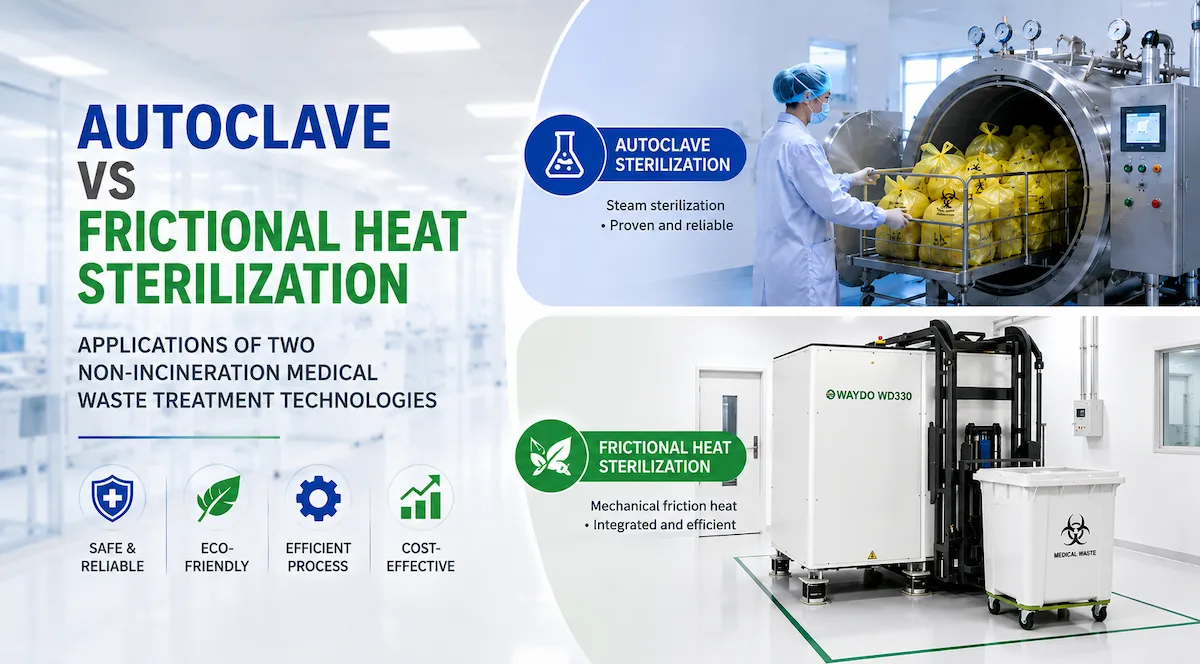
Both autoclaves and frictional heat treatment systems belong to the broader category of non-incineration medical waste treatment. They use thermal energy at temperatures high enough to inactivate pathogens but below the temperatures associated with combustion or pyrolysis.
However, their engineering approaches are different:
- Autoclaves use steam, pressure, air removal, and controlled exposure time.
- Frictional heat treatment uses high-speed mechanical shredding to generate heat within the waste.
- Conventional autoclaves may require separate shredding after treatment.
- FHT combines shredding and thermal treatment in one vessel.
- Autoclave output normally retains its original physical form unless mechanically processed.
- FHT output is shredded during the treatment cycle.
These differences influence infrastructure, workflow, installation, operating costs, maintenance, and final waste handling.
What Is Medical Waste Autoclave Sterilization?
A medical waste autoclave is a sealed pressure vessel that uses saturated steam to disinfect infectious healthcare waste.
A typical treatment cycle may include:
- Waste loading
- Chamber sealing
- Air evacuation
- Steam introduction
- Controlled temperature and pressure exposure
- Steam discharge
- Unloading
- Biological and operational documentation
- Optional shredding or compaction
Air removal is essential because trapped air can prevent steam from reaching all parts of the waste load. Depending on the equipment, air may be removed through gravity displacement, pre-vacuum, pressure pulsing, or combined vacuum cycles.
WHO training materials provide 121°C for 30 minutes as an example of typical autoclave operating conditions that must be verified with biological indicators. Actual cycle parameters depend on the equipment, load density, packaging, waste composition, required inactivation level, and local regulations.
Main Advantages of Medical Waste Autoclaves
Autoclaves are widely recognized and have a long history of use in healthcare-waste treatment.
Their main advantages include:
- Established steam-sterilization principles
- Familiar validation procedures
- Availability in small, medium, and centralized capacities
- Lower air-pollutant generation than incineration
- Potential recovery of properly separated glass, plastic, and metal after treatment
- Compatibility with healthcare facilities that already have reliable steam infrastructure
Autoclaves can remain in service for many years when operators follow preventive maintenance schedules and regularly check seals, valves, gauges, pipes, filters, drains, air-removal efficiency, and safety devices.
Main Limitations of Medical Waste Autoclaves
A conventional autoclave does not necessarily destroy the physical appearance of treated waste.
Items such as syringes, tubing, containers, and disposable instruments may remain recognizable after steam treatment. A separate shredder or compactor may therefore be needed to reduce volume, prevent unauthorized reuse, and improve final handling.
Autoclave projects must also consider:
- Steam generation or steam supply
- Water quality and consumption
- Pressure-vessel safety requirements
- Air evacuation and filtration
- Condensate and drainage
- Ventilation and odor control
- Biological indicator testing
- Separate shredding equipment
- Operator training
- Preventive maintenance
Waste segregation is critical. WHO states that volatile or semi-volatile organic compounds, cytotoxic waste, mercury-containing waste, other hazardous chemicals, and radioactive materials should not be processed in a medical waste autoclave.
What Is Frictional Heat Sterilization?
Frictional Heat Treatment, or FHT, is a non-burning treatment method that converts mechanical energy into thermal energy.
Inside an FHT system, a high-speed rotor shreds and mixes infectious medical waste. Continuous contact among the rotor, waste, and treatment chamber creates friction. This friction raises the temperature of the material until the required microbial inactivation conditions are achieved.
The general FHT cycle includes:
- Waste loading
- Pre-shredding
- High-speed friction and heating
- Controlled thermal treatment
- Cooling
- Automatic discharge
According to Weidun’s published technical information, its FHT system reaches up to 150°C without an external heat source, chemical additives, or a pressure vessel. Shredding and thermal treatment take place automatically in one vessel during a continuous cycle.
Published Performance of Weidun FHT Technology
Weidun reports the following treatment metrics for its FHT process:
| Treatment Metric | Published FHT Performance |
|---|---|
| Operating temperature | Up to 150°C |
| Microbial inactivation | 6 Log10, STAAT Level IV |
| Treatment cycle | Approximately 25–35 minutes |
| Volume reduction | Up to 80% |
| Weight reduction | Up to 30% |
| Heat source | Mechanical friction |
| Pressure vessel | Not required |
| Chemical additives | Not required |
| Final output | Dry, sterile, shredded residue |
These values are manufacturer-published specifications. Buyers should request model-specific test reports, biological validation records, applicable certificates, utility requirements, and evidence of acceptance by the authority responsible for the destination project.
Main Advantages of Frictional Heat Treatment
FHT is designed to combine several steps that may otherwise require separate equipment.
Its main operational advantages include:
- Shredding and thermal treatment in one chamber
- No external steam boiler
- No pressurized treatment vessel
- No chemical disinfectants
- On-site treatment at the point of waste generation
- Automatic reduction of waste volume
- Unrecognizable final residue
- Reduced need to handle waste between sterilization and shredding
- Potential reduction in infectious-waste storage and transport requirements
This integrated approach can be particularly valuable for hospitals seeking to shorten the path between waste generation and treatment.
Main Limitations of Frictional Heat Treatment
FHT is not a universal solution for every medical waste stream.
Buyers must evaluate:
- Rotor and blade wear
- Spare-parts availability
- Motor and electrical requirements
- Cooling-water requirements
- Treatment-chamber cleaning
- Waste segregation quality
- Operator training
- Local regulatory acceptance
- Model capacity and peak-load capability
- Biological validation under actual waste-loading conditions
Weidun lists radioactive materials and flammable or explosive compounds among the materials that cannot be processed by its FHT systems. Other waste types may also require separate treatment according to local regulations and the supplier’s approved waste matrix.
Autoclave vs Frictional Heat Sterilization: Side-by-Side Comparison
The following comparison combines WHO guidance on autoclave systems with Weidun’s published information on FHT technology.
| Decision Factor | Medical Waste Autoclave | Frictional Heat Treatment |
|---|---|---|
| Heating principle | Saturated steam | Mechanical friction |
| Pressure vessel | Required | Not required |
| External steam | Required | Not required |
| Waste shredding | Usually separate or optional | Integrated into treatment cycle |
| Physical destruction | Limited without shredder | Waste is shredded during treatment |
| Output appearance | Often remains recognizable | Dry and unrecognizable residue |
| Volume reduction | Requires shredding or compaction | Up to 80% according to Weidun |
| Chemical additives | Not required | Not required |
| Typical infrastructure | Steam, water, drainage, pressure controls, ventilation | Electrical supply, cooling water, treatment room, ventilation |
| Validation focus | Time, temperature, pressure, steam penetration, biological indicators | Time, temperature, rotor performance, biological indicators |
| Maintenance focus | Seals, valves, gauges, steam lines, filters, pressure systems | Rotor, blades, bearings, motor, chamber, cooling system |
| Best suited to | Facilities with established steam and pressure-system capabilities | Facilities seeking integrated on-site shredding and sterilization |
| Final decision | Depends on utilities, regulations, capacity, and disposal route | Depends on utilities, regulations, capacity, and disposal route |
1. Sterilization Performance and Validation
Both systems can achieve high levels of microbial inactivation when correctly designed, operated, loaded, and validated.
For autoclaves, treatment effectiveness depends on steam reaching every part of the waste. Dense loads, sealed containers, trapped air, unsuitable packaging, or poor loading practices can create cold spots.
Autoclave validation normally examines:
- Chamber temperature
- Pressure
- Exposure time
- Steam penetration
- Load configuration
- Chemical indicators
- Biological indicators
For FHT, performance depends on uniform shredding, heat generation, waste moisture, treatment time, rotor speed, load composition, and temperature distribution.
FHT validation should examine:
- Maximum and minimum treatment temperature
- Temperature consistency
- Particle-size reduction
- Treatment duration
- Biological inactivation
- Load capacity
- Automatic monitoring
- Data recording
A quoted temperature alone is not enough to prove treatment performance. Buyers should compare validated microbial reduction under representative waste loads rather than comparing only nominal operating temperatures.
2. Installation and Utility Requirements
Infrastructure is often the deciding factor in an autoclave vs frictional heat sterilization project.
Autoclave Infrastructure
An autoclave installation may require:
- Steam generator or boiler
- Treated water supply
- Pressure-rated chamber
- Vacuum or air-removal system
- Exhaust filtration
- Drainage and condensate handling
- Ventilation
- Separate shredder
- Pressure-system inspections
Autoclaves can be practical where hospitals already operate central steam systems and have experienced engineering personnel.
FHT Infrastructure
An FHT installation generally focuses on:
- Electrical power
- Cooling-water connection
- Waste loading area
- Safe treatment-room layout
- Ventilation
- Residue collection
- Equipment access for maintenance
- Blade and spare-parts planning
Because the heat is generated mechanically, Weidun’s FHT design does not require an external steam boiler or pressure vessel. This can simplify certain new-build and on-site projects, although the entire installation must still be designed around capacity, utilities, safety, local permits, and maintenance access.
3. Shredding, Waste Reduction, and Final Output
This is one of the clearest operational differences.
WHO notes that conventional autoclave-treated waste retains its physical appearance unless a shredder or compactor is added. Shredding can reduce volume and make treated items unrecognizable, but it introduces another mechanical system that requires maintenance.
FHT performs shredding before and during thermal treatment inside a closed chamber. This increases the waste surface area, supports heat transfer, and produces a dry, unrecognizable residue.
Integrated shredding can help facilities:
- Reduce storage volume
- Prevent recognizable items from entering the disposal stream
- Reduce manual handling between machines
- Improve consistency of final residue
- Simplify transport after treatment
However, facilities interested in separating and recycling individual glass, metal, or plastic fractions may prefer a workflow that preserves those materials until after treatment. WHO notes that separated autoclaved materials may be recovered and re-melted in suitable recycling systems.
4. Workflow and Occupational Exposure
A conventional autoclave workflow may involve loading infectious waste, unloading treated but recognizable material, transferring it to a shredder, and then moving the shredded output to disposal.
Every transfer point should be assessed for:
- Worker contact
- Sharps risk
- Bag breakage
- Manual handling
- Equipment downtime
- Contaminated surfaces
An integrated FHT system reduces the number of transfers by combining shredding and thermal treatment in one enclosed vessel.
This does not eliminate the need for safe operating procedures. Staff still require appropriate personal protective equipment, segregation training, loading instructions, emergency procedures, cleaning protocols, and preventive maintenance.
5. Operating and Maintenance Requirements
Autoclaves have proven reliability when properly maintained, but they contain several pressure- and steam-related components.
Maintenance may involve:
- Door seals and gaskets
- Steam valves
- Vacuum pumps
- Pressure gauges
- Relief valves
- Filters
- Drain lines
- Thermocouples
- Boiler systems
- Corrosion inspection
FHT maintenance focuses more heavily on mechanical components exposed to repeated shredding loads:
- Rotors
- Cutting blades
- Bearings
- Drive motors
- Seals
- Chamber surfaces
- Temperature sensors
- Water-injection components
- Discharge mechanisms
The better technology is not simply the one with fewer components. It is the system the local technical team can maintain reliably with available spare parts, documented procedures, remote support, and reasonable service response times.
6. Cost and Total Cost of Ownership
Equipment price alone does not provide a reliable comparison.
Autoclave Cost Drivers
Autoclave project costs may include:
- Pressure chamber
- Boiler or steam generator
- Water treatment
- Vacuum system
- Exhaust filtration
- Drainage
- Separate shredding equipment
- Building modifications
- Pressure-system inspection
- Biological validation
- Steam, water, and maintenance
FHT Cost Drivers
FHT project costs may include:
- Treatment chamber and rotor system
- Electrical infrastructure
- Loading automation
- Cooling-water connection
- Blade replacement
- Preventive maintenance
- Spare-parts inventory
- Commissioning
- Performance validation
- Residue transport and disposal
A complete financial evaluation should calculate:
Purchase price + installation + utilities + labor + consumables + maintenance + downtime + storage + transport + final disposal
FHT may reduce certain boiler, pressure-vessel, separate-shredding, storage, or off-site transport costs. However, the actual saving depends on the local waste volume, electricity price, transport distance, labor model, maintenance plan, and regulatory framework.
Which Technology Is Better for Different Projects?
| Buyer Scenario | More Suitable Starting Point | Reason |
|---|---|---|
| Hospital already has reliable steam infrastructure | Autoclave | Existing utilities and trained maintenance personnel may reduce project complexity |
| New hospital wants an integrated on-site system | FHT | Combines shredding and thermal treatment without a boiler or pressure vessel |
| Facility needs dry, unrecognizable residue | FHT | Mechanical destruction occurs during the treatment cycle |
| Central operator follows an established autoclave protocol | Autoclave | Familiar validation, staffing, and permitting procedures |
| Remote facility wants to reduce off-site infectious-waste transport | FHT | Supports treatment at the point of generation |
| Project wants separated material recovery | Autoclave may be suitable | Properly segregated materials can remain recoverable after steam treatment |
| Facility has unstable electrical power | Site-specific evaluation | Both systems require reliable utilities and contingency planning |
| Waste stream includes radioactive or hazardous chemical materials | Neither standard system | A specialized and legally approved treatment route is required |
| Local regulation specifically approves only autoclaving | Autoclave or regulatory review | Technology acceptance must be confirmed before procurement |
| Hospital prioritizes a single-vessel automated process | FHT | Shredding, heating, sterilization, cooling, and discharge are integrated |
What Waste Can Autoclaves and FHT Systems Treat?
Both systems are primarily intended for compatible infectious healthcare waste, but treatment eligibility must be confirmed before procurement.
Potentially compatible materials may include:
- Contaminated dressings and bandages
- Disposable gowns, masks, caps, and gloves
- Certain syringes and sharps after proper collection
- Medical tubing and filters
- Laboratory disposables
- Test tubes and Petri dishes
- Dialysis-related disposables
- Blood and urine bags where approved
- Selected non-liquid clinical waste
Neither method should be presented as a universal solution.
Autoclaves should not receive radioactive materials, mercury-containing materials, cytotoxic waste, volatile chemicals, or other incompatible hazardous substances. FHT systems also have defined exclusions, including radioactive and flammable or explosive materials. Waste acceptance must follow the manufacturer’s approved matrix and local environmental and healthcare-waste regulations.
Procurement Checklist for Hospitals and Project Buyers
Before choosing between an autoclave and FHT system, request written answers to these questions:
| Procurement Question | Why It Matters |
|---|---|
| What waste categories are approved for treatment? | Prevents incompatible material from entering the system |
| What is the validated microbial reduction level? | Confirms treatment performance |
| What capacity is achieved with real hospital waste? | Nominal chamber size may not equal practical daily throughput |
| What utilities are required? | Determines installation and operating costs |
| Is shredding integrated or separate? | Affects workflow, output, maintenance, and floor space |
| What is the complete cycle time? | Exposure time alone does not show total throughput |
| Which components require routine replacement? | Helps forecast maintenance expenditure |
| What test reports and certifications are available? | Supports regulatory review and technical due diligence |
| What happens during equipment downtime? | Hospitals need a contingency treatment plan |
| What after-sales support is available locally? | Reduces operational and spare-parts risk |
When Is Weidun FHT Technology a Strong Candidate?
Weidun FHT technology is particularly relevant for healthcare facilities that prioritize:
- Treatment at the point of waste generation
- Integrated shredding and sterilization
- No external steam boiler
- No pressure vessel
- No chemical disinfectants
- Automatic waste-volume reduction
- Dry and unrecognizable final residue
- Shorter infectious-waste storage periods
- Reduced reliance on off-site treatment transport
Weidun publishes an FHT cycle operating at up to 150°C, with a reported 6 Log10 inactivation level, treatment cycles of approximately 25–35 minutes, up to 80% volume reduction, and up to 30% weight reduction. These figures should be evaluated against the selected model, actual waste composition, project capacity, third-party validation, and local approval requirements.
Frequently Asked Questions
1. Is frictional heat sterilization the same as autoclaving?
No. Autoclaves use steam under pressure, while FHT systems generate heat through high-speed mechanical friction and shredding.
2. Are both methods non-incineration technologies?
Yes. Both treat compatible infectious medical waste without combustion.
3. Does an autoclave shred medical waste?
A conventional autoclave normally does not shred waste. Shredding may be performed by separate equipment or by an integrated hybrid autoclave system.
4. Does FHT require a steam boiler?
Weidun’s FHT process does not require an external steam boiler. Heat is generated through mechanical friction inside the treatment chamber.
5. Which system produces less recognizable waste?
FHT normally produces less recognizable output because shredding is integrated into the treatment cycle. A conventional autoclave requires additional shredding to achieve a similar physical result.
6. Which method has lower operating costs?
The answer depends on electricity, water, steam, labor, maintenance, waste volume, transport distance, and disposal fees. A project-specific lifecycle-cost analysis is necessary.
7. Can an autoclave or FHT system treat all medical waste?
No. Radioactive, chemical, cytotoxic, pharmaceutical, pathological, or explosive waste may require separate treatment. Always verify the approved waste matrix.
8. How should treatment performance be verified?
Buyers should review temperature records, cycle data, biological indicator results, microbial inactivation reports, load-validation procedures, and third-party test documentation.
9. Is FHT suitable for on-site hospital waste treatment?
It can be suitable where the required capacity, waste types, utilities, room layout, local regulations, and final disposal arrangements support on-site operation.
10. What information should a buyer send to an equipment supplier?
Provide daily and peak waste quantities, waste composition, operating hours, available utilities, installation space, local treatment standards, preferred automation level, and the intended final disposal route.
Conclusion
The autoclave vs frictional heat sterilization decision should not be made by comparing temperature, cycle time, or equipment price alone.
Autoclaves remain a practical option for facilities with dependable steam infrastructure, trained pressure-system personnel, established validation processes, and a suitable solution for post-treatment shredding or material recovery.
Frictional heat treatment offers a different operational model. It combines mechanical destruction and thermal treatment in one closed cycle, avoids an external steam boiler and pressure vessel, and produces reduced-volume, unrecognizable residue. These features make it especially relevant for hospitals and healthcare projects seeking integrated on-site medical waste treatment.
The better method is the one that meets the project’s waste profile, required microbial reduction, daily capacity, infrastructure, staffing, maintenance capability, environmental objectives, local regulations, and total lifecycle-cost target.
Contact Weidun Environmental to evaluate your waste composition, daily treatment volume, installation conditions, and regulatory requirements for a customized FHT medical waste treatment solution.